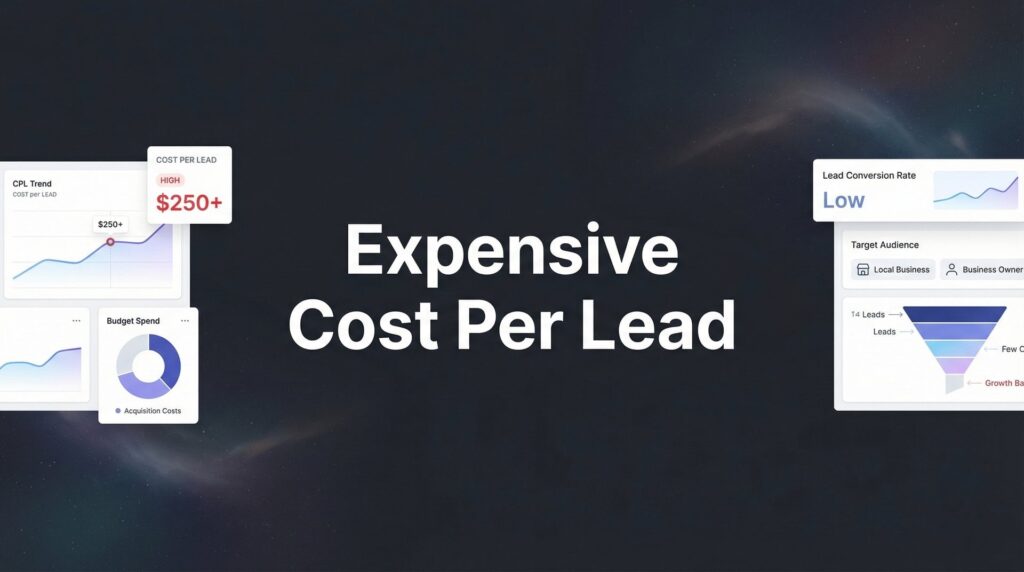
You’re staring at your ad dashboard again. Another $2,000 spent this month. Twelve leads came in. That’s $166 per lead. Your profit margin can’t support that math. You know something’s wrong, but every agency you’ve talked to says “that’s just what it costs in your market.” Meanwhile, your competitor down the street seems to be thriving with the same ad budget you have.
Here’s the truth: expensive cost per lead isn’t an unavoidable tax on doing business. It’s a symptom of specific, fixable problems in your marketing system.
We’ve audited hundreds of local business campaigns, and the pattern is consistent. Most expensive CPL situations stem from three to five correctable issues—not market conditions, not competition, not bad luck. The businesses that figure this out stop hemorrhaging money and start generating leads at prices that actually support profitable growth.
Understanding What “Expensive” Actually Means for Your Business
Before you can fix an expensive cost per lead problem, you need to know if you actually have one. That sounds obvious, but most business owners are comparing their numbers to the wrong benchmarks.
Cost per lead is simple math: total ad spend divided by number of leads generated. If you spent $3,000 and got 20 leads, your CPL is $150. But that surface-level calculation misses critical context that determines whether that number is actually a problem.
The first layer most people miss is hidden costs. Your true CPL includes the obvious ad spend, but also the cost of your landing page tools, CRM subscriptions, and the time your team spends managing campaigns. A lead that appears to cost $100 in ad spend might actually cost $130 when you factor in the full system.
Industry context matters more than generic benchmarks. A $200 cost per lead would be catastrophic for a local restaurant but potentially excellent for an HVAC company. Legal services, medical practices, and home services typically face higher CPLs because the customer lifetime value justifies it. A single roofing job might generate $8,000 in revenue, which completely changes the math on what’s acceptable.
Lead quality transforms the entire equation. This is where most business owners get stuck in the wrong mental model. A $50 lead that never answers the phone or isn’t actually interested in your service is infinitely more expensive than a $200 lead that books an appointment and becomes a paying customer.
Think about it this way: if you’re getting leads at $75 each but only 5% convert to customers, your actual customer acquisition cost is $1,500. If another campaign generates leads at $150 each but 20% convert, your customer acquisition cost drops to $750. The “cheaper” leads are actually twice as expensive.
Your maximum acceptable CPL should be calculated backwards from your business economics. Start with your average customer value, multiply by your typical conversion rate from lead to customer, then factor in your target profit margin. If your average customer is worth $2,000 and you close 25% of qualified leads, you can afford to pay up to $500 per lead and still maintain healthy margins.
Most local businesses discover they’re not actually overpaying—they’re under-converting. The leads cost what they cost, but the sales process isn’t capturing enough of them to make the math work.
The Five Hidden Problems Inflating Your Lead Costs
When we audit campaigns with expensive cost per lead, we find the same culprits over and over. These aren’t exotic problems requiring advanced technical knowledge. They’re fundamental issues that most businesses could fix in a week if they knew where to look.
Audience Targeting That’s Too Broad: Your ads are showing to people who will never buy from you. We see this constantly—a local plumber running ads to the entire metro area when they only service three specific zip codes. Every click from outside their service area is wasted money. Or a B2B service targeting “business owners” when they really need “manufacturing companies with 20-50 employees.” The broader your targeting, the more you pay to reach people who aren’t actually prospects.
Landing Page Friction Killing Conversions: Your ad did its job—it got the click. But your landing page is losing 85% of visitors before they fill out the form. Maybe it loads slowly on mobile. Maybe the form asks for too much information upfront. Maybe the value proposition isn’t clear within three seconds. Every visitor who bounces is money down the drain, and each one makes your CPL more expensive.
The math here is brutal. If your landing page converts at 3% instead of 12%, you need four times as much traffic to get the same number of leads. That means four times the ad spend for the same result.
Bidding Strategies That Work Against You: Google’s automated bidding can be powerful, but it needs data and proper constraints to work. We regularly find campaigns set to “maximize conversions” with no target CPA, essentially telling Google “spend whatever it takes.” Or manual bidding that hasn’t been adjusted in six months while competition has increased. Your bidding strategy directly controls what you pay, and most businesses are using the wrong approach for their situation.
Campaign Structure Creating Waste: All your keywords lumped into one ad group. Search and display mixed together in the same campaign. No negative keywords to exclude irrelevant searches. Poor campaign structure means you can’t optimize effectively, can’t control bids precisely, and can’t identify what’s actually working. It’s like trying to drive with your eyes closed—you might move forward, but you’re going to crash into expensive mistakes.
Ad Copy That Attracts the Wrong People: Your ads are getting clicks, but from people who misunderstand what you offer. An ad that says “Free Consultation” attracts price shoppers who were never going to pay your rates. An ad that doesn’t mention your service area gets clicks from people three states away. Every misaligned click increases your CPL while decreasing your lead quality.
The pattern we see most often: businesses focus on getting more traffic when the real problem is that they’re wasting the traffic they already have. Fixing these five issues typically reduces CPL by meaningful margins without changing the ad budget at all.
How Quality Score Secretly Controls What You Pay
Google has a rating system that directly determines how much you pay per click, and most advertisers either don’t know about it or don’t understand how it works. It’s called Quality Score, and it’s one of the most powerful levers for reducing expensive cost per lead.
Quality Score is Google’s 1-10 rating of how relevant and useful your ads are to searchers. Higher scores mean Google charges you less per click. Lower scores mean you pay more for the same position. This isn’t speculation—it’s documented Google Ads functionality that’s been core to the platform for years.
Here’s why it matters: two advertisers bidding on the same keyword can pay drastically different amounts per click based solely on their Quality Scores. An advertiser with a Quality Score of 8 might pay $3 per click while an advertiser with a Quality Score of 4 pays $6 for the same position. Over thousands of clicks, that difference compounds into massive CPL disparities.
Quality Score is built on three pillars, each equally weighted in Google’s calculation.
Expected Click-Through Rate: Google predicts how likely your ad is to get clicked based on historical performance and relevance to the search query. If your ad consistently gets clicked more than average for your keywords, your Quality Score improves. If people see your ad and skip it, your score drops. This is why generic ad copy that doesn’t speak to searcher intent kills your Quality Score and inflates your costs.
Ad Relevance: How closely does your ad match what the person searched for? If someone searches “emergency plumber Chicago” and your ad talks about general plumbing services without mentioning emergency or location, Google rates that as poor relevance. Tight keyword-to-ad matching improves this component. Throwing all your keywords into one generic ad destroys it.
Landing Page Experience: Does your landing page deliver what the ad promised? Does it load quickly? Is it mobile-friendly? Does it provide relevant information? Google evaluates the actual user experience after the click. A slow, confusing, or irrelevant landing page tanks this component of Quality Score, which directly increases what you pay.
The compounding effect is what makes Quality Score so powerful. Improving your score doesn’t just reduce your cost per click—it improves your ad position at the same bid, which increases click-through rate, which further improves Quality Score, which reduces costs even more. It’s a virtuous cycle that can cut your CPL dramatically.
Most businesses with expensive lead costs have Quality Scores between 3 and 5. Getting those scores up to 7 or 8 can reduce costs by substantial margins without any increase in budget. The fixes aren’t mysterious: tighter keyword grouping, more specific ad copy, faster landing pages, and better message match between ad and landing page.
Proven Tactics That Lower CPL Without Killing Lead Volume
The fear that stops most businesses from optimizing is simple: “What if I reduce costs but also reduce the number of leads?” It’s a valid concern, but the right fixes actually improve both metrics simultaneously by eliminating waste and improving efficiency.
Audience Refinement Through Strategic Exclusions: Start by identifying who you don’t want to reach. Build a negative keyword list of terms that trigger your ads but attract the wrong people. If you’re a premium service, add “cheap,” “free,” and “discount” as negatives. If you only serve businesses, exclude “residential” and “home.” Add geographic exclusions for areas you don’t service. Every irrelevant click you prevent is money that can go toward reaching actual prospects.
We regularly see campaigns cut wasted spend by significant amounts just by implementing comprehensive negative keyword lists. The lead volume stays the same or increases because the budget is now concentrated on relevant searches.
Landing Page Speed and Clarity Fixes: Run your landing page through Google PageSpeed Insights. If it scores below 70 on mobile, you’re losing leads to impatience. Compress images, remove unnecessary scripts, and simplify the page structure. Speed directly impacts conversion rates, which directly impacts CPL.
Then audit the page for clarity. Can a visitor understand your offer within three seconds? Is the form visible without scrolling? Does the headline match what the ad promised? Remove any friction between arrival and conversion. Every percentage point improvement in conversion rate reduces your CPL proportionally.
Campaign Restructuring for Precision Control: Break broad campaigns into tightly themed ad groups. Each ad group should contain 5-15 closely related keywords, with ad copy written specifically for those terms. This improves Quality Score, increases relevance, and gives you granular control over what’s working.
Separate your top-performing keywords into their own campaigns with higher budgets. Isolate underperformers so you can either fix them or eliminate them without affecting your winners. Structure creates visibility, and visibility enables optimization.
Bid Strategy Alignment With Your Goals: If you’re using automated bidding, set a target CPA that aligns with your business economics. Don’t let Google spend without constraints. If you’re using manual bidding, implement a regular review schedule—check performance weekly and adjust bids based on what’s actually converting, not just what’s getting clicks.
For campaigns with limited conversion data, start with manual CPC bidding to build history, then transition to Target CPA once you have enough data. Automated bidding without sufficient conversion history often overspends while it “learns.”
Message Match Optimization: Make sure your ad copy, landing page headline, and form offer all say the same thing in the same language. If your ad promises “Free Roof Inspection,” your landing page headline should say “Free Roof Inspection,” not “Professional Roofing Services.” Consistency reduces cognitive friction and improves conversion rates, which lowers CPL.
The common thread in all these tactics: they eliminate waste rather than cutting investment. You’re not spending less—you’re spending smarter. The result is lower cost per lead while maintaining or increasing lead volume.
When Higher Lead Costs Actually Make Business Sense
Not every expensive cost per lead is a problem that needs fixing. Sometimes higher CPL is the right strategic choice, and pushing for cheaper leads would actually hurt your business.
Customer lifetime value changes everything. If your average customer generates $15,000 in revenue over three years, paying $400 per lead isn’t expensive—it’s a bargain, assuming your conversion rates support it. The businesses that get this wrong are optimizing for cheap leads when they should be optimizing for valuable customers.
Consider a financial advisor who pays $300 per lead but converts 15% into clients worth $50,000 in lifetime fees. That’s a $2,000 customer acquisition cost for a $50,000 return. Compare that to a campaign generating $75 leads with 5% conversion—same $1,500 customer acquisition cost but probably lower lead quality and more sales time wasted on unqualified prospects.
Certain industries should expect higher CPL because the competition and customer value justify it. Legal services, medical practices, high-end home services, and B2B consulting all operate in markets where leads naturally cost more. A personal injury attorney paying $800 per lead isn’t overpaying if cases settle for six figures. A $50 lead in that market would be suspect—probably low quality leads or from an irrelevant source.
Geographic factors matter too. Leading in Manhattan costs more than leading in rural Iowa, not because the campaigns are poorly optimized but because the market dynamics are different. If your business operates in a high-cost market, comparing your CPL to national averages will make you feel like you’re overpaying when you’re actually right in line with local reality.
The calculation that matters is maximum acceptable CPL based on your economics. Take your average customer value, multiply by your close rate, and factor in your target profit margin. If a customer is worth $5,000 and you close 20% of leads, you can afford to pay up to $1,000 per lead and still maintain 50% margins.
Here’s the key question: would you rather have 50 cheap leads that convert at 5% (2.5 customers) or 25 expensive leads that convert at 25% (6.25 customers)? The expensive leads deliver more than twice as many customers for half the volume. Lead quality often correlates with lead cost—better targeting and better positioning attract more qualified leads who cost more but convert better.
The trap is optimizing for the wrong metric. If you’re focused purely on lowering CPL, you might achieve that goal while simultaneously destroying your revenue. The metric that actually matters is cost per customer or return on ad spend, not cost per lead in isolation.
Building a System That Keeps CPL Under Control Long-Term
One-time fixes create temporary improvements. Sustainable low CPL requires building systems that continuously optimize based on real performance data.
The foundation is a feedback loop between your sales process and your marketing campaigns. Most businesses run ads, collect leads, and never connect what happens next back to the marketing system. That’s like driving while only looking at the speedometer—you know how fast you’re going but not whether you’re headed toward your destination or off a cliff.
Track every lead through to outcome. Which campaigns generate leads that actually book appointments? Which keywords produce leads that close? Which ad copy attracts qualified prospects versus tire-kickers? This data tells you where to invest more and where to cut back. Without it, you’re optimizing blind.
Conversion rate optimization becomes your long-term CPL reduction engine. Small improvements compound over time. A landing page that converts 5% better this month doesn’t just reduce CPL now—it creates a baseline for further improvement. Test headlines, form lengths, page layouts, and calls-to-action. Each winning test reduces your cost per lead permanently.
Regular campaign audits catch problems before they become expensive. Set a monthly review schedule: check Quality Scores, review search term reports for new negative keywords, analyze conversion rates by device and location, and adjust bids based on performance. Campaigns drift toward inefficiency without active management.
The question every business eventually faces: should we manage this internally or bring in specialized help? The honest answer depends on three factors: your available time, your technical knowledge, and the complexity of your campaigns.
Managing effective pay per click advertising requires consistent attention and specialized knowledge. If you’re running a business, you probably don’t have 10-15 hours per week to dedicate to campaign optimization. And even if you have the time, the learning curve is steep—Google Ads has thousands of settings and options, most of which can quietly waste your budget if configured wrong.
Specialized agencies or consultants bring experience from managing hundreds of campaigns. They’ve seen the patterns, know the pitfalls, and can implement optimizations faster than someone learning as they go. The cost of expertise often pays for itself through reduced waste and improved performance.
But expertise varies wildly in this industry. Look for partners who focus on your specific market, understand your business economics, and can explain their strategy in plain language. Avoid anyone promising guaranteed results or offering packages that don’t align with your actual goals.
Taking Control of Your Lead Costs
Expensive cost per lead isn’t a permanent condition you have to accept. It’s a signal that specific parts of your marketing system need attention. The businesses that figure this out stop watching their budgets drain into campaigns that barely break even and start generating leads at prices that support real growth.
The path forward is clearer than most business owners realize. Audit your Quality Scores and fix the basics—tighter keyword grouping, more relevant ad copy, faster landing pages. Implement negative keywords to stop wasting money on irrelevant searches. Restructure campaigns for better control and visibility. Connect your sales data back to your marketing so you know what’s actually working.
Focus on the metrics that matter: cost per customer and return on ad spend, not just cost per lead in isolation. A more expensive lead that converts is always better than a cheap lead that goes nowhere.
Most importantly, build systems that continuously improve rather than hoping for one-time fixes. Regular optimization, consistent testing, and clear feedback loops between sales and marketing create sustainable efficiency that keeps CPL under control long-term.
If you’re tired of spending money on marketing that doesn’t produce real revenue, there’s a better approach. We build lead systems that turn traffic into qualified leads and measurable sales growth. If you want to see what this would look like for your business, we’ll walk you through how it works and break down what’s realistic in your market. No generic promises—just an honest assessment of where your money is going and how to make it work harder.
Want More Leads for Your Business?
Most agencies chase clicks, impressions, and “traffic.” Clicks Geek builds lead systems. We uncover where prospects are dropping off, where your budget is being wasted, and which channels will actually produce ROI for your business, then we build and manage the strategy for you.