Growing a small business online can feel complicated. With so many options, where should you start? The good news is you don't need a huge budget to see real results. The key is to focus on a few proven tactics that work.
This guide breaks down the most effective digital marketing strategies for small businesses. We'll give you a clear, actionable plan you can use today. Forget theory—we’re focused on the "how-to" for each strategy, from getting fast traffic with Google Ads to building a loyal customer base with Local SEO.
Whether you're a local service company or an e-commerce brand, these strategies will help you attract more customers. Let's get straight to what drives growth.
People Also Ask
What is the most effective digital marketing strategy for a small business?
The most effective strategy depends on your goals. For immediate leads, Google Ads is often best. For long-term, low-cost growth, Local SEO and Content Marketing are powerful. Most businesses benefit from a mix of both.
How can I promote my small business with no money?# 10 Proven Digital Marketing Strategies for Small Businesses
Growing a small business online can feel complicated. With so many options, where should you start? The good news is you don't need a huge budget to see real results. The key is to focus on a few proven tactics that work.
This guide breaks down the most effective digital marketing strategies for small businesses. We'll give you a clear, actionable plan you can use today. Forget theory—we’re focused on the "how-to" for each strategy, from getting fast traffic with Google Ads to building a loyal customer base with Local SEO.
Whether you're a local service company or an e-commerce brand, these strategies will help you attract more customers. Let's get straight to what drives growth.
People Also Ask
What is the most effective digital marketing strategy for a small business?
The most effective strategy depends on your goals. For immediate leads, Google Ads is often best. For long-term, low-cost growth, Local SEO and Content Marketing are powerful. Most businesses benefit from a mix of both.
How can I promote my small business with no money?
You can use several free strategies:
- Optimize your Google Business Profile for local searches.
- Create helpful blog content (Content Marketing & SEO).
- Engage with your audience on social media.
- Build an email list and send regular updates.
What are the 4 main digital marketing strategies?
The four main pillars of digital marketing are:
- Search Engine Optimization (SEO): Earning organic traffic from search engines.
- Pay-Per-Click (PPC) Advertising: Buying traffic from platforms like Google Ads.
- Social Media Marketing: Engaging with audiences on social platforms.
- Content Marketing: Creating valuable content to attract and retain customers.
1. Google Ads (Search, Display, Shopping)
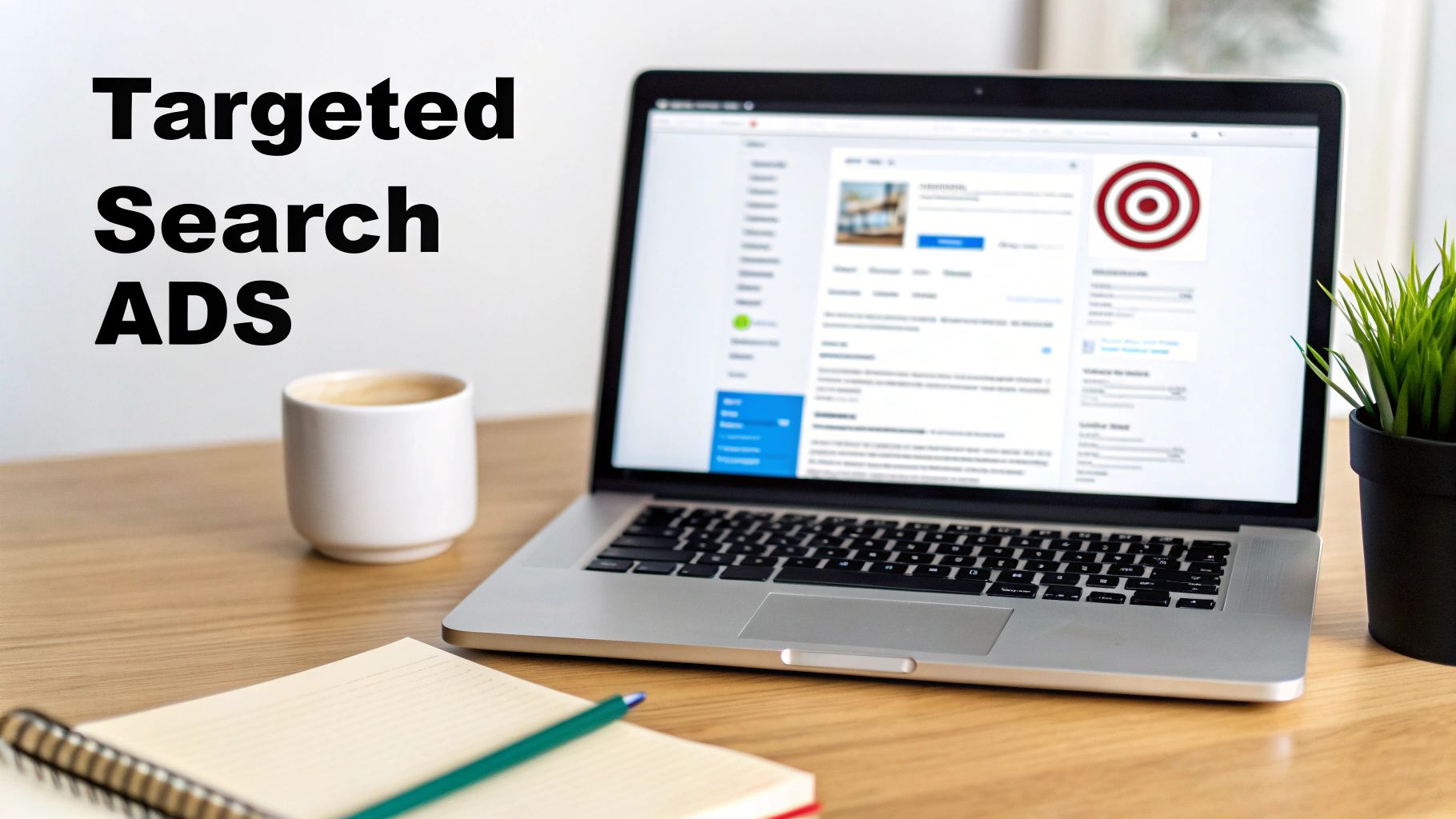
When you need customers now, Google Ads is one of the most powerful digital marketing strategies for small businesses. It's a paid advertising platform that puts your business in front of people actively searching for what you offer. Unlike waiting for SEO, Google Ads gives you instant visibility.
The platform uses a pay-per-click (PPC) model. You only pay when someone clicks your ad. This makes it easy to track your return on investment (ROI), which is perfect for small businesses. Whether it's a plumber bidding on "emergency plumber near me" or a store using Google Shopping, it connects you with ready-to-buy customers.
Actionable Tips for Google Ads Success
To avoid wasting your budget, focus on these key steps:
- Structure Granular Campaigns: Create separate campaigns for each service (e.g., "HVAC Repair" vs. "New AC Installation"). This helps you write more relevant ads and track performance better.
- Master Your Keywords: Focus on long-tail keywords like "affordable 24-hour plumber in Brooklyn." They have less competition and higher purchase intent.
- Track Everything: Set up conversion tracking right away. You need to know which ads and keywords are driving actual sales, not just clicks.
- Use Ad Extensions: For local businesses, location extensions and call extensions are essential. They make it easy for customers to find and call you from the ad.
- Refine with Negative Keywords: Add irrelevant search terms (like "jobs" or "free") to a negative keyword list to stop wasting money on bad clicks.
In Short: Google Ads offers a fast way to get in front of customers who are ready to buy, providing immediate visibility and a measurable return.
2. Facebook Ads & Instagram Ads (Meta Platform)
Google Ads captures people who are searching. Meta's platforms (Facebook and Instagram) let you find customers before they even start searching. This strategy helps you build demand, not just respond to it. You can target users based on their interests, demographics, and behaviors.
The power of Meta Ads is its visual nature and precise audience targeting. It's a flexible tool for building brand awareness and generating leads. A gym can target people interested in "health and wellness" nearby, while a contractor can reach new homeowners.
Actionable Tips for Meta Ads Success
To get the most from your ad budget, use these tips:
- Build Custom & Lookalike Audiences: Upload your customer email list to create a Custom Audience. Then, create a Lookalike Audience to find new users who are similar to your best customers.
- Implement the Meta Pixel: Install the Meta Pixel on your website immediately. This tracking code helps you monitor conversions and build retargeting audiences.
- Prioritize Video and Engaging Creative: Video usually performs better than static images. Create short, attention-grabbing videos or carousel ads to showcase your services.
- Leverage Lead Forms: For service businesses, use Meta's built-in lead forms. They let people submit their contact info without leaving the app, which increases conversion rates.
- Monitor Ad Frequency: Keep an eye on your frequency metric. If people see your ad too often, they'll ignore it. Aim for a frequency of 3-5 before refreshing your creative.
In Short: Meta Ads are perfect for generating demand by reaching specific audiences with visual content and powerful lead generation tools.
3. Local SEO (Search Engine Optimization)
For businesses serving a specific area, Local SEO is one of the most important digital marketing strategies for small businesses. It optimizes your online presence to show up in local searches, like on Google Maps. When someone searches for "plumber near me," Local SEO helps your business appear in the "Map Pack."
Unlike general SEO, Local SEO is all about geographic relevance. It tells search engines you are a good fit for someone in a specific location. For a dentist trying to attract patients from the neighborhood, this strategy is a must-have for driving local calls and foot traffic.
Actionable Tips for Local SEO Success
To dominate local search, focus on these steps:
- Optimize Your Google Business Profile: This is the cornerstone of Local SEO. Claim and completely fill out your profile with accurate hours, address, phone number, and photos.
- Build Consistent Citations: Make sure your business name, address, and phone number (NAP) are the same across all online directories like Yelp and Apple Maps.
- Generate and Respond to Reviews: Encourage happy customers to leave reviews on your Google profile. A steady stream of positive reviews builds trust. Respond to all reviews, good and bad.
- Create Location-Specific Pages: If you serve multiple towns, create dedicated pages on your website for each location (e.g., "HVAC repair in [City Name]").
- Use Local Schema Markup: Add local business schema to your website. This code gives search engines structured info about your business, like your location and hours.
In Short: Local SEO is a fundamental strategy for attracting nearby customers by making your business highly visible on Google Maps and in local search results.
4. Content Marketing & SEO
Paid ads offer a sprint, but Content Marketing & SEO is the marathon that builds long-term growth. This strategy involves creating valuable content like blog posts and guides to attract your audience organically. Instead of paying to interrupt people, you pull them in by answering their questions.
This is one of the most cost-effective digital marketing strategies for small businesses over time. A single blog post that ranks well can bring in free, qualified traffic for years. A landscaping company could write a guide on "best drought-resistant plants," attracting potential clients before they're ready to buy.
Actionable Tips for Content & SEO Success
To turn your website into a lead generator, follow these steps:
- Start with Audience Intent: Use keyword research tools to find the questions your customers are asking. Focus on question-based keywords (e.g., "how much does a new roof cost?") to create helpful content.
- Create Pillar Content: Develop comprehensive, long-form guides on core topics. These "pillar pages" act as a central hub for a topic and can be broken down into smaller blog posts.
- Optimize Every Page: Ensure every piece of content has a keyword-focused title tag, a compelling meta description, and proper headers (H1, H2, H3).
- Build Internal Links: When you publish a new post, link to other relevant articles on your site. This helps search engines find your content and keeps visitors on your site longer.
- Promote Your Content: Don't just publish and hope for the best. Share new content on your social media channels and send it to your email list.
In Short: Content Marketing & SEO is a long-term strategy that builds brand authority and drives organic traffic by establishing your business as an expert.
5. Email Marketing & Automation
Email marketing remains one of the highest-ROI digital marketing strategies for small businesses. It's a direct line of communication with people who are already interested in your brand. By capturing emails, you own your audience, free from social media algorithms.
The real power is in automation. You can set up workflows that trigger based on customer actions. For example, a new subscriber gets a welcome series, or a customer who abandons their cart gets a reminder. This nurtures leads into loyal customers with minimal effort.
Actionable Tips for Email Marketing Success
A strong email strategy sends the right message at the right time. Focus on these steps:
- Create Irresistible Lead Magnets: Offer something valuable for an email address. This could be a discount code, a free guide, or a checklist.
- Segment Your List: Don't send the same email to everyone. Group subscribers by their interests or purchase history. A new lead needs different content than a repeat customer.
- Set Up Automated Workflows: Start with the basics: a welcome series for new subscribers and an abandoned cart sequence for e-commerce. A comprehensive Email Marketing Automation Guide can be an invaluable resource.
- Write Compelling Subject Lines: Your subject line is your first impression. Make it clear and intriguing to boost open rates. A/B test different versions.
- Optimize for Mobile: Most emails are opened on a mobile device. Use a single-column layout, large fonts, and clear call-to-action buttons.
In Short: Email marketing and automation create a powerful channel that nurtures leads, drives repeat business, and delivers a very high return on investment.
6. Web Design & Conversion Rate Optimization (CRO)
Your website is your digital storefront. Getting traffic is only half the battle. Web design and Conversion Rate Optimization (CRO) are essential digital marketing strategies for small businesses. CRO is the process of turning more of your website visitors into customers.
A high-converting website makes all your other marketing more effective. If you spend money on ads, a website optimized for conversions ensures that money isn't wasted. By testing elements like headlines and call-to-action (CTA) buttons, you can increase leads and sales from the same amount of traffic.
Actionable Tips for Better Web Conversions
To make your site a lead-generating machine, focus on these fundamentals:
- Start with Mobile-First Design: Most web traffic comes from mobile. Make sure your site works perfectly on a smartphone.
- Place a Strong CTA "Above the Fold": Your most important button (e.g., "Get a Free Quote") should be visible without scrolling.
- Simplify Your Forms: Only ask for essential information. Every extra field reduces the chance someone will complete the form.
- Leverage Social Proof: Display testimonials, case studies, and client logos. This builds trust with new visitors.
- Prioritize Page Speed: Your website should load in under three seconds. Slow pages cause visitors to leave.
- Test Everything: Use A/B testing to try different headlines, button colors, and images to see what drives more conversions.
In Short: Combining great web design with CRO turns your website into a powerful sales tool that maximizes the return on all your marketing campaigns.
7. AI-Powered Call Assistants & Call Answering Services
What happens when a customer calls after hours? For most small businesses, that lead is lost. AI-powered call assistants are game-changing digital marketing strategies for small businesses that solve this problem, ensuring you never miss a call. These systems can answer calls, qualify leads, and schedule appointments 24/7.
Unlike voicemail, an AI assistant has a natural conversation, capturing key information and adding it to your CRM or calendar. For a home service company, this means catching an emergency repair request at 2 AM. To learn more, read about The Benefits of Voice AI Agents for Small Businesses.
Actionable Tips for AI Call Assistant Success
To create a great customer experience, follow these steps:
- Start with Simple, High-Impact Tasks: Program your AI to handle basic tasks first, like appointment scheduling or providing business hours.
- Customize Scripts to Match Your Brand: Your AI is an extension of your business. Customize its scripts to reflect your brand's voice. Avoid robotic language.
- Integrate with Your Core Systems: Connect your AI to your CRM and scheduling software. This automates data entry and saves you time.
- Set Clear Escalation Paths: Program rules for when a call needs to be transferred to a live person, like for complex issues or high-value sales inquiries.
- Monitor and Refine Performance: Listen to call recordings to find areas for improvement. Use this data to refine scripts and improve the call flow.
In Short: AI call assistants provide 24/7 lead capture and customer service, turning missed calls into scheduled appointments.
8. Paid Social Media Advertising & Retargeting
SEO builds long-term traffic, but paid social media advertising offers a direct line to new and existing customers. It’s a versatile strategy because you can reach specific demographics on platforms like Facebook, Instagram, LinkedIn, and TikTok. The real power is in retargeting.
Retargeting shows your ads to people who have already visited your website. By placing a small piece of code (a pixel) on your site, you can remind these warm leads to come back and complete a purchase or fill out a form. This is incredibly effective for moving customers through your sales funnel.
Actionable Tips for Paid Social Success
Effective paid social requires a strategic approach.
- Tailor Creative to Each Platform: Don't cross-post the same ad everywhere. A polished video that works on LinkedIn will likely fail on TikTok. Adapt your message and visuals for each platform.
- Install Your Pixel Immediately: Before spending money on ads, install the Meta Pixel, LinkedIn Insight Tag, or TikTok Pixel. This lets you build retargeting audiences from day one.
- Segment Your Retargeting Audiences: Create different ad campaigns for different user actions. For example, show abandoned cart ads to people who left items in their cart.
- Set Clear Exclusions: To avoid wasting money, create exclusion lists. Make sure to exclude recent converters so they don't see ads for a product they just bought.
- Use Sequential Messaging: Guide users on their journey. A first-touch ad might introduce your brand, while a retargeting ad could follow up with a testimonial or a special offer.
In Short: Paid social advertising finds new customers, while retargeting brings back warm leads, creating a powerful combination that boosts conversions.
9. Landing Pages & Lead Generation Funnels
Sending paid traffic to your homepage is often a waste of money. A much better approach is to use dedicated landing pages and funnels. A landing page has one single job: to get a visitor to take a specific action, like filling out a form or making a purchase.
This focused approach increases conversion rates by removing distractions. By matching the message from your ad to the landing page, you create a seamless journey. A lead generation funnel guides prospects through a multi-step process that qualifies them as a high-potential lead.
Actionable Tips for High-Converting Funnels
To build pages that convert, stick to these principles:
- One Goal, One Page: Every landing page should have a single, clear call-to-action (CTA). Remove all other navigation to eliminate exit points.
- Match the Message: The headline on your landing page must match the ad a user clicked. This "message match" builds trust.
- Keep Forms Simple: Only ask for the information you absolutely need. For a first-time lead, a name and email is often enough.
- Leverage Social Proof: Include testimonials, star ratings, or client logos. Social proof is a powerful psychological trigger that builds credibility.
- Optimize for Mobile First: Ensure your page loads fast and looks perfect on a small screen, with a large, easy-to-tap CTA button.
In Short: Dedicated landing pages and funnels are essential for maximizing your return on ad spend by guiding visitors toward one specific goal.
10. Partner & Affiliate Marketing
Imagine growing your customer base without spending money on ads until after you make a sale. That's the power of partner and affiliate marketing. This strategy leverages the audiences of other businesses, who refer customers to you for a commission.
This strategy is performance-based. You only pay for actual results, like a closed deal or a qualified lead, making it a low-risk channel. A web designer could refer a client who needs SEO, or an accountant could partner with a business coach. It's a powerful way to expand your reach.
Actionable Tips for Partner & Affiliate Success
Building a successful partner program requires structure and clear communication.
- Identify Complementary Partners: Look for non-competing businesses that serve the same audience. A roofer could partner with a solar panel installer.
- Create an Irresistible Offer: Offer competitive commission rates to incentivize partners. Make it financially attractive for them to promote you.
- Equip Partners for Success: Provide partners with marketing materials, email templates, and a clear process for submitting referrals. The easier you make it, the more leads you'll get.
- Implement a Tracking System: You need a reliable way to track where leads come from. This can be a simple form or dedicated affiliate management software.
- Nurture Your Relationships: Keep in regular contact with your partners. Send them updates, celebrate their successes, and ask for feedback.
In Short: Partner and affiliate marketing is a performance-based strategy that scales your sales by incentivizing other businesses to refer you customers.
Putting It All Together: Your Next Steps to Marketing Success
So there you have it—ten of the most impactful digital marketing strategies for small businesses. It's easy to look at this list and feel overwhelmed.
The key takeaway? You don't have to do everything at once.
The most successful small businesses don't master all ten strategies overnight. They start by mastering one or two.
From Information to Action: Your 3-Step Launch Plan
So, where do you go from here?
- Identify Your #1 Goal: What is the most important thing you need right now? If it's getting the phone to ring this week, start with Local SEO and Google Ads. If you want to build a long-term asset, focus on Content Marketing and Email Marketing.
- Align Strategy with Resources: Take a realistic look at your budget and time. Facebook Ads require a financial investment and time to monitor. Optimizing your Google Business Profile might require more time but less cash.
- Commit, Measure, and Pivot: Once you choose a strategy, commit to it for at least 90 days. Track your key performance indicators (KPIs). The data will tell you what's working and what isn't. Be prepared to pivot based on results.
The Power of a Hybrid Approach
As you gain momentum, you'll see the power of an integrated strategy. Your Content Marketing makes your emails more valuable. Great Web Design makes your Google Ads more profitable. Your AI Call Assistant ensures you never miss a lead from your Local SEO work.
In Short: The goal is to build a cohesive marketing engine where each part makes the others stronger. Combining a "quick win" strategy like paid ads with a long-term play like SEO creates both immediate cash flow and sustainable growth.
Mastering these digital marketing strategies for small businesses is essential for growth. By starting small, focusing your efforts, and measuring your results, you can build a system for attracting new customers and scaling your business.
Feeling overwhelmed or want to fast-track your results? At Clicks Geek, we help service-based businesses implement these digital marketing strategies to drive real growth. If you’re ready to see how a team of experts can build your marketing engine for you, learn more at Clicks Geek.