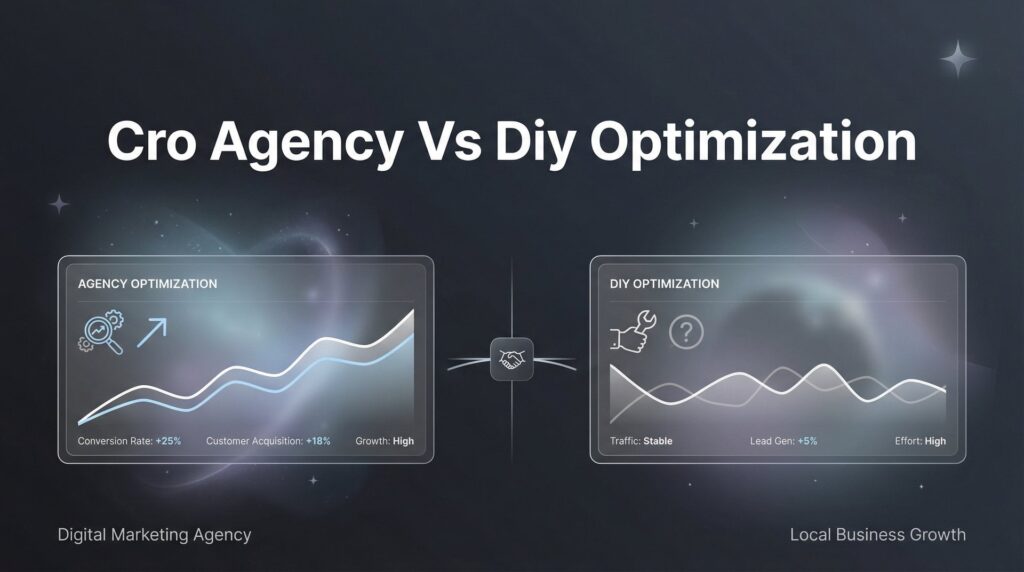
Every local business owner faces this pivotal question: should you hire a CRO agency or handle conversion rate optimization yourself? The answer isn’t one-size-fits-all. Your decision depends on your budget, technical skills, time availability, and growth goals. Making the wrong choice can cost you thousands in wasted ad spend or missed revenue opportunities.
This guide breaks down seven strategic frameworks to help you make the right call for your business. Whether you’re a plumber generating leads or an auto repair shop booking appointments, you’ll walk away knowing exactly which path delivers the best ROI for your specific situation.
Let’s cut through the confusion and build a decision framework that actually works for your business.
1. Audit Your Current Conversion Baseline Before Deciding
The Challenge It Solves
You can’t make an informed CRO decision without knowing where you currently stand. Most business owners have a vague sense that their website “could convert better,” but they lack the specific metrics needed to evaluate whether DIY optimization or agency intervention makes financial sense. Without baseline data, you’re essentially gambling with your marketing budget.
This uncertainty leads to paralysis—you keep spending on ads while your conversion rate bleeds money, or you hire an agency without understanding what improvement is realistically achievable.
The Strategy Explained
Start by documenting your current performance across key conversion metrics. For most local businesses, this means tracking form submissions, phone calls, chat conversations, and appointment bookings. Pull data from the last 90 days to establish statistically meaningful patterns.
Calculate your current conversion rate by dividing total conversions by total visitors. If you’re running paid traffic, calculate your cost per conversion and customer acquisition cost. These numbers become your decision-making foundation when evaluating conversion rate optimization services against DIY approaches.
Here’s what matters: if you’re currently converting at 2% and industry benchmarks for your business type sit around 5-8%, you have significant room for improvement. The gap between your current performance and realistic targets determines your optimization potential.
Implementation Steps
1. Set up proper conversion tracking in Google Analytics and your advertising platforms, ensuring every lead source is accurately attributed to specific traffic channels and landing pages.
2. Document your current conversion rate, cost per conversion, and average customer value for a complete 90-day period to account for seasonal fluctuations.
3. Research realistic conversion benchmarks for your specific industry and business model using resources like Google’s industry benchmarks or conversations with other business owners in your market.
4. Calculate your improvement potential by multiplying the conversion rate gap by your current traffic volume and average customer value to understand the revenue opportunity.
Pro Tips
Don’t just look at overall conversion rate—segment by traffic source. Your Google Ads traffic might convert at 4% while organic traffic converts at 1%. This reveals where optimization will deliver the biggest impact. Also, track conversion quality, not just quantity. Ten leads worth $500 each beat fifty leads worth $50 each every time.
2. Calculate the True Cost of DIY Optimization
The Challenge It Solves
DIY optimization appears free on the surface, but it carries substantial hidden costs that most business owners overlook. You might save the agency retainer, but you’re trading dollars for hours—and those hours have a price tag. The real question isn’t whether you can do it yourself, but whether you should.
Business owners often underestimate the time investment required to learn CRO fundamentals, implement tests, analyze results, and iterate on improvements. Meanwhile, their core business activities that generate immediate revenue get neglected.
The Strategy Explained
Calculate your effective hourly rate by dividing your annual business profit by your annual working hours. For most successful local business owners, this number ranges from $75 to $300 per hour. This becomes your opportunity cost baseline.
Realistic DIY optimization requires 10-20 hours monthly for learning, implementation, and analysis when you’re starting out. Multiply your hourly rate by these hours to understand your true monthly investment. Add tool costs for testing platforms, analytics software, and design resources.
Compare this total against agency pricing. If your time costs $150 per hour and you invest 15 hours monthly, you’re spending $2,250 in opportunity cost plus tools. Understanding conversion optimization agency pricing helps you make an apples-to-apples comparison—an agency charging $2,000 monthly suddenly looks like a bargain when they deliver results faster.
Implementation Steps
1. Calculate your true hourly business value by tracking what revenue-generating activities you’d sacrifice to focus on CRO work instead.
2. List every tool you’ll need for effective DIY optimization including heatmap software, A/B testing platforms, analytics tools, and design resources with their monthly subscription costs.
3. Estimate your realistic monthly time investment based on your current technical skill level, being brutally honest about the learning curve you face.
4. Add opportunity cost plus tool costs to get your true DIY monthly investment, then compare this number against agency proposals for an apples-to-apples comparison.
Pro Tips
Factor in your learning curve realistically. The first three months of DIY optimization will consume significantly more time as you master new tools and concepts. Also consider the cost of mistakes—implementing changes that actually hurt conversion can cost you more than an agency fee. If your time is worth more than $100 per hour and you’re not naturally analytical, the math usually favors professional help.
3. Evaluate Your Technical Capabilities Honestly
The Challenge It Solves
Effective conversion rate optimization requires a specific skill stack that extends far beyond basic website management. Many business owners dive into DIY optimization assuming it’s simpler than it actually is, only to waste months making changes based on gut feelings rather than data. This leads to random tweaks that deliver random results.
The gap between watching a YouTube tutorial and implementing statistically valid testing protocols is substantial. Without proper technical foundation, you risk making decisions on insufficient data or implementing changes that inadvertently break user experience.
The Strategy Explained
Successful DIY optimization demands competency across four core areas: analytics interpretation, user experience design, persuasive copywriting, and statistical testing methodology. You don’t need to be an expert in all four, but you need functional capability in each.
Analytics interpretation means understanding what metrics actually matter and how to extract actionable insights from data. UX design involves recognizing friction points and knowing how page elements impact user behavior. Copywriting requires crafting messages that address customer objections and motivate action. Testing methodology means understanding sample sizes, statistical significance, and how to isolate variables.
Be honest about your current skill level in each area. If you’re strong in two or three, DIY becomes viable with focused learning in your weak spots. Investing in the best conversion rate optimization tools can help bridge skill gaps, but tools alone won’t replace fundamental knowledge.
Implementation Steps
1. Rate yourself honestly on a 1-10 scale across analytics, UX design, copywriting, and testing methodology based on actual past experience, not perceived ability.
2. Identify your biggest skill gaps and research the time investment required to reach functional competency in those areas through courses, books, or mentorship.
3. Run a small-scale test project to validate your capabilities—pick one landing page and attempt to improve its conversion rate using proper methodology.
4. Track how long each phase takes you compared to expected timelines, and assess whether the quality of your work matches professional standards.
Pro Tips
The most common DIY failure point is testing methodology. Business owners often declare victory after seeing improved results from a single week of data, not realizing they’re looking at normal statistical noise rather than real improvement. If you can’t explain what statistical significance means and why sample size matters, you’re not ready for DIY testing. Consider partnering with a CRO specialist for at least the testing design and analysis phases.
4. Match Your Strategy to Your Traffic Volume
The Challenge It Solves
Traffic volume fundamentally determines which optimization approaches will actually work for your business. Many local business owners attempt sophisticated A/B testing strategies designed for high-traffic e-commerce sites, only to wait months for statistically meaningful results. Low traffic doesn’t mean you can’t optimize—it means you need different tactics.
Running split tests with insufficient traffic leads to false conclusions and wasted effort. You might think version B outperformed version A when you’re actually looking at random variation, leading you to implement changes that don’t actually improve performance.
The Strategy Explained
Reliable A/B testing typically requires hundreds of conversions per variation to reach statistical significance. If your landing page gets 500 visitors monthly and converts at 3%, you’re generating only 15 conversions per month. A traditional split test would take six months or longer to produce meaningful results.
Low-traffic businesses should focus on qualitative optimization instead: user testing, heuristic analysis, best practice implementation, and friction point removal. Professional landing page optimization services can help identify quick wins without requiring massive sample sizes.
High-traffic businesses can run multiple simultaneous tests, iterate quickly, and validate changes with statistical rigor. If you’re generating 100+ conversions monthly, proper A/B testing becomes viable. This is where agencies truly shine—they can run sophisticated testing programs that DIY efforts struggle to match.
Implementation Steps
1. Calculate your monthly conversion volume by multiplying your traffic by your current conversion rate to determine your testing viability.
2. If you’re generating fewer than 100 conversions monthly, focus on qualitative improvements like removing obvious friction points, implementing proven best practices, and conducting user testing sessions.
3. For moderate traffic (100-500 conversions monthly), consider sequential testing where you implement one change at a time and measure impact over longer periods.
4. If you’re generating 500+ conversions monthly, you have sufficient volume for proper split testing and should prioritize testing methodology and statistical rigor.
Pro Tips
Don’t let low traffic paralyze you. Some of the highest-impact CRO improvements come from fixing obvious problems that don’t require testing—broken forms, confusing navigation, missing trust signals, or unclear value propositions. Run your site through a heuristic evaluation checklist and fix the glaring issues first. Save sophisticated testing for when your traffic justifies it.
5. Assess Agency ROI Potential Using Revenue Math
The Challenge It Solves
Agency pricing feels expensive until you run the revenue math. A $3,000 monthly retainer sounds substantial, but if optimization improvements generate an additional $15,000 in monthly revenue, you’re looking at a 5x return. The challenge is determining whether an agency can realistically deliver those results for your specific business.
Most business owners evaluate agencies based on price rather than potential return. This backwards approach leads to either avoiding agencies altogether due to sticker shock, or choosing the cheapest option that delivers mediocre results.
The Strategy Explained
Start with your current numbers. If you’re spending $5,000 monthly on paid traffic and converting at 2%, you’re generating roughly 100 conversions monthly. If your average customer value is $500, that traffic produces $50,000 in revenue.
A realistic CRO improvement might increase your conversion rate from 2% to 3%—a 50% relative improvement. Understanding how to optimize your conversion funnel helps you identify where those gains will come from. That same $5,000 ad spend now generates 150 conversions and $75,000 in revenue.
If an agency charges $3,000 monthly and delivers that improvement within three months, your first-year return is $264,000 in additional revenue against $36,000 in agency fees. Even if the improvement is more modest—say 2% to 2.5%—the math still works strongly in favor of professional optimization.
Implementation Steps
1. Calculate your current monthly revenue from the traffic sources you’ll optimize, establishing your baseline revenue number.
2. Model conservative improvement scenarios at 25%, 50%, and 75% conversion rate increases to understand your potential revenue gains.
3. Compare the annual revenue increase from each scenario against the total annual agency investment to calculate your potential return multiples.
4. Ask prospective agencies for case studies from similar businesses and question them specifically about timeline to results and typical improvement ranges.
Pro Tips
Beware of agencies promising specific percentage improvements—legitimate CRO professionals will discuss ranges and emphasize that results depend on your baseline performance and implementation. Ask about their testing methodology, how they handle low-traffic scenarios, and what happens if tests don’t produce improvements. The best agencies focus on process and learning rather than guaranteed outcomes. Also confirm they’ll improve conversion quality, not just quantity—more leads mean nothing if they don’t close.
6. Consider the Speed-to-Results Factor
The Challenge It Solves
Time is money in optimization work. Every month your website underperforms costs you real revenue. The DIY approach carries a substantial learning curve that can stretch improvements across six to twelve months, while experienced agencies can often implement meaningful changes within the first 30-60 days.
Business owners underestimate how long it takes to develop CRO competency. You’re not just learning tools—you’re developing an entirely new analytical mindset and skill set while simultaneously running your core business operations.
The Strategy Explained
DIY optimization typically follows this timeline: months 1-2 involve learning fundamentals and setting up proper tracking, months 3-4 focus on initial testing and analysis, and months 5-6 deliver your first meaningful improvements. That’s half a year before you see real results, and that assumes you avoid major mistakes along the way.
Agencies compress this timeline dramatically. They arrive with established processes, proven testing frameworks, and cross-industry insights. A competent CRO agency can audit your current setup, identify quick wins, and implement initial improvements within the first month. More sophisticated testing programs launch in month two.
Calculate the opportunity cost of delayed results. If optimization could generate an additional $10,000 monthly but DIY delays that improvement by six months, you’ve sacrificed $60,000 in revenue. Even a $4,000 monthly agency fee looks attractive when it accelerates results by half a year. Some businesses explore performance based marketing agency models to align costs with actual results.
Implementation Steps
1. Estimate your realistic DIY timeline based on your available weekly hours and current skill level, adding buffer time for the inevitable learning curve and mistakes.
2. Calculate the monthly revenue you’re currently leaving on the table by multiplying your traffic by the conversion rate gap and your average customer value.
3. Multiply that monthly opportunity cost by the number of months DIY would delay improvements compared to agency implementation.
4. Compare your total delayed revenue against the agency investment to determine whether speed justifies the expense.
Pro Tips
Speed matters most when you’re actively scaling paid traffic. If you’re increasing your ad spend, every percentage point of conversion improvement compounds across larger budgets. Waiting six months to DIY optimization while scaling ads means you’re burning money on inefficient traffic. In this scenario, agency speed typically delivers far better economics than DIY savings. Conversely, if you’re not actively growing traffic volume, the urgency decreases and DIY timelines become more acceptable.
7. Build a Decision Framework Based on Business Stage
The Challenge It Solves
The right optimization approach changes as your business evolves. What works for a startup generating 50 leads monthly differs dramatically from an established business processing 500 leads monthly. Applying the wrong strategy for your current stage wastes resources and delays growth.
Business owners often make optimization decisions based on where they want to be rather than where they currently are. This leads to premature agency investments that don’t deliver ROI, or extended DIY efforts that hold back businesses ready to scale.
The Strategy Explained
Early-stage businesses (under $20,000 monthly revenue) should focus on DIY best practices implementation. You’re still validating your offer and finding product-market fit. Sophisticated optimization is premature when you’re generating minimal traffic. Focus on removing obvious friction and implementing proven principles.
Growth-stage businesses ($20,000-$100,000 monthly revenue) face the critical decision point. You have sufficient traffic for meaningful optimization, but resources remain constrained. This is where the math from earlier strategies becomes crucial. Calculate your true DIY costs against agency ROI potential using real numbers. Understanding digital marketing agency pricing helps you budget appropriately for this stage.
Scale-stage businesses (over $100,000 monthly revenue) should strongly consider professional optimization. You’re generating substantial traffic, small percentage improvements create significant revenue gains, and your time is too valuable for DIY work. The opportunity cost of not optimizing professionally typically exceeds agency fees by multiples.
Implementation Steps
1. Honestly assess your current business stage based on monthly revenue, traffic volume, and conversion volume rather than aspirational goals.
2. Match your optimization approach to your stage—early stage focuses on fundamentals, growth stage evaluates DIY vs agency economics, scale stage defaults to professional help.
3. Set clear criteria for when you’ll transition to the next optimization level, such as specific revenue thresholds or conversion volume milestones.
4. Revisit your optimization strategy every six months as your business grows, recognizing that what worked last quarter might not be optimal for your current situation.
Pro Tips
Don’t let ego drive your decision. Many successful business owners pride themselves on doing everything in-house, but optimization is a specialized skill that requires significant investment to master. There’s no shame in recognizing when professional help delivers better economics. Conversely, don’t hire an agency just because it feels more “professional”—if you’re early stage with limited traffic, you’ll get better ROI from investing that money in traffic generation and learning fundamentals yourself.
Your Implementation Roadmap
The CRO agency vs DIY optimization debate ultimately comes down to honest self-assessment and simple math. Start by auditing your current conversion baseline and calculating the true cost of your time. If you’re generating substantial traffic and your potential revenue gains significantly outweigh agency fees, professional help typically delivers faster, more reliable results.
For businesses still building traffic or operating on tight margins, strategic DIY optimization using proven best practices can move the needle without the investment. Focus on removing obvious friction points, implementing industry best practices, and learning the fundamentals before attempting sophisticated testing.
Whatever path you choose, the worst decision is no decision. Every day your website underperforms costs you customers. Run the numbers honestly, assess your capabilities realistically, and commit to a path forward.
Tired of spending money on marketing that doesn’t produce real revenue? We build lead systems that turn traffic into qualified leads and measurable sales growth. If you want to see what this would look like for your business, we’ll walk you through how it works and break down what’s realistic in your market.
Want More Leads for Your Business?
Most agencies chase clicks, impressions, and “traffic.” Clicks Geek builds lead systems. We uncover where prospects are dropping off, where your budget is being wasted, and which channels will actually produce ROI for your business, then we build and manage the strategy for you.