You’re watching your ad spend climb every month. The dashboard shows thousands of clicks. Your bank account shows thousands spent. But when you count the actual leads that turned into customers? The math doesn’t add up.
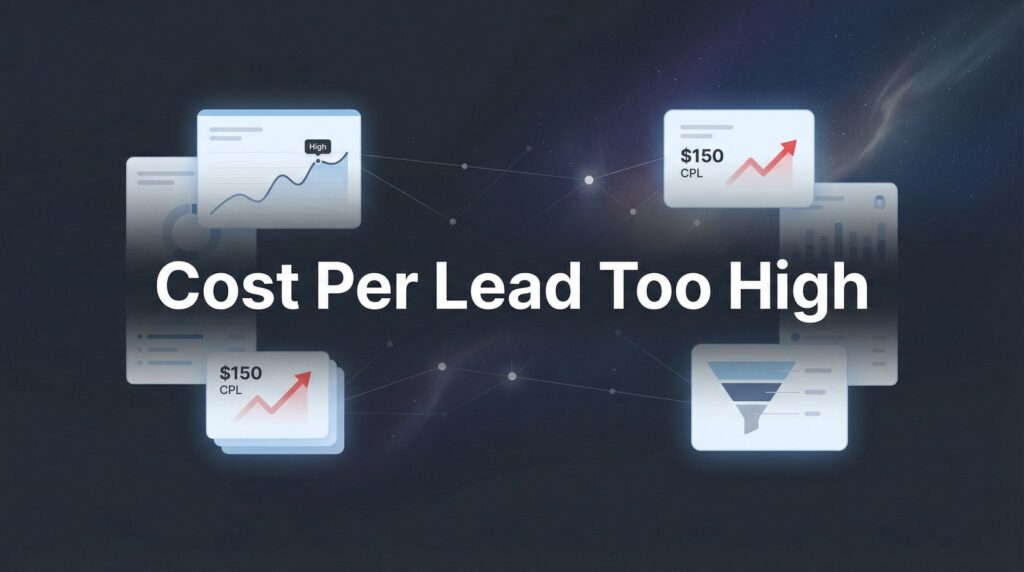
Here’s what makes a high cost per lead so dangerous: it’s not just about wasting money today. It’s about whether your business can actually grow profitably. When you’re paying $150 per lead in an industry where the average customer is worth $500, the margins evaporate fast. Add in overhead, fulfillment costs, and the reality that not every lead converts, and suddenly you’re running a marketing machine that loses money with every revolution.
The good news? A high cost per lead isn’t a life sentence. It’s a symptom. And symptoms can be diagnosed and treated. This guide will walk you through the real reasons your lead costs are inflated—beyond the obvious “competition is tough” explanation—and show you exactly how to fix each one. No theory, no fluff. Just the systematic approach that actually brings costs down while keeping lead quality high.
What’s Actually Driving Your Lead Costs Through the Roof
Let’s start with the uncomfortable truth: competition might be intense in your market, but it’s rarely the primary reason your cost per lead is too high. The real culprits are usually hiding inside your own campaigns.
Think of Google Ads and Facebook Ads as efficiency reward systems. Both platforms use quality scoring mechanisms that directly impact what you pay per click. When Google calculates your Quality Score, it’s measuring three things: expected click-through rate, ad relevance, and landing page experience. Facebook’s relevance diagnostics work similarly. Here’s why this matters: a campaign with a Quality Score of 7 might pay $3 per click, while an identical campaign with a score of 3 could pay $6 or more for the same placement.
Poor audience targeting creates a cascade effect. You show ads to people who aren’t interested. They don’t click. Your click-through rate drops. The platform interprets this as “this ad isn’t relevant,” and your quality score tanks. Now you’re paying premium prices for the few clicks you do get. And those clicks? They’re often from the least qualified portion of your audience—the tire-kickers who click out of curiosity rather than intent.
Landing page disconnects compound the problem. Picture this: your ad promises “Free Quote on Kitchen Remodeling” but clicks through to your generic homepage with a navigation menu and no clear path to that quote. The visitor bounces. Google notices. Your landing page experience score drops. Your costs rise. Meanwhile, your competitor sends that same click to a dedicated landing page with a simple quote form, converts the lead, and pays half what you’re paying.
Campaign structure issues often fly under the radar. Many businesses run campaigns that have grown organically over time—adding ad groups here, launching new campaigns there—until they’re managing a bloated, inefficient mess. Overlapping audiences mean you’re bidding against yourself. Too many ad groups fragment your budget so nothing gets enough data to optimize properly. Improper bid strategies can send costs spiraling overnight when market conditions shift.
The quality score factor isn’t just about paying less per click. It’s about algorithmic preference. Platforms want to show ads that users engage with because engagement keeps users on the platform. When your campaigns demonstrate relevance through strong click-through rates and conversion rates, you get preferential placement at lower costs. When they don’t, you’re fighting an uphill battle where every lead costs more than it should.
The Targeting Trap: When You’re Paying to Reach the Wrong People
Broad targeting feels safe. Cast a wide net, reach more people, generate more leads. Except it doesn’t work that way. What actually happens is you pay to reach thousands of people who will never become customers, diluting your budget and inflating your cost per lead.
The difference between vanity traffic and buyer-intent audiences is everything. Vanity traffic looks good in reports—high impressions, decent click volume—but converts poorly because the people clicking aren’t in buying mode. They’re browsers, researchers, or just curious. Buyer-intent audiences are smaller but exponentially more valuable. These are people actively searching for solutions, comparing options, and ready to make decisions.
Here’s a practical example: a local HVAC company running ads to “everyone interested in home improvement” in their metro area. Sounds reasonable, right? Except that audience includes people who just bought a new system last month, renters who can’t make HVAC decisions, DIY enthusiasts looking for tutorials, and homeowners who are years away from needing service. The company is paying for all those clicks.
Now consider the same company targeting homeowners aged 35-65 in specific zip codes, excluding recent converters, and layering in search intent signals like “AC repair near me” or “furnace replacement cost.” The audience is dramatically smaller, but the conversion rate is three times higher because they’re reaching people who actually need HVAC service right now.
Audience refinement requires layering. Start with demographic basics—age, location, income level—but don’t stop there. Add behavioral signals: website visitors who viewed specific pages, people who engaged with your content, users who searched for solution-oriented keywords. Use exclusions aggressively: existing customers, recent converters, job seekers, competitors, and anyone who’s demonstrated they’re not a fit.
In Google Ads, negative keywords are your best friend. Every search campaign should have a comprehensive negative keyword list that grows continuously. Common wastes: “free,” “DIY,” “jobs,” “salary,” “how to become,” and any terms that indicate research rather than buying intent. For local businesses, excluding nearby cities where you don’t service can save significant budget. Understanding how pay per click advertising works helps you make smarter targeting decisions from the start.
In Facebook and Meta advertising, exclusion audiences work similarly. Create custom audiences of existing customers and exclude them. Build audiences of people who visited your site but didn’t convert, then exclude them from top-of-funnel campaigns while targeting them with retargeting. Exclude people who engaged with your content but didn’t take action—they’re interested but not ready, and continued exposure at this stage wastes money.
The goal isn’t to reach fewer people. It’s to reach fewer wrong people and more right people. Every dollar you stop spending on unqualified traffic becomes a dollar you can invest in reaching high-intent prospects. That shift alone can cut your cost per lead dramatically.
Landing Pages That Leak Money (And How to Plug the Holes)
Your landing page is where money gets made or wasted. You can have perfect targeting and brilliant ad creative, but if your landing page doesn’t convert, you’re just paying for expensive traffic that goes nowhere.
Sending traffic to your homepage is the single most common landing page mistake. Your homepage is designed to serve multiple audiences—existing customers, job seekers, press, partners. It has navigation menus, multiple calls to action, and information that’s irrelevant to someone clicking an ad about a specific offer. Every additional option is a chance for the visitor to get distracted and leave without converting.
A high-converting landing page has one job: convert the visitor into a lead. That means radical focus. The message on the page should match the message in the ad—this is called message match, and it’s critical. If your ad says “Get a Free Roof Inspection,” your landing page headline better say something nearly identical. When visitors experience continuity between the ad and the page, conversion rates soar. When there’s disconnect, they bounce.
Clear calls to action eliminate confusion. The visitor should know exactly what you want them to do and why they should do it. “Submit” on a button is weak. “Get My Free Quote” is specific and action-oriented. Place your primary CTA above the fold where it’s immediately visible, then repeat it lower on the page for visitors who scroll.
Trust signals matter more than most businesses realize. Third-party validation—reviews, ratings, certifications, awards, client logos—builds credibility fast. For local businesses, displaying your Google rating prominently can increase conversion rates significantly. Security badges near forms reduce friction. Testimonials that speak to specific concerns (“I was worried about cost, but…”) address objections before they become reasons not to convert.
Form fields are a delicate balance. Every field you add increases friction and lowers conversion rates. But too few fields can attract low-quality leads. For most businesses, name, email, and phone number are sufficient for initial contact. If you need more qualification, consider a two-step process: minimal information to start the conversation, detailed information during the sales process.
Page speed is a silent killer. Mobile traffic dominates most industries now, and mobile users are impatient. If your landing page takes more than three seconds to load, you’re losing leads before they even see your offer. Compress images, minimize scripts, use fast hosting. Google’s PageSpeed Insights tool will identify specific issues.
Mobile responsiveness isn’t optional anymore. Your landing page must work flawlessly on phones. Forms should be easy to fill out with thumbs. Text should be readable without zooming. Buttons should be large enough to tap accurately. Test your pages on actual mobile devices, not just desktop browser simulators.
Quick wins that can improve conversion rates immediately: remove navigation menus to eliminate exit paths, add a compelling subheadline that expands on your main promise, include a brief bullet list of key benefits, display your phone number prominently for people who prefer to call, and add urgency where appropriate (“Limited slots available,” “Schedule within 48 hours”). The right conversion rate optimization tools can help you identify exactly where visitors drop off.
The landing page audit question to ask: “If I were a stranger clicking this ad, would everything on this page make me want to take action, or would I find reasons to leave?” Be ruthlessly honest. Every element should either build desire or reduce friction. Everything else is waste.
Ad Creative and Copy That Actually Converts
Generic ads attract generic leads. When your ad copy could apply to any business in your industry, you’re not giving high-intent prospects a reason to choose you over competitors. Worse, you’re attracting price shoppers and tire-kickers who click because your ad was there, not because it resonated.
Pre-qualifying through ad copy is one of the most underutilized strategies in paid advertising. By being specific about who you serve and what you offer, you filter out poor-fit leads before they cost you money. A generic ad might say “Professional Plumbing Services.” A pre-qualifying ad says “Emergency Plumbing Repairs for Homeowners—Available 24/7 in [City].” The second ad repels people looking for new construction plumbing, DIY advice, or service outside your area. That’s exactly what you want.
Setting expectations before the click saves money and improves lead quality. If you’re a premium service, say so. If you require a minimum project size, mention it. If you only serve certain areas, be explicit. Some businesses worry this will reduce click-through rates. It will. That’s the point. You want fewer, better clicks from people who are actually good fits.
Specificity beats vagueness every time. Compare these headlines: “Get More Leads” versus “Generate 20+ Qualified Sales Leads Per Month.” The first is forgettable. The second sets a concrete expectation and attracts people who want that specific outcome. Even if you can’t promise exact numbers, you can be specific about the benefit: “Turn Website Visitors Into Booked Appointments” is more compelling than “Improve Your Marketing.”
Pain point messaging connects with people actively experiencing problems. Your best prospects aren’t casually browsing—they’re frustrated, stuck, or searching for solutions. Ad copy that acknowledges their situation (“Tired of leads that never respond?”) creates instant relevance. Follow with your solution and a clear path forward. This approach directly addresses the low quality leads problem many businesses face.
The creative testing trap many businesses fall into: testing everything randomly and never gathering enough data to make decisions. Effective testing requires discipline. Test one variable at a time—headline, image, or call to action—so you know what caused performance changes. Run tests long enough to gather statistical significance, typically at least a few hundred clicks per variation. Document what you learn and apply those insights to future campaigns.
For testing frameworks, start with your biggest assumptions. If you think your audience cares most about price, test price-focused messaging against quality-focused messaging. If you’re unsure whether to emphasize speed or thoroughness, test both. Let the data tell you what resonates rather than guessing based on personal preference.
Visual elements matter more on platforms like Facebook where you’re interrupting people rather than answering searches. Images should be relevant, high-quality, and attention-grabbing without being gimmicky. For service businesses, showing your team or your work in progress often outperforms stock photos because it builds authenticity.
The ad copy audit question: “Does this ad make a specific promise to a specific person about a specific outcome?” If the answer is no, you’re leaving performance on the table. Tighten your messaging, clarify your offer, and watch both your click-through rate and your lead quality improve.
Campaign Structure Mistakes That Secretly Inflate Your CPL
Campaign bloat happens gradually. You launch a campaign. It works okay. You add another ad group to test something. Then another campaign for a different service. Before long, you’re managing a sprawling account with dozens of campaigns, hundreds of ad groups, and no clear strategy. This fragmentation is expensive.
When you spread your budget too thin across too many campaigns, nothing gets enough data to optimize properly. Machine learning algorithms need volume to identify patterns and improve performance. A campaign spending $10 per day might never exit the learning phase. Meanwhile, you’re paying for that inefficiency in the form of higher costs per click and lower conversion rates.
Overlapping audiences create a particularly insidious problem: you’re bidding against yourself. If you have one campaign targeting “homeowners interested in home improvement” and another targeting “people searching for kitchen remodeling,” there’s significant overlap. When both campaigns enter the same auction, you’re competing with yourself, driving up costs for both. The solution is careful audience segmentation with clear boundaries and exclusions.
Bid strategy mistakes can double your costs overnight. Many businesses set their campaigns to maximize conversions or target CPA without understanding how these strategies work. When market conditions change—a competitor increases spending, seasonal demand shifts, or your conversion rate fluctuates—automated bid strategies can spiral out of control. You wake up to find you spent your entire monthly budget in three days with nothing to show for it.
Manual bidding or enhanced CPC gives you more control but requires active management. Automated strategies can work well once you have sufficient conversion data—typically at least 30 conversions per month—but they need monitoring and adjustment. Setting bid caps prevents runaway spending. Regular bid reviews ensure you’re not overpaying for placements that don’t convert.
Account hygiene is the unsexy work that keeps costs under control. Regular optimization routines should include: reviewing search term reports to identify new negative keywords, analyzing placement reports to exclude websites or apps that waste budget, checking device performance to adjust bids based on what actually converts, and pausing underperforming ads and ad groups rather than letting them continue burning money.
Negative keywords deserve special attention. In Google Ads, every search campaign should have three layers of negatives: account-level negatives that apply everywhere (jobs, free, DIY), campaign-level negatives specific to that campaign’s theme, and ad group-level negatives that prevent irrelevant traffic within targeted themes. Review your search term report weekly, especially in new campaigns. You’ll be amazed at the irrelevant searches triggering your ads.
Placement exclusions work similarly in display and video campaigns. If you’re advertising on the Google Display Network or YouTube, you’re likely showing up on some websites and channels that don’t align with your brand or attract your audience. Regularly exclude placements with high costs and low conversions. Build a list of excluded placements that grows over time.
The consolidation question to ask: “Could I achieve the same results with fewer, better-funded campaigns?” Often the answer is yes. Consolidating campaigns improves data density, simplifies management, and allows algorithms to optimize more effectively. The goal isn’t to have the most campaigns. It’s to have the most efficient campaigns.
Putting It Into Action: Your 30-Day CPL Reduction Plan
Theory is useless without execution. Here’s a systematic 30-day plan to lower your cost per lead without sacrificing quality. Work through these steps in order—they’re sequenced to deliver quick wins while building toward sustainable improvement.
Week 1: Diagnostic Phase
Start by establishing your baseline. Document your current cost per lead, conversion rate, and lead quality metrics. Review the last 30 days of campaign data to identify your biggest cost drains. Which campaigns have the highest CPL? Which ad groups convert poorly? Where is budget being wasted on irrelevant clicks?
Audit your landing pages against the criteria we discussed. Are they focused? Is there message match with your ads? Do they load quickly on mobile? Make a prioritized list of landing page fixes, focusing first on pages receiving the most traffic.
Review your audience targeting and create a comprehensive list of negative keywords and exclusion audiences. This is often the fastest way to reduce wasted spend. Implement these exclusions immediately—you should see cost reductions within days.
Week 2: Landing Page Optimization
Focus this week on your highest-traffic landing pages. Implement the quick wins: improve headlines for message match, simplify forms, add trust signals, optimize page speed. If you’re sending traffic to your homepage, create dedicated landing pages for your primary offers.
Set up proper conversion tracking if it’s not already in place. You can’t optimize what you don’t measure. Track form submissions, phone calls, and any other lead generation actions. Test your tracking to ensure it’s working correctly.
Launch simple A/B tests on your top landing pages. Test headline variations, form length, or CTA button text. Don’t get fancy—focus on high-impact changes that could meaningfully improve conversion rates.
Week 3: Campaign Structure and Ad Creative
Consolidate bloated campaigns. Merge ad groups with similar themes. Pause campaigns that consistently underperform. Redistribute budget toward campaigns that generate leads efficiently.
Refresh your ad creative using the pre-qualification and specificity principles. Write new ads that speak directly to your ideal customer’s pain points and clearly differentiate your offer. Launch these ads alongside your existing ones so you can compare performance.
Review and adjust your bid strategies. If you’re using automated bidding without sufficient conversion data, consider switching to manual or enhanced CPC until you build more volume. Set bid caps to prevent runaway spending.
Week 4: Refinement and Scaling
Analyze the results of your changes. What improved? What didn’t? Landing page conversion rate increases should flow through to lower CPL. Better targeting should reduce wasted clicks. Improved ad creative should increase click-through rates and quality scores.
Double down on what’s working. Increase budget on campaigns that improved. Expand successful audiences carefully. Scale winners, not losers.
Establish ongoing optimization routines: weekly search term reviews, bi-weekly performance analysis, monthly strategic reviews. Continuous improvement beats occasional overhauls. The right marketing automation tools can streamline much of this ongoing work.
Metrics Beyond CPL
Cost per lead is important, but it’s not the only metric that matters. Track your lead-to-customer conversion rate—a lower CPL means nothing if those leads don’t close. Monitor cost per acquisition (what you pay to acquire an actual customer) as your north star metric. If you’re dealing with a high cost per acquisition problem, fixing your CPL is only part of the solution. Calculate customer lifetime value to understand how much you can profitably spend on acquisition.
For businesses with longer sales cycles, track lead quality indicators: response rates, appointment show rates, proposal acceptance rates. Sometimes a slightly higher CPL delivers dramatically better lead quality, resulting in lower overall acquisition costs and higher revenue.
When to Get Professional Help
Some businesses can execute this plan internally. Others benefit from expert guidance. Consider professional help when: your monthly ad spend exceeds $10,000 and inefficiency is expensive, you lack the internal expertise to manage complex campaigns, you’ve tried to optimize but costs remain stubbornly high, or you’re too busy running the business to give marketing the attention it needs.
The right agency or consultant doesn’t just manage your campaigns—they bring strategic thinking, testing discipline, and experience across multiple industries. A performance based marketing agency aligns their incentives with your results. They’ve seen what works and what doesn’t. They can spot issues you’d miss and implement solutions faster than you could figure them out.
Your Next Steps
A high cost per lead isn’t a permanent condition. It’s a solvable problem with identifiable causes and proven solutions. The businesses that win in paid advertising aren’t necessarily the ones with the biggest budgets—they’re the ones that systematically eliminate waste and maximize efficiency.
Start with the highest-impact changes: tighten your targeting to stop paying for irrelevant clicks, fix your landing pages to convert more of the traffic you’re already getting, and pre-qualify through ad copy to attract better leads. These three changes alone can reduce your customer acquisition cost by significant margins while improving lead quality.
Then move to the refinement work: campaign structure optimization, continuous testing, and ongoing account hygiene. Make optimization a routine, not an event. The businesses with the lowest acquisition costs didn’t get there through one big fix—they got there through consistent, disciplined improvement.
Remember that your goal isn’t to hit some arbitrary industry benchmark. It’s to improve your own baseline performance until your marketing becomes profitably scalable. When you can acquire customers at a cost that leaves healthy profit margins, you’ve built a growth engine that compounds over time.
The question isn’t whether you can lower your cost per lead. You can. The question is whether you’ll take systematic action to make it happen, or continue hoping that results will somehow improve on their own. They won’t. But with the right approach, you can transform your lead generation from a money pit into a profit center.
Tired of spending money on marketing that doesn’t produce real revenue? We build lead systems that turn traffic into qualified leads and measurable sales growth. If you want to see what this would look like for your business, we’ll walk you through how it works and break down what’s realistic in your market.
Want More Leads for Your Business?
Most agencies chase clicks, impressions, and “traffic.” Clicks Geek builds lead systems. We uncover where prospects are dropping off, where your budget is being wasted, and which channels will actually produce ROI for your business, then we build and manage the strategy for you.