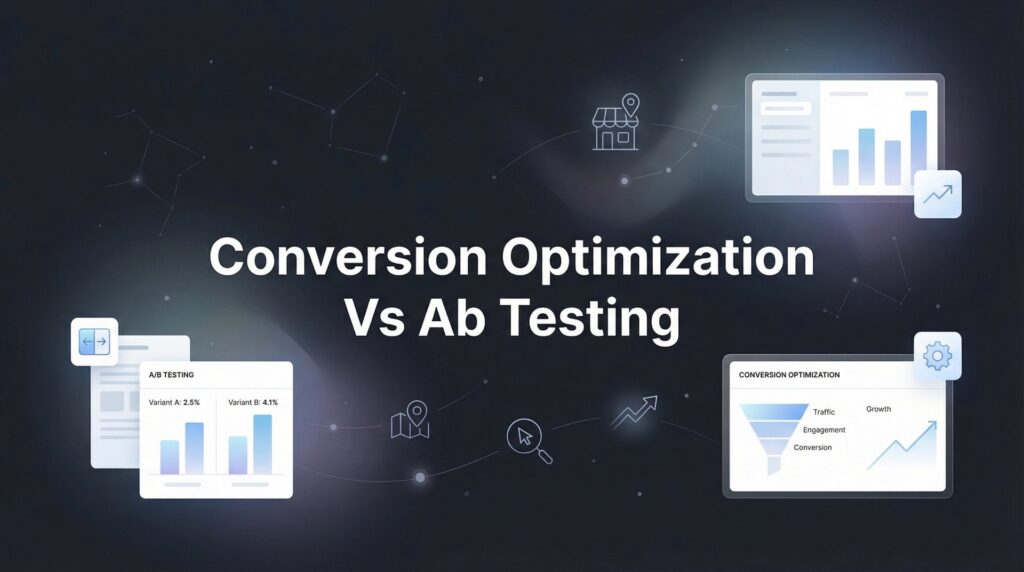
Most business owners treat conversion optimization and A/B testing as interchangeable terms—or worse, as an either/or decision. This confusion costs them money and wastes precious testing cycles.
Here’s the truth: conversion optimization is the strategic framework that identifies what needs fixing on your website, while A/B testing is the scientific method you use to validate those fixes actually work.
Think of conversion optimization as the detective work and A/B testing as the courtroom evidence. You need both to win the case for more conversions.
The real question isn’t which one to choose—it’s how to use them together to systematically turn more of your website visitors into paying customers. These seven strategies will show you exactly how to combine both disciplines for maximum ROI, whether you’re running a local service business or scaling an e-commerce operation.
1. Start With Data-Driven Diagnosis Before Any Testing
The Challenge It Solves
Too many businesses jump straight into A/B testing without understanding what’s actually broken. They test random elements—changing button colors, tweaking headlines, rearranging page sections—hoping something sticks. This shotgun approach wastes time and budget while missing the real conversion killers hiding in your data.
Without proper diagnosis, you’re essentially performing surgery blindfolded. You might accidentally fix something, but you’re more likely to waste months testing irrelevant variables while your biggest conversion leaks continue draining revenue.
The Strategy Explained
Before running a single A/B test, become a detective investigating where visitors abandon your conversion funnel. Use analytics to identify drop-off points, heatmaps to see where attention dies, and session recordings to watch real users struggle with your interface.
This diagnostic phase reveals patterns that statistics alone can’t show. You’ll discover that users scroll past your call-to-action because it’s buried below the fold, or that they click your pricing button repeatedly because it doesn’t work on mobile devices.
The goal isn’t to guess what might improve conversions. It’s to observe actual user behavior and identify specific friction points that prevent conversions from happening. These observations become your testing roadmap.
Implementation Steps
1. Install heatmap and session recording tools on your highest-traffic pages to capture real user behavior patterns over at least two weeks of normal traffic.
2. Review your analytics funnel reports to identify the exact pages and steps where the largest percentage of visitors abandon your conversion process.
3. Watch 20-30 session recordings of users who didn’t convert, noting every point where they hesitate, backtrack, or show confusion through erratic mouse movement.
4. Document your findings in a spreadsheet with three columns: page location, observed problem, and estimated impact on conversions.
Pro Tips
Focus your initial diagnostic work on pages that directly generate revenue—your product pages, service inquiry forms, and checkout process. Generic pages like your about page can wait. Also, filter your session recordings to show only users who spent at least 30 seconds on the page; this eliminates accidental clicks and gives you meaningful behavior to analyze.
2. Build Your Conversion Hypothesis Framework
The Challenge It Solves
Random testing produces random results. When you change multiple elements simultaneously or test without a clear hypothesis, you can’t determine what actually caused any improvement you see. Even worse, you might implement a “winning” variation that actually succeeds for reasons completely unrelated to what you changed.
Without structured hypotheses, your optimization efforts become a collection of disconnected experiments that don’t build on each other or create transferable knowledge about what works for your specific audience.
The Strategy Explained
A proper conversion hypothesis connects observed user behavior to a specific change you believe will improve results. It follows this format: “Because we observed [specific user behavior], we believe that changing [specific element] will result in [measurable improvement] for [target audience segment].”
This framework forces you to base tests on actual evidence rather than opinions or industry best practices that may not apply to your business. It also creates a learning system where each test—whether it wins or loses—teaches you something concrete about your customers.
Strong hypotheses make your A/B testing program cumulative rather than circular. You build knowledge that informs future tests instead of endlessly testing random variations hoping for accidental wins.
Implementation Steps
1. Take each problem identified in your diagnostic phase and write a specific hypothesis explaining why you believe a particular change will solve it.
2. Include the quantitative goal in your hypothesis—not just “increase conversions” but “increase form completions by at least 15% among mobile visitors.”
3. Identify the specific user segment most affected by the problem and target your test to that segment if your traffic volume allows it.
4. Document your reasoning so you can review it after the test completes and understand what you learned regardless of whether the test wins or loses.
Pro Tips
Write your hypothesis before designing the test variation, not after. This prevents confirmation bias where you unconsciously design tests to prove what you already believe. Also, keep a hypothesis library where you track all tested hypotheses and their results—this becomes your competitive advantage as you accumulate knowledge about what resonates with your specific audience.
3. Match Your Testing Method to Your Traffic Reality
The Challenge It Solves
Many local businesses and smaller operations struggle with A/B testing because they don’t have the traffic volume needed for statistical significance. They run tests for months without reaching conclusive results, or worse, they implement changes based on statistically invalid tests that happened to show positive results by random chance.
The frustration leads many to abandon optimization entirely, concluding that “testing doesn’t work for smaller businesses.” The real problem isn’t testing—it’s using the wrong validation method for your traffic situation.
The Strategy Explained
Traditional A/B testing requires substantial traffic to detect meaningful differences between variations. If you’re working with limited traffic, you need alternative validation methods that still provide directional insights without requiring thousands of visitors per variation.
Sequential testing allows you to implement changes one at a time and compare performance before and after, accounting for seasonal variations. User testing with small samples can validate whether your changes solve the observed problems even if you can’t prove statistical significance. Qualitative feedback from actual customers often reveals insights that pure statistics miss.
The key is matching your validation rigor to your traffic reality while still making evidence-based decisions rather than random changes.
Implementation Steps
1. Calculate how many visitors you receive monthly on your highest-traffic pages to determine if traditional A/B testing is viable for your situation.
2. For lower-traffic scenarios, implement changes sequentially with clear before-and-after measurement periods of at least 30 days to account for weekly fluctuations.
3. Supplement quantitative testing with qualitative methods like user testing sessions where you watch 5-10 people interact with both versions of your page.
4. Use tools like exit surveys or on-page feedback widgets to gather direct input about what prevents visitors from converting.
Pro Tips
If you’re running sequential tests, implement changes during comparable time periods—don’t compare December holiday traffic to February off-season performance. Also, combine multiple small changes into a single larger redesign when traffic is extremely limited, then use qualitative feedback to understand which specific elements drove any improvement you observe.
4. Optimize Your Highest-Value Pages First
The Challenge It Solves
Limited time and resources force you to make choices about where to focus optimization efforts. Many businesses spread their attention across every page on their website, making tiny improvements everywhere while ignoring the pages that actually generate revenue.
This scattered approach produces minimal results because you’re optimizing pages that don’t matter. A 50% improvement on a page that generates zero revenue is still zero revenue.
The Strategy Explained
Revenue concentration typically follows the 80/20 rule—roughly 80% of your conversions come from 20% of your pages. Identify which specific pages directly generate leads, sales, or qualified inquiries, then focus your optimization work exclusively on those high-impact pages.
For most businesses, this means prioritizing your product pages, service inquiry forms, pricing pages, and checkout process. These pages sit at the bottom of your conversion funnel where small improvements create immediate revenue impact.
Once you’ve optimized your revenue-generating pages, you can expand to supporting pages like landing pages and category pages. But start where the money is.
Implementation Steps
1. Review your analytics to identify which specific pages generate the most conversions, whether that’s form submissions, phone calls, purchases, or consultation bookings.
2. Calculate the revenue value of improving each page by multiplying monthly conversions by average customer value and potential conversion rate improvement.
3. Rank your pages by potential revenue impact and commit to optimizing only your top 3-5 highest-value pages before expanding to others.
4. Set clear success metrics for each priority page based on current conversion rates and realistic improvement targets.
Pro Tips
Don’t confuse highest-traffic pages with highest-value pages. Your blog posts might get tons of traffic, but if they don’t directly generate revenue, they’re lower priority than your contact form that converts at 5% but drives actual sales. Also, consider the entire conversion value, not just immediate revenue—a consultation booking page might be more valuable than a direct purchase page if consultations lead to higher-value contracts.
5. Design Tests That Actually Prove Something
The Challenge It Solves
Poorly designed A/B tests produce misleading results that lead to bad decisions. When you change multiple variables simultaneously, test for too short a duration, or declare winners before reaching statistical significance, you’re essentially making random changes and calling it optimization.
These invalid tests waste resources and create false confidence. You implement “winning” variations that actually perform worse over time, or you abandon legitimately better versions because you stopped the test too early.
The Strategy Explained
Valid A/B tests follow strict protocols that ensure any difference you observe is real rather than random chance. This means testing only one variable at a time so you know what caused any change, running tests long enough to account for weekly traffic patterns, and requiring sufficient sample sizes before declaring a winner.
Proper test design also means defining your success metric before starting the test—not cherry-picking favorable metrics after seeing results. If you’re testing a headline change, your success metric is conversions on that page, not time on page or scroll depth.
The discipline of proper test design separates real optimization from random tinkering that happens to produce occasional positive results by luck.
Implementation Steps
1. Limit each A/B test to a single variable change—test the headline OR the call-to-action button, never both simultaneously in the same test.
2. Run tests for at least two full weeks to capture weekend versus weekday behavior patterns, and continue until you reach your predetermined sample size.
3. Use a statistical significance calculator before starting to determine how many visitors you need for valid results based on your current conversion rate.
4. Document your success metric and significance threshold before launching the test, then stick to those criteria regardless of what you observe mid-test.
Pro Tips
Resist the temptation to stop tests early when you see a clear winner emerging. Traffic patterns shift, and early results often don’t hold up over time. Also, be especially skeptical of dramatic improvements—a variation showing 300% better results is more likely a tracking error or sample size issue than a genuine breakthrough.
6. Implement a Continuous Optimization Loop
The Challenge It Solves
One-off optimization projects create temporary improvements that plateau quickly. You run a few tests, implement the winners, then move on to other priorities. Six months later, your conversion rates have stagnated because you stopped the improvement process.
Sustainable growth requires continuous optimization where each test informs the next one, creating compound improvements over time rather than isolated gains.
The Strategy Explained
A continuous optimization loop treats conversion improvement as an ongoing discipline rather than a project with an end date. You establish a regular cadence of diagnosis, hypothesis formation, testing, analysis, and implementation that becomes part of your standard business operations.
This systematic approach compounds results because each test teaches you something about your audience that informs future tests. You build institutional knowledge about what resonates with your customers, allowing you to make increasingly accurate predictions about what will improve conversions.
The businesses that dominate their markets online aren’t necessarily smarter about individual tests—they’re more consistent about running the optimization loop repeatedly over years.
Implementation Steps
1. Schedule a monthly optimization review where you analyze current conversion data, identify new problems, and prioritize upcoming tests.
2. Maintain a backlog of test ideas ranked by expected impact so you always know what to test next when a current test concludes.
3. Create a standardized documentation process that captures what you learned from each test regardless of whether it won or lost.
4. Set quarterly conversion improvement goals that require consistent testing activity to achieve, making optimization a measured business priority.
Pro Tips
Start with a realistic testing cadence you can sustain—one test per month is better than three tests this month and then nothing for six months. Also, review your losing tests as carefully as your winners; understanding why something didn’t work often provides more valuable insights than confirming what already seemed obvious.
7. Connect Testing Results to Revenue Impact
The Challenge It Solves
Optimization efforts often get deprioritized because stakeholders don’t understand the revenue impact. When you report that you “increased conversions by 0.5%,” leadership hears “tiny improvement” rather than “significant revenue increase.”
Without clear revenue connection, optimization becomes the first budget cut when resources tighten, even though it’s often the highest-ROI marketing activity you can do.
The Strategy Explained
Every conversion improvement translates directly to revenue impact when you do the math properly. A business converting 2% of traffic that improves to 2.5% isn’t seeing a “small 0.5% improvement”—they’re seeing a 25% increase in conversions from the same traffic investment.
Calculate the actual dollar value of each improvement by multiplying the conversion rate increase by your traffic volume and average customer value. This transforms abstract percentages into concrete revenue numbers that justify continued optimization investment.
When you can demonstrate that a single successful test generated an extra $15,000 in monthly revenue, optimization stops being a nice-to-have and becomes a strategic priority.
Implementation Steps
1. Calculate your average customer lifetime value so you can translate conversion improvements into actual revenue rather than just lead counts.
2. Create a simple spreadsheet that shows current monthly traffic, current conversion rate, current monthly revenue, improved conversion rate, and projected revenue increase.
3. Track the cumulative revenue impact of all optimization efforts over time to show the compound effect of continuous testing.
4. Present optimization results in revenue terms first, then include the technical conversion metrics as supporting detail.
Pro Tips
Be conservative in your revenue calculations to maintain credibility—use the lower end of your conversion value range and account for seasonal variations. Also, track the cost of your optimization efforts including tools, time, and any external expertise so you can calculate true ROI and demonstrate that testing pays for itself many times over. If you’re struggling to connect the dots, proper marketing conversion tracking is essential for accurate revenue attribution.
Putting It All Together
Conversion optimization and A/B testing aren’t competing approaches—they’re two halves of a complete system for growing your business online. Start with the diagnostic work of conversion optimization to find what’s broken, build testable hypotheses, then use A/B testing to validate your fixes with real data.
The businesses that win online aren’t guessing about what works. They’re systematically testing, learning, and improving.
Begin with Strategy 1 this week: audit your highest-traffic pages with heatmaps and analytics to identify your biggest conversion leaks. That single step will give you a prioritized list of improvements worth testing. Then move to Strategy 4 and focus exclusively on your highest-value pages where improvements create immediate revenue impact.
Remember that even modest conversion improvements compound significantly over time. A local service business converting 3% of website visitors that improves to 4% sees a 33% increase in leads from the same marketing spend. That’s not a marginal improvement—that’s transformational growth without spending an extra dollar on advertising.
The most common mistake is treating optimization as a one-time project rather than an ongoing discipline. Commit to the continuous optimization loop in Strategy 6, and you’ll build compound advantages that competitors can’t match because they’re still making random changes and hoping for the best.
Ready to accelerate your conversion optimization efforts with expert guidance? Tired of spending money on marketing that doesn’t produce real revenue? We build lead systems that turn traffic into qualified leads and measurable sales growth. If you want to see what this would look like for your business, we’ll walk you through how it works and break down what’s realistic in your market.
Start with one strategy this week. Document what you learn. Test your hypothesis. Measure the revenue impact. Then move to the next strategy. That’s how you turn conversion optimization and A/B testing from buzzwords into a systematic revenue growth engine.
Want More Leads for Your Business?
Most agencies chase clicks, impressions, and “traffic.” Clicks Geek builds lead systems. We uncover where prospects are dropping off, where your budget is being wasted, and which channels will actually produce ROI for your business, then we build and manage the strategy for you.