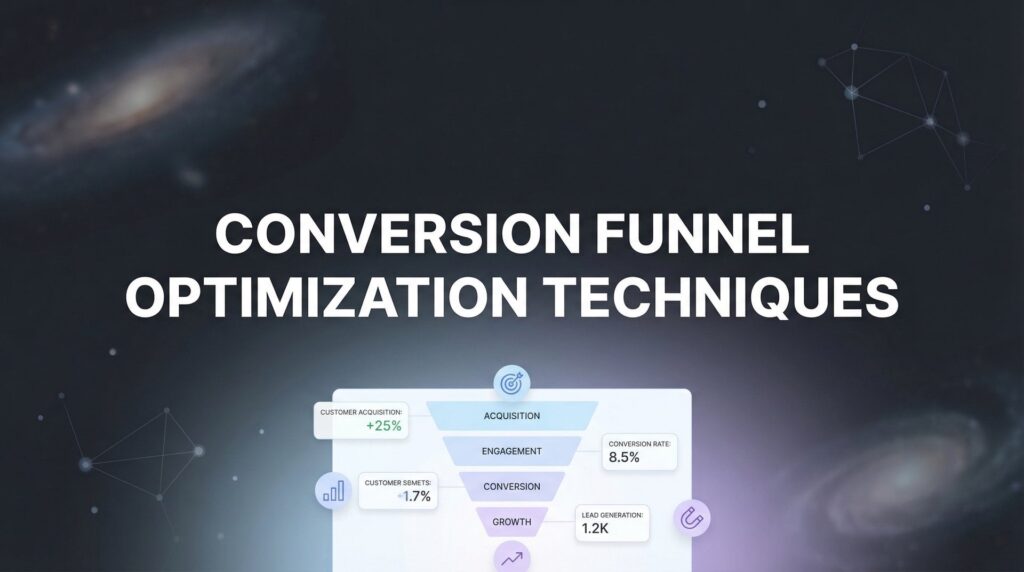
You’re spending money to drive traffic to your website. Google Ads, Facebook campaigns, maybe some SEO investment. Visitors are arriving—your analytics confirm it. But here’s the brutal reality: most businesses lose 96-98% of those visitors without a single conversion. They click, they look around, and they’re gone.
That’s not just frustrating. It’s expensive.
Every visitor who bounces represents wasted ad spend. Lost revenue. A potential customer who went to your competitor instead. When you’re paying $5, $10, or $50 per click in competitive markets, a leaky funnel doesn’t just hurt—it bleeds your marketing budget dry.
The good news? Small, strategic improvements at each stage of your conversion funnel compound into massive gains. Fix a 2% conversion rate issue at the top of your funnel, and that improvement multiplies through every subsequent stage. The businesses that understand this aren’t just getting better results—they’re turning the same traffic into 2x, 3x, even 5x more customers.
This guide delivers proven conversion funnel optimization techniques that local businesses and growth-focused companies can implement immediately. No theoretical frameworks. No invented case studies. Just actionable strategies grounded in behavioral psychology and established marketing principles that move the needle on your bottom line.
Let’s fix your funnel.
1. Map Your Funnel Leaks Before You Fix Anything
The Challenge It Solves
Most businesses approach conversion optimization backwards. They start tweaking button colors, rewriting headlines, or redesigning pages based on gut feelings or what worked for someone else. Meanwhile, their biggest conversion killers go unaddressed because nobody actually looked at the data to find where visitors are really dropping off.
You can’t fix what you can’t see. And guessing which funnel stage needs attention wastes time and money on improvements that don’t matter.
The Strategy Explained
Funnel mapping means using analytics to create a visual representation of your customer journey, then identifying exactly where visitors abandon that journey. You’re looking for the stages with the biggest drop-offs and the highest revenue impact.
Start by defining your funnel stages clearly. For most businesses, this looks something like: landing page view → product/service page → form start → form completion → thank you page. Set up goal tracking or event tracking in Google Analytics for each stage. Then calculate the conversion rate between each step.
Here’s where it gets interesting: a 50% drop-off between two stages isn’t necessarily your priority. If that stage only affects 100 visitors per month, fixing it might gain you 50 conversions. But a 20% drop-off affecting 10,000 visitors? That’s 2,000 lost conversions—a much bigger prize.
Prioritize fixes based on potential revenue impact, not just percentage drop-offs. Understanding how to optimize your conversion funnel starts with knowing exactly where your leaks exist.
Implementation Steps
1. Install Google Analytics 4 or your preferred analytics platform with proper event tracking for each funnel stage (not just pageviews—track button clicks, form interactions, and scroll depth).
2. Create a simple spreadsheet mapping each funnel stage, the number of visitors who reach it, the conversion rate to the next stage, and the calculated drop-off volume.
3. Calculate potential revenue impact by multiplying drop-off volume by your average customer value, then rank your funnel stages by this revenue opportunity number.
Pro Tips
Use heatmaps and session recordings to understand the “why” behind your drop-offs. Numbers tell you where people leave; recordings show you why. Look for rage clicks, confused scrolling patterns, and repeated form field interactions—these signal friction points worth investigating. Don’t just map your funnel once and forget it. Review monthly, because visitor behavior changes and new leaks develop as you modify your site.
2. Eliminate Top-of-Funnel Friction With Landing Page Alignment
The Challenge It Solves
Someone clicks your ad expecting one thing and lands on a page that looks completely different. The headline doesn’t match. The offer isn’t clear. The visual style shifts dramatically. Within three seconds, they’re confused—and confused visitors don’t convert. They bounce.
This disconnect between ad messaging and landing page experience is one of the most common—and most expensive—conversion killers. You’re paying for clicks that never had a chance of converting because you broke the visitor’s trust before they even started reading.
The Strategy Explained
Landing page alignment means creating message match and visual consistency between your traffic source and your landing page. When someone clicks an ad about “emergency plumbing repair in Austin,” your landing page headline should echo that exact phrase. The visual style should feel like a natural continuation of the ad they just clicked.
This principle extends beyond just headlines. Your landing page should deliver on the promise made in your ad without forcing visitors to search for what they came for. Every element should reduce cognitive load—the mental effort required to understand what you’re offering and what to do next.
The businesses that excel at this create dedicated landing pages for each major ad campaign or traffic source. Learning how to optimize landing pages for conversions is essential for maximizing your paid traffic investment.
Implementation Steps
1. Audit your current ads and their corresponding landing pages—write down the primary message/promise in each ad, then compare it to the landing page headline and opening copy.
2. Create message-matched landing pages that use the same language, keywords, and value propositions as your ads (if your ad says “Get a free quote in 24 hours,” your landing page headline should reference that 24-hour promise).
3. Simplify your landing page layout to a single clear path—remove navigation menus, minimize choices, and make your primary call-to-action the dominant visual element on the page.
Pro Tips
Test different levels of message match intensity. Sometimes an exact headline match works best; other times, a headline that builds on the ad’s promise (“Yes, we can repair your plumbing emergency in 24 hours—here’s how”) performs better. Use dynamic text replacement tools to automatically match landing page headlines to ad copy without building dozens of separate pages. And remember: alignment isn’t just about words—match the emotional tone too. If your ad creates urgency, your landing page should maintain that energy rather than shifting to a relaxed, browsing-friendly experience.
3. Deploy Strategic Exit-Intent Interventions
The Challenge It Solves
You’ve invested in getting visitors to your site. They’ve looked around, maybe read some content, but now they’re about to leave without converting. Once they close that browser tab, they’re probably gone forever—especially if they came from paid advertising. You need one more chance to capture their attention before they disappear.
The challenge is doing this without being obnoxious. Poorly executed exit-intent popups feel desperate and damage your brand. But strategic interventions, deployed at the right moment with the right offer, can recover a significant portion of abandoning visitors.
The Strategy Explained
Exit-intent technology detects when a visitor is about to leave your site (typically by tracking rapid upward mouse movement toward the browser’s close button). At that moment, you can display a targeted message designed to address the specific concern preventing conversion.
The key word is “strategic.” This isn’t about throwing a generic “Wait! Don’t go!” message at everyone. Effective exit-intent interventions are contextual. Someone abandoning a product page might need a discount code. Someone leaving a blog post might need a content upgrade. Someone who’s been on your pricing page for three minutes might need to speak with someone to answer questions.
Match your intervention to the visitor’s behavior and the stage of your funnel where they’re exiting. If you’re experiencing website traffic but no conversions, exit-intent strategies can help recover abandoning visitors.
Implementation Steps
1. Segment your exit-intent triggers by page type and visitor behavior—create different interventions for blog readers (offer related content downloads), product browsers (offer limited-time discounts), and form abandoners (offer to save their progress or get help).
2. Design your exit-intent popup to provide genuine value rather than manipulation—focus on solving the problem preventing conversion, whether that’s uncertainty, pricing concerns, or needing more information.
3. A/B test different offer types and messaging approaches—try educational content offers versus discount codes, question-focused headlines versus benefit-focused ones, and minimal designs versus more detailed explanations.
Pro Tips
Don’t trigger exit-intent popups immediately on page load or for visitors who just arrived. Set a minimum time threshold (at least 30 seconds) or engagement level (scrolled past 50% of the page). This ensures you’re only interrupting visitors who’ve actually engaged with your content. For mobile users, exit-intent is less reliable, so consider time-based or scroll-based triggers instead. And always, always include an easy way to dismiss the popup—respect is more valuable than a forced conversion.
4. Implement Progressive Trust Building Throughout the Funnel
The Challenge It Solves
Visitors don’t trust you yet. Why should they? They just arrived at your site, probably from an ad, and you’re asking them to hand over their email address, phone number, or credit card. That’s a big ask when they barely know who you are.
Many businesses try to overcome this with a single trust signal—maybe a testimonial or a security badge—placed randomly on their landing page. That’s not enough. Trust isn’t built with one element; it’s built progressively as visitors move through your funnel, with different types of credibility signals matching each stage of their decision-making process.
The Strategy Explained
Progressive trust building means strategically placing different types of social proof and credibility indicators at each funnel stage, matched to the specific concerns visitors have at that point in their journey.
Early in the funnel, visitors need social proof that you’re legitimate and that others have used your service. Customer logos, review counts, and years in business work well here. Mid-funnel, as they’re evaluating whether your solution fits their needs, they want to see that people like them got results. Specific testimonials with names, photos, and details become important. Late in the funnel, right before conversion, they need reassurance about the transaction itself—security badges, money-back guarantees, and clear policies reduce final hesitation.
Think of it as answering objections before they fully form. Understanding the customer acquisition funnel helps you place the right trust signals at each stage.
Implementation Steps
1. Map your funnel stages to visitor concerns—early stage equals “Is this company legitimate?”, mid-stage equals “Will this work for someone like me?”, late stage equals “Is this transaction safe and reversible if needed?”
2. Place appropriate trust signals at each stage—use aggregate social proof (review counts, customer numbers) on landing pages, detailed testimonials with specifics on product/service pages, and security/guarantee indicators near forms and checkout buttons.
3. Collect and display testimonials that address specific objections—ask customers what almost prevented them from buying, then showcase testimonials from others who overcame those exact concerns.
Pro Tips
Specificity makes testimonials dramatically more effective. “This company is great!” means nothing. “We were spending $15K/month on Google Ads with a 1.2% conversion rate. After working with them for 90 days, we’re at 3.8% with the same budget—that’s an extra $47K in monthly revenue” tells a story visitors can believe and relate to. Video testimonials outperform text when you have them, but authentic text with a real name and photo beats generic video. And don’t bury your best social proof—if you’ve got impressive credentials or results, make them prominent early in the funnel.
5. Optimize Your Forms for Maximum Completion
The Challenge It Solves
Your form is where good traffic goes to die. Visitors made it through your funnel, they’re interested enough to start filling out your contact form or checkout process, and then they abandon it. Maybe it’s too long. Maybe it’s asking for information too early. Maybe it just feels like too much work on a mobile device.
Form abandonment rates can exceed 80% for poorly designed forms. That means you’re losing eight out of ten people who were interested enough to start the conversion process. The revenue impact of form optimization often exceeds any other funnel improvement because you’re fixing leaks at the point of highest intent.
The Strategy Explained
Form optimization balances two competing priorities: collecting enough information to qualify leads properly while minimizing friction that causes abandonment. The solution isn’t always “make forms shorter”—sometimes longer forms actually improve conversion by pre-qualifying leads and increasing perceived value.
The key is strategic form design. Multi-step forms often outperform single-page forms because they reduce the perceived effort of starting. Smart defaults and auto-fill reduce typing. Clear progress indicators reduce uncertainty. Mobile-first design ensures forms work where most of your traffic actually completes them.
Every form field should justify its existence by answering this question: “Is the value of having this information worth the conversion rate decrease it causes?” If you’re struggling with low conversion rates, form optimization is often the highest-impact fix.
Implementation Steps
1. Audit your current forms by tracking completion rates for each field—identify where users abandon most frequently and question whether those fields are truly necessary at this stage.
2. Implement multi-step form design for forms with more than 4-5 fields—break them into logical sections (contact info, then project details, then preferences) with a clear progress indicator showing how many steps remain.
3. Optimize for mobile completion specifically—use appropriate input types (number pads for phone fields, email keyboards for email fields), make buttons large enough for thumb-tapping, and test your form on actual mobile devices, not just desktop browser simulators.
Pro Tips
The first field in your form has outsized importance—if it’s intimidating or unclear, people won’t even start. Begin with the easiest, least personal field (usually first name or email). Consider using inline validation that confirms correct input as users type, rather than waiting until they submit to show errors. And A/B test your form button text—”Get My Free Quote” often outperforms generic “Submit” because it reminds visitors of the value they’re receiving. For longer forms, consider adding a save-and-continue feature that emails users a link to finish later.
6. Create Urgency Without Manipulation
The Challenge It Solves
Visitors are interested. They might even be convinced your solution is right for them. But they’re not ready to commit right now. They’ll “think about it” or “come back later” or “discuss it with their team.” In reality, most of them never return. Every day of delay is another opportunity for them to forget about you, encounter a competitor, or simply lose the motivation to solve their problem.
You need urgency to push interested visitors toward action. But here’s the problem: most urgency tactics are transparent manipulations that erode trust. Fake countdown timers. False scarcity. “Only 2 spots left!” claims that reset every time you refresh the page. Visitors see through these tactics, and when they do, they question everything else you’ve told them.
The Strategy Explained
Legitimate urgency comes from real constraints—actual limited availability, genuine time-sensitive offers, or natural consequences of delaying action. The principle behind urgency is sound: people are more motivated to avoid loss than to pursue gain. But the execution must be authentic.
Seasonal promotions create real urgency because they genuinely end. Limited service capacity creates real urgency because you actually can’t take unlimited clients. Time-sensitive bonuses create real urgency when they’re truly temporary additions. The key is building urgency into your business model and offers rather than fabricating it with countdown timers that reset.
When you use real urgency, you can be transparent about why it exists—and that transparency builds trust rather than destroying it. This approach aligns with conversion focused marketing principles that prioritize long-term customer relationships.
Implementation Steps
1. Identify genuine constraints in your business—limited service slots, seasonal pricing changes, inventory levels, or upcoming price increases that are actually happening regardless of whether any individual customer converts.
2. Communicate the specific reason for urgency rather than just creating a deadline—instead of “Offer ends Friday!” explain “We’re raising prices March 1st to reflect increased costs, but existing customers before that date keep the current rate.”
3. Use urgency selectively for high-intent visitors rather than displaying it to everyone immediately—show urgency messages to visitors who’ve viewed multiple pages, returned multiple times, or spent significant time on your pricing page.
Pro Tips
Consequence-based urgency often works better than deadline-based urgency. Instead of “Buy now before this offer expires,” try “Schedule your consultation this week to launch before your busy season starts.” This shifts focus from your arbitrary deadline to their actual business need. For service businesses, transparent capacity communication works well: “We’re currently booking projects starting in April. To secure a March start date, we’d need to finalize scope by this Friday.” That’s real urgency based on actual constraints. And remember: once you set an urgency deadline, honor it. Nothing destroys credibility faster than extending “final deadlines” or bringing back “expired” offers.
7. Build a Systematic Funnel Testing Framework
The Challenge It Solves
You’ve implemented improvements. Some worked, some didn’t, and honestly, you’re not entirely sure which was which because you changed multiple things at once. Now you’re stuck—should you keep testing? What should you test next? How do you know if the results are real or just random fluctuation?
Random, unstructured testing wastes time and rarely produces compounding improvements. You need a systematic approach that prioritizes high-impact tests, properly measures results, and builds organizational knowledge about what actually moves your conversion rates.
The Strategy Explained
A systematic testing framework means establishing a repeatable process for identifying opportunities, prioritizing tests, running them properly, and learning from results. This isn’t about testing everything—it’s about testing the right things in the right order.
The ICE prioritization framework works well here: Impact (how much could this improve conversions?), Confidence (how sure are you it will work?), and Ease (how difficult is it to implement?). Score each potential test on these three factors, then tackle high-scoring opportunities first.
Proper testing means changing one variable at a time, running tests until you reach statistical significance, and documenting both wins and losses so you build institutional knowledge about what works for your specific audience and business. The best conversion rate optimization tools can help you run and analyze these tests effectively.
Implementation Steps
1. Create a testing backlog spreadsheet tracking potential tests with ICE scores—list the element you’d test, the hypothesis about why the change would improve conversions, and scores for Impact (1-10), Confidence (1-10), and Ease (1-10).
2. Establish minimum sample size requirements before declaring test winners—use a sample size calculator to determine how much traffic you need based on your current conversion rate and the minimum improvement you want to detect reliably.
3. Document every test with the hypothesis, implementation details, results, and key learnings—include screenshots of both variations and note any external factors that might have influenced results (seasonality, promotions, traffic source changes).
Pro Tips
Don’t stop tests too early just because you see a winner emerging. Conversion rates fluctuate, and early results often don’t hold up with more data. Run tests for at least one full business cycle (usually a week for B2C, possibly longer for B2B) to account for day-of-week variations. When a test loses, document why you think it failed—these lessons are often more valuable than wins because they prevent you from making similar mistakes. And remember that testing is never “done.” Markets change, competitors evolve, and visitor expectations shift. The businesses that consistently outperform their competitors are the ones that never stop systematically improving their funnels.
Putting It All Together
These seven conversion funnel optimization techniques aren’t theoretical concepts—they’re proven strategies that local businesses and growth-focused companies use to turn more traffic into actual revenue. The difference between companies that grow and companies that stagnate often comes down to how systematically they approach funnel optimization.
Here’s your implementation roadmap: Start with funnel mapping. You can’t fix what you can’t see, and mapping reveals your highest-impact opportunities. Once you know where your biggest leaks are, apply the relevant techniques from this guide. If top-of-funnel drop-offs are your issue, focus on landing page alignment. If you’re losing people at the decision stage, implement progressive trust building. If form abandonment is killing you, optimize those forms first.
The critical insight is this: conversion funnel optimization isn’t a one-time project. It’s an ongoing competitive advantage. Your competitors are either systematically improving their funnels or they’re not. If they’re not, you’ll steadily pull ahead as your improvements compound. If they are, you can’t afford to stand still.
Small improvements multiply through your funnel. A 10% improvement at the top of your funnel becomes a 10% improvement in every subsequent stage. Fix three stages by 10% each, and you’re not looking at 30% more conversions—you’re looking at 33% more conversions due to compounding effects. Over a year, systematic optimization can easily double or triple your conversion rates. Understanding website conversion rates and what’s achievable in your industry helps you set realistic improvement targets.
Start with your biggest leak. Apply these techniques systematically. Test, measure, and refine. Your funnel will never be perfect, but it can always be better than it was yesterday—and significantly better than your competitors’.
Tired of spending money on marketing that doesn’t produce real revenue? We build lead systems that turn traffic into qualified leads and measurable sales growth. If you want to see what this would look like for your business, we’ll walk you through how it works and break down what’s realistic in your market. No fluff. No invented case studies. Just honest assessment of what’s possible when you fix the leaks in your funnel and optimize for actual conversions that drive revenue growth.
Want More Leads for Your Business?
Most agencies chase clicks, impressions, and “traffic.” Clicks Geek builds lead systems. We uncover where prospects are dropping off, where your budget is being wasted, and which channels will actually produce ROI for your business, then we build and manage the strategy for you.