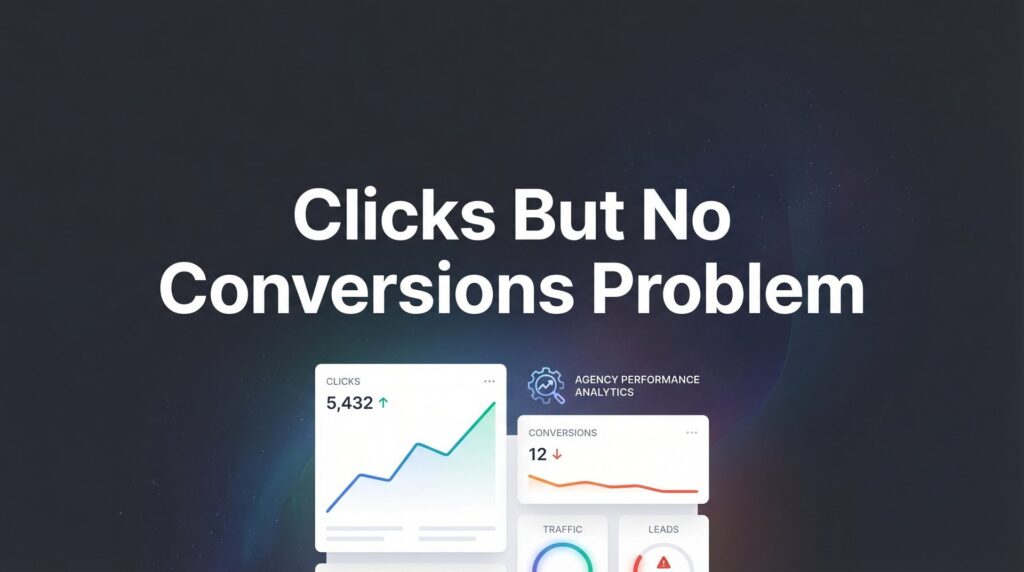
You check your ad account and see 247 clicks this week. Your heart lifts for a second—until you scroll to the conversions column. Zero. Again.
The budget keeps draining. The clicks keep coming. But your phone isn’t ringing, your calendar stays empty, and your revenue stays flat. You start wondering if Google Ads is broken, if Facebook is scamming you, if digital advertising even works anymore.
Here’s the hard truth: the platform isn’t the problem. The clicks but no conversions problem reveals something more fundamental—a disconnect somewhere between the person who clicks your ad and the action you need them to take. And while that sounds discouraging, it’s actually good news. Because unlike platform algorithms you can’t control, this problem has identifiable causes and concrete solutions.
Every click represents someone who saw your offer compelling enough to stop what they were doing and learn more. That’s real interest. Real potential. The gap between that click and a conversion isn’t some mysterious black box—it’s a series of specific, fixable issues in your marketing funnel. This article breaks down exactly how to diagnose what’s breaking your conversion path and implement the fixes that turn traffic into revenue.
The Disconnect Between Traffic and Revenue
When you’re getting clicks but no conversions, you’re experiencing what marketers call a “leaky funnel.” Traffic enters at the top, but it drains out before reaching the bottom where revenue happens. Understanding this dynamic changes how you approach the problem.
The clicks but no conversions problem isn’t actually about traffic volume. It’s about traffic quality meeting conversion readiness. You might have 500 visitors land on your page, but if they’re the wrong people arriving at the wrong time with the wrong expectations, conversion rates stay at zero no matter how many show up.
Think of it this way: there’s a massive difference between “curious clicks” and “qualified clicks.” Curious clicks come from people browsing, comparing, researching—they’re not ready to buy, hire, or commit. They might be students doing research, competitors checking you out, or people casually interested but three months away from making a decision. Qualified clicks come from people with active intent, real budget, and immediate need. They’re comparing final options, not just exploring possibilities.
Your job isn’t to get more clicks. It’s to get more qualified clicks, then remove every barrier preventing those qualified visitors from converting. That requires a systematic diagnostic approach, not random changes based on gut feeling.
We use a three-part framework to diagnose conversion problems: Audience, Message, and Destination. Are you reaching the right people? Are you telling them the right story? Are you sending them to the right place? When all three align, conversions happen naturally. When even one misaligns, you get the frustrating pattern of website traffic but no conversions.
The rest of this article walks through each component of that framework with specific diagnostic questions and actionable fixes. By the end, you’ll know exactly where your funnel is leaking and how to patch it.
Your Targeting Might Be Attracting the Wrong Crowd
Let’s start with the most common culprit: you’re paying for clicks from people who were never going to buy from you in the first place. This isn’t about the quality of your offer—it’s about showing that offer to the wrong audience.
Broad match keywords are a primary offender here. When you bid on “home renovation” using broad match, Google might show your ads for “DIY home renovation tips,” “home renovation TV shows,” or “home renovation cost calculator.” Those searchers aren’t looking for a contractor—they’re looking for information or entertainment. They click because your ad appeared, not because they’re ready to hire someone. You pay for the click, they bounce immediately, and your conversion rate suffers.
Geographic targeting creates similar problems, especially for local businesses. If you’re a plumber in Austin but your ads show to anyone in Texas, you’re paying for clicks from Houston residents who will never drive two hours for your services. Or worse, your location settings might include “people interested in Austin” rather than just “people in Austin,” which means you’re advertising to tourists planning a vacation.
Audience segmentation failures amplify these issues. Running the same ad to cold prospects who’ve never heard of you and warm leads who visited your site three times sends mixed signals. Cold traffic needs education and trust-building. Warm traffic needs a compelling reason to choose you now. One ad can’t effectively serve both.
Here’s how to tighten your targeting and improve click quality:
Switch to phrase match and exact match keywords: Instead of broad match “home renovation,” use phrase match “home renovation contractor” or exact match “[Austin home renovation contractor].” You’ll get fewer clicks, but dramatically higher intent.
Audit your search terms report weekly: This shows exactly what people typed before clicking your ad. You’ll discover irrelevant searches you’re paying for and can add them as negative keywords. If you’re a commercial HVAC company and you’re getting clicks for “residential AC repair,” add “residential” as a negative keyword.
Restrict geographic targeting to your actual service area: Use radius targeting around your location, not entire states or regions. Set it to “people in your targeted locations” not “people interested in your targeted locations.” This single change can cut wasted spend by 40% or more for local businesses.
Create separate campaigns for different audience temperatures: One campaign for people who’ve never heard of you, focused on education and brand building. Another for people who’ve visited your site, focused on conversion and urgency. Different audiences need different messages and different landing pages.
Use demographic exclusions strategically: If your service costs $5,000 minimum and you’re getting clicks from people in low-income brackets who can’t afford it, adjust your targeting. If you serve businesses but keep getting clicks from individual consumers, refine your audience settings. This is often the root cause of the low quality leads problem many businesses face.
The goal isn’t maximum traffic. It’s qualified traffic from people who match your ideal customer profile, have the budget for your solution, and are actively looking to make a decision soon. Every targeting refinement that reduces irrelevant clicks improves your conversion rate and your return on ad spend.
When Your Ad Promises Don’t Match Your Landing Page Reality
You’ve probably experienced this as a consumer: you click an ad promising “50% off all furniture,” land on a page with regular prices, and immediately hit the back button. That’s message mismatch, and it kills conversions faster than almost anything else.
Message mismatch happens when the story your ad tells doesn’t continue on your landing page. The visitor feels confused, misled, or uncertain—and confused visitors don’t convert. They leave.
Here’s what message mismatch looks like in practice. Your ad headline says “Same-Day HVAC Repair in Denver.” The visitor clicks, expecting fast emergency service. But your landing page headline says “Trusted HVAC Services Since 1987” with no mention of same-day service until three paragraphs down. The disconnect creates doubt. They wonder if you actually offer same-day service, or if the ad was misleading. Rather than dig through your page to find out, they click back and try the next result.
Or your ad promotes a free consultation, but your landing page’s main CTA says “Get a Quote.” Are those the same thing? The visitor isn’t sure. That moment of uncertainty is enough to prevent conversion. They don’t want to fill out a form if they’re not clear what happens next.
Visual consistency matters too. If your ad uses professional photography and clean modern design, but your landing page looks like it was built in 2003 with stock photos and clashing colors, visitors question your credibility. The aesthetic disconnect makes them wonder if they’ve landed on the right site, or if something seems off.
The offer itself must align perfectly. If your ad says “No credit card required” but your landing page form asks for payment information, trust evaporates instantly. If your ad emphasizes affordability but your landing page leads with premium pricing, you’ve attracted the wrong audience and set wrong expectations. Understanding how to improve ads starts with ensuring this alignment exists.
Here’s how to audit your campaigns for message match:
Map every ad to its landing page and check headline alignment: Your landing page headline should echo or directly continue the promise made in your ad. If the ad says “Get More Qualified Leads,” the landing page headline might say “We’ll Build You a Lead Generation System That Delivers Qualified Prospects.” The core message stays consistent.
Ensure your primary CTA uses the same language as your ad: If your ad says “Book Your Free Strategy Session,” your landing page button should say “Book My Free Strategy Session,” not “Contact Us” or “Learn More.” Exact language match removes friction.
Check that your landing page immediately addresses the specific promise from your ad: Don’t make visitors hunt for the thing that made them click. If your ad promotes a specific service, that service should be front and center on the landing page, not buried in a dropdown menu or three sections down.
Match visual style and tone: If your ads are professional and corporate, your landing page should be too. If your ads are casual and friendly, your landing page should match that energy. Consistency builds trust.
Verify that urgency and scarcity elements carry through: If your ad mentions a limited-time offer, your landing page needs to reinforce that urgency with a countdown timer, clear deadline, or inventory indicator. If the ad creates urgency but the page doesn’t, visitors assume they can come back later—and they rarely do.
Message match isn’t about being clever or creative. It’s about being consistent and clear. When visitors land on your page and immediately think “yes, this is exactly what I was looking for,” conversions happen naturally. When they land and feel even slight confusion or disconnect, they leave.
Landing Page Friction That Drives Visitors Away
You’ve attracted the right people with the right message. They land on your page ready to convert. Then something stops them. That something is friction—any element that makes taking action harder, slower, or more uncertain than it needs to be.
Technical friction kills conversions before visitors even see your offer. Page load speed is the most brutal example. Research consistently shows that visitors abandon pages that take longer than three seconds to load. If your landing page is packed with high-resolution images, unoptimized code, or heavy scripts, visitors are hitting the back button before your headline even renders.
Mobile optimization failures create massive friction for the majority of your traffic. If your page looks perfect on desktop but breaks on mobile—with tiny text, buttons too small to tap, forms that don’t resize properly—you’re losing conversions from every mobile visitor. And depending on your industry, mobile traffic might represent 60-80% of your total clicks.
Navigation and clarity issues create cognitive friction. When visitors land on your page, they should immediately understand what you’re offering, who it’s for, and what action to take next. If your page is cluttered with multiple CTAs pointing in different directions, if your value proposition is buried in paragraph text, if visitors have to scroll through five sections to find your contact form, you’re creating unnecessary decision fatigue.
Trust barriers represent another category of friction entirely. These are the psychological obstacles that make visitors hesitate even when they’re interested. Missing or unclear pricing makes people wonder if you’re hiding expensive costs. Lack of reviews or testimonials raises questions about whether anyone has actually used your service successfully. Weak or absent guarantees make the purchase feel risky. No visible contact information makes you seem less legitimate.
Form friction deserves special attention because it’s where many conversions die. Long forms asking for unnecessary information create abandonment. If you’re asking for company size, annual revenue, and detailed project specifications just to download a guide or schedule a call, you’re adding friction without gaining valuable information. Every field you add to a form reduces completion rates.
Here’s how to identify and eliminate friction from your landing pages:
Run a speed test on your landing page using Google PageSpeed Insights: Aim for load times under two seconds. Compress images, minimize code, remove unnecessary scripts. Speed improvements often deliver immediate conversion rate increases.
Test your page on actual mobile devices, not just desktop browser simulators: Check that all elements resize properly, buttons are easily tappable, forms work smoothly, and the page doesn’t require horizontal scrolling. Fix any mobile-specific issues immediately.
Conduct the “five-second test” with someone unfamiliar with your business: Show them your landing page for five seconds, then ask what the page offers and what action they should take. If they can’t answer clearly, your messaging and layout need simplification.
Add trust signals prominently: Include customer reviews, testimonials, case study snippets, certifications, and guarantees above the fold. Make it easy for visitors to verify you’re legitimate and trustworthy.
Reduce form fields to the absolute minimum: For most lead generation, you need name, email, and phone number. Everything else can be gathered later in the sales process. Every field you remove increases form completion rates.
Make your CTA button impossible to miss: Use contrasting colors, clear action-oriented text, and place it prominently without requiring scrolling. Test different button colors and text to find what drives the highest click-through rate. Professional landing page optimization services can help identify these friction points systematically.
Add a clear privacy statement near your form: Simple text like “We respect your privacy and never share your information” reduces form abandonment by addressing a common concern.
Friction isn’t always obvious to you because you know your business intimately. But to a first-time visitor making a split-second decision about whether to trust you with their information or money, every small obstacle matters. Eliminating friction is about removing every possible reason someone might hesitate or leave before converting.
The Conversion Rate Optimization Fixes That Actually Work
You’ve identified the problems. Now you need a systematic approach to fixing them and preventing future conversion leaks. This is where conversion rate optimization methodology separates businesses that continuously improve from those that make random changes and hope for results.
Start with proper tracking implementation. You can’t optimize what you can’t measure. Set up conversion tracking that captures every meaningful action: form submissions, phone calls, chat initiations, purchases. Install heat mapping tools like Hotjar or Microsoft Clarity to see exactly where visitors click, how far they scroll, and where they abandon your page. This data reveals problems you’d never spot just by looking at your page. If you’re struggling with this, our guide on fixing marketing conversion tracking walks through the entire process.
Analytics should show you the complete user journey. Where do visitors come from? Which pages do they view? How long do they stay? Where do they exit? When you can see that 70% of visitors abandon your page after viewing your pricing section, you know exactly where to focus your optimization efforts.
Prioritize fixes based on impact and effort. Use a simple framework: high-impact, low-effort changes first. Fixing a broken form that’s preventing submissions is high-impact and relatively low-effort—do it immediately. Redesigning your entire site is high-effort and uncertain impact—save it for later. Focus on quick wins that move your conversion rate while you plan larger improvements.
Here’s a prioritized action plan for most businesses facing the clicks but no conversions problem:
Week 1 – Technical Audit: Fix page speed issues, ensure mobile optimization, verify all forms and CTAs work properly across devices. These are table-stakes requirements that must work before anything else matters.
Week 2 – Message Match Review: Audit every ad-to-landing-page combination. Ensure headlines align, offers match, CTAs use consistent language. Create dedicated landing pages for your top-performing ad campaigns if you’re currently sending all traffic to your homepage.
Week 3 – Trust Signal Implementation: Add customer reviews, testimonials, case study snippets, certifications, and guarantees to your landing pages. Make it easy for visitors to verify you’re legitimate and capable.
Week 4 – Form Optimization: Reduce form fields to the minimum necessary. Test different form layouts, button colors, and CTA text. Implement progressive profiling if you need detailed information—collect basics first, gather more details later.
Once you’ve addressed obvious issues, implement a testing framework for continuous improvement. A/B testing lets you compare two versions of a page element to see which performs better. Test one variable at a time: headline variations, different CTA button colors, form placement above or below the fold, long-form versus short-form copy.
Run tests until you reach statistical significance—typically requiring at least 100 conversions per variation. Don’t stop a test early because one version is winning after three days. Let it run long enough to account for day-of-week variations, traffic source differences, and random fluctuations.
Document everything. Keep a testing log that records what you tested, the hypothesis behind it, the results, and what you learned. This creates institutional knowledge and prevents you from testing the same thing twice or forgetting what worked. Understanding marketing attribution models helps you accurately credit which changes actually drove improvements.
Build a regular optimization cadence. Review analytics weekly, identify new friction points monthly, run structured tests quarterly. Conversion rate optimization isn’t a one-time project—it’s an ongoing process of incremental improvement that compounds over time.
The businesses that consistently outperform competitors aren’t necessarily the ones with bigger budgets or better products. They’re the ones who systematically identify conversion barriers, test solutions, implement what works, and repeat the process continuously. Small improvements add up: a 5% increase in conversion rate means 5% more revenue from the same ad spend. Do that four times and you’ve increased revenue by 20% without spending another dollar on advertising.
Putting It All Together
The clicks but no conversions problem feels overwhelming when you’re in the middle of it. You’re spending money, seeing activity, but getting zero return. It’s natural to question whether digital advertising works at all.
But as we’ve covered throughout this article, the problem isn’t the platform or the concept of digital advertising. It’s specific, identifiable issues in your marketing funnel: targeting that brings unqualified traffic, message mismatch between ads and landing pages, or friction that prevents interested visitors from converting.
The diagnostic framework is straightforward. Check your Audience—are you attracting the right people with genuine intent and budget? Verify your Message—does your landing page continue the story your ad started? Examine your Destination—does your landing page make it easy and compelling to take action?
Most businesses discover their conversion problem stems from one or two primary issues, not everything at once. Maybe your targeting is solid but your landing page loads too slowly on mobile. Or your page is technically perfect but your ad promises don’t match your landing page content. Systematic diagnosis reveals where to focus your efforts for maximum impact.
For businesses with the time and expertise to tackle this themselves, the framework and action steps in this article provide a clear roadmap. Start with the technical fundamentals, ensure message consistency, eliminate obvious friction, then build a testing process for continuous improvement.
But here’s the reality: conversion rate optimization requires specialized expertise, dedicated time, and ongoing attention. If you’re running a business, you’re already stretched thin managing operations, serving customers, and handling the hundred other demands on your time. Optimizing landing pages, running statistical tests, and analyzing user behavior might not be the highest-value use of your hours.
That’s where professional CRO expertise makes sense. When you work with specialists who diagnose conversion problems daily, you get faster results with less trial and error. You avoid common mistakes that waste time and budget. You implement proven strategies rather than guessing what might work.
Every click represents real money you’ve spent and real potential revenue sitting on the table. The gap between traffic and conversions isn’t a mystery—it’s a solvable problem with systematic diagnosis and targeted fixes. Whether you tackle it yourself or bring in expert help, solving your conversion problem transforms your advertising from an expense that drains budget into an investment that generates predictable, profitable growth.
Diagnose before you fix, so you are not paying to test changes that miss the real cause. Close your conversion gap with our team. We will start where the data points.