You’ve just spent $3,000 on Google Ads this month. Your landing page got 2,847 visitors. Exactly 43 of them converted. You know something’s broken, so you reach out to three different agencies for help. One quotes you $750. Another says $4,500. The third comes back with $12,000. Same problem. Wildly different prices. No clear explanation of what you’re actually getting.
This is the reality for most local business owners exploring landing page optimization. The pricing landscape feels like the Wild West—chaotic, confusing, and designed to make you second-guess every decision.
Here’s what makes this particularly frustrating: you’re not looking for the cheapest option. You’re willing to invest real money if it delivers real results. But how do you evaluate a landing page optimization quote when you don’t know what “good” looks like? How do you separate legitimate expertise from expensive guesswork?
Understanding what actually goes into a professional CRO quote changes everything. It transforms you from someone who’s choosing based on gut feeling or lowest price into someone who can evaluate proposals intelligently, ask the right questions, and invest in optimization that genuinely moves your conversion numbers. This guide breaks down exactly what you should expect, what you should pay, and how to spot the providers who will actually deliver results worth paying for.
What You’re Actually Paying For in a Professional CRO Quote
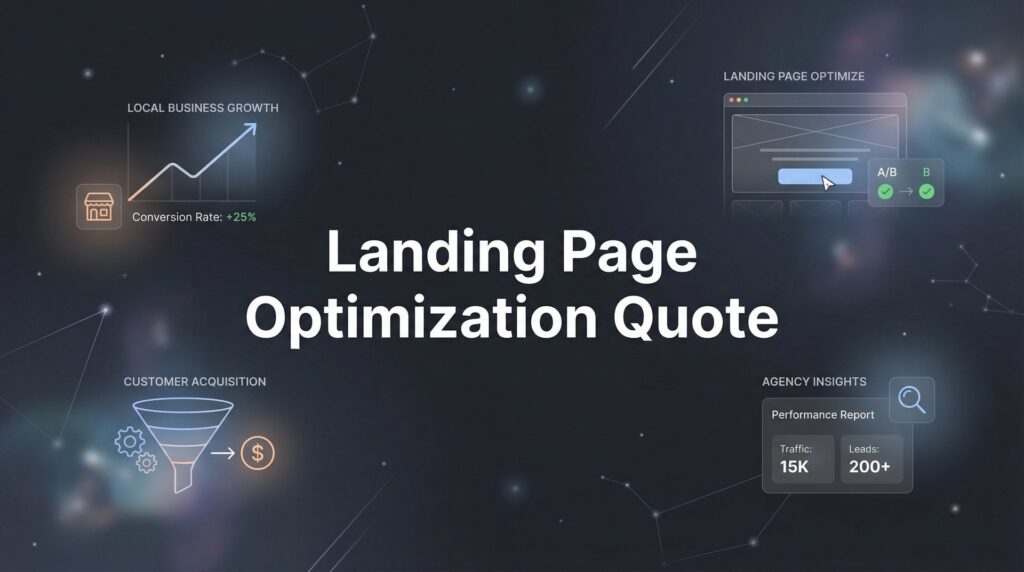
When you receive a landing page optimization quote, you’re not just paying for someone to change your headline and move a button. Professional conversion rate optimization involves distinct phases, each requiring specific expertise and time investment.
The discovery and audit phase forms the foundation of legitimate optimization work. This is where a provider digs into your current performance data, installs tracking tools if needed, and identifies exactly where visitors are dropping off. They’re analyzing heatmaps to see where people click and scroll. They’re watching session recordings to understand user behavior patterns. They’re examining your analytics to pinpoint conversion bottlenecks.
Think of it like a doctor running diagnostic tests before prescribing treatment. A provider who skips this phase is essentially guessing at solutions without understanding the actual problem.
This discovery work typically takes 5-15 hours depending on your page complexity and existing data infrastructure. If your quote doesn’t explicitly mention this audit phase, that’s your first warning sign.
Next comes strategy development and testing roadmap creation. This is where hypothesis-driven optimization separates from random changes. A professional provider builds specific, testable hypotheses based on audit findings: “We believe changing the value proposition headline will increase conversions because heatmap data shows 67% of visitors never scroll past the fold.”
They prioritize which tests to run first using frameworks like ICE scoring (Impact, Confidence, Ease) or PIE (Potential, Importance, Ease). They develop A/B testing plans with clear success metrics and statistical significance requirements. They map out a 30-90 day optimization roadmap showing which elements get tested when and why.
This strategic work is what transforms optimization from cosmetic tweaks into systematic improvement. It typically represents 8-20 hours of strategist time in a comprehensive quote.
The implementation and ongoing optimization phase is where strategy becomes reality. This includes designing variation pages, writing conversion-focused copy, making technical changes, setting up A/B tests in your testing platform, and monitoring results as data accumulates.
Here’s what many business owners don’t realize: legitimate optimization is iterative, not one-and-done. Initial tests inform subsequent tests. Winning variations become new control pages that get tested against new variations. This cycle continues because optimization compounds over time.
Professional quotes account for multiple testing cycles, not just a single round of changes. Implementation typically requires 15-40 hours depending on page complexity and number of tests included.
The reporting and analysis component often gets overlooked but proves crucial. You need regular updates showing test results, statistical significance, and recommended next steps. Professional providers build in weekly or bi-weekly reporting calls, detailed analytics dashboards, and clear documentation of what’s working and what isn’t.
When you understand these components, you can evaluate whether a quote includes actual optimization or just surface-level changes. A legitimate landing page optimization quote breaks down these phases explicitly, showing you exactly what work happens when and who’s responsible for each component.
Understanding What Different Price Points Actually Buy You
Landing page optimization quotes cluster into three distinct tiers, each delivering fundamentally different value and results. Understanding what each tier actually provides helps you match your budget to realistic expectations.
Budget-tier quotes ($500-$2,000) typically offer template-based recommendations or one-time audits. You’re getting someone to review your page, point out obvious problems, and suggest generic fixes based on best practices. The work product is usually a PDF report or spreadsheet listing issues like “Add trust badges” or “Shorten your form.”
What you’re not getting: custom strategy based on your specific data, actual implementation of changes, A/B testing to validate improvements, or ongoing optimization cycles. You receive recommendations, then you’re responsible for figuring out how to implement them and whether they actually work.
This tier works if you have in-house design and development resources who can execute the recommendations and run tests internally. It fails if you’re expecting the provider to actually improve your conversions—they’re just identifying opportunities, not delivering results.
Many business owners choose budget-tier quotes hoping to save money, then discover they’ve paid for advice they can’t implement or that doesn’t move their numbers. The apparent savings evaporate when you factor in the time and additional costs required to turn recommendations into actual improvements.
Mid-range quotes ($2,000-$7,000) represent the sweet spot for most local businesses. You’re getting custom strategy development based on your specific data, conversion-focused copywriting, design of test variations, implementation of changes, and actual A/B testing over a 30-90 day optimization window.
A typical mid-range engagement includes the full discovery audit, development of 3-5 prioritized hypotheses, design and copywriting for test variations, setup and monitoring of A/B tests, bi-weekly reporting, and recommendations for next optimization phase based on results.
The key difference from budget tier: you’re paying for results, not just recommendations. The provider handles implementation and validates improvements through actual testing. You see which changes increase conversions and which don’t, backed by real data from your traffic.
This tier typically involves 40-80 total hours of work from strategists, copywriters, designers, and analysts. The timeline spans 6-12 weeks to allow for proper test duration and statistical significance.
For a local business generating 1,000-5,000 monthly landing page visitors, mid-range optimization delivers the best ROI. You’re getting professional execution without paying for enterprise-level infrastructure you don’t need.
Premium quotes ($7,000+) deliver comprehensive CRO programs with dedicated strategists, advanced analytics implementation, multivariate testing, personalization engines, and often performance-based pricing models. You’re working with specialized conversion rate optimization agencies who handle everything from technical implementation to ongoing program management.
Premium engagements typically include custom analytics dashboards, integration with your CRM and marketing automation, advanced segmentation and personalization, continuous testing programs running multiple experiments simultaneously, and dedicated account teams providing strategic guidance.
This tier makes sense for businesses with substantial traffic volume (10,000+ monthly visitors), high customer lifetime values where small conversion improvements generate significant revenue, or complex sales funnels requiring sophisticated optimization across multiple touchpoints.
The mistake many local businesses make is assuming premium pricing automatically delivers premium results. If you’re generating 2,000 monthly visitors, a $15,000 optimization program can’t generate enough incremental conversions to justify the investment, regardless of how sophisticated the approach. Premium tier works when your traffic volume and customer economics support the investment math.
Understanding these tiers helps you evaluate whether a quote matches your actual business situation. A $1,200 quote promising “guaranteed 50% conversion increase” is fantasy. A $5,000 quote delivering custom strategy, implementation, and validated testing over 90 days represents legitimate professional work. A $20,000 quote for a page getting 1,500 monthly visitors is overkill unless your average customer value is exceptionally high.
Warning Signs That Should Make You Walk Away
Certain red flags in a landing page optimization quote signal providers who either don’t understand legitimate CRO or are intentionally misleading you. Spotting these warnings protects you from wasting money on work that won’t deliver results.
Vague deliverables represent the most common red flag. If a quote lists “landing page optimization” or “conversion improvements” without specifying exactly what work gets done, you’re looking at a provider who either doesn’t know what they’re doing or doesn’t want you to realize how little you’re getting.
Legitimate quotes break down deliverables precisely: “Discovery audit including heatmap analysis of 100+ sessions, analytics review of 90-day conversion funnel, and competitive analysis of 5 direct competitors. Strategy development including 3-5 prioritized test hypotheses with expected impact estimates. Implementation of 3 A/B tests over 60-day period with bi-weekly reporting.”
When deliverables stay vague, you have no way to hold the provider accountable or evaluate whether you received what you paid for. This vagueness usually masks inadequate work.
Guaranteed conversion percentages without seeing your data represent another massive red flag. Any provider promising “we’ll increase your conversions by 40%” before analyzing your current performance, traffic quality, or page elements is selling fantasy, not professional services.
Here’s why this matters: legitimate CRO involves testing hypotheses that sometimes fail. Professional providers might say “based on similar clients, we typically see 15-35% conversion improvements over 90 days” as context, but they won’t guarantee specific numbers because too many variables affect outcomes.
A provider guaranteeing results either plans to manipulate metrics to show false improvements (like counting different actions as conversions), will blame you when they don’t deliver (“your traffic quality was the problem”), or is simply lying to close the sale.
No mention of testing methodology or statistical significance requirements signals a provider who doesn’t understand how legitimate optimization works. If a quote doesn’t explain how they’ll validate improvements—what testing platform they use, how long tests will run, what confidence levels they require before declaring winners—they’re probably just making changes and hoping something works.
Professional CRO requires running tests until reaching statistical significance, typically 95% confidence with adequate sample size. This takes time. A quote promising results in 2 weeks with 500 monthly visitors isn’t based in mathematical reality.
Absence of ongoing measurement and iterative optimization indicates one-and-done thinking that contradicts how conversion optimization actually works. If the quote describes a single round of changes with no plan for continued testing, you’re not getting optimization—you’re getting a redesign with fingers crossed.
Real optimization compounds through multiple testing cycles. Initial tests inform subsequent tests. Winning variations become new controls that get tested against new variations. A quote should outline this iterative approach, not present optimization as a one-time fix.
Another warning sign: no questions about your business model, customer journey, or current conversion tracking setup. Professional providers ask detailed questions before quoting because optimization strategy depends on understanding your specific situation. A provider who quotes without asking questions is using a template approach that won’t address your actual conversion barriers.
Finally, watch for quotes that ignore implementation logistics. Who handles the actual design changes? Who writes new copy? Who sets up the A/B tests? If these responsibilities aren’t clearly defined, you might discover you’re paying for recommendations you can’t execute without hiring additional resources.
The Questions That Separate Professional Providers From Pretenders
Asking the right questions before signing any optimization agreement reveals whether a provider can actually deliver results or is just good at selling services. These questions force specificity that exposes competence or lack thereof.
Start with: “What specific metrics will you track, and how will you attribute improvements to your work?” This question matters because conversion optimization success depends on measuring the right things correctly. A professional provider will explain exactly which metrics they’ll track (conversion rate, revenue per visitor, form completion rate, etc.), how they’ll isolate the impact of their changes from other factors, and what reporting you’ll receive.
Weak answers sound like: “We’ll track conversions and make sure they go up.” Strong answers include: “We’ll track primary conversion rate, micro-conversions like email signups and phone clicks, time on page, and scroll depth. We’ll use Google Optimize for A/B testing with 95% confidence requirements and minimum 2-week test durations. You’ll receive bi-weekly reports showing test results, statistical significance, and recommended next steps.”
Next question: “How many tests are included, what’s the testing timeline, and what happens if initial tests don’t perform?” This reveals whether the provider understands that optimization involves iteration and some tests fail. Professional providers build in multiple testing cycles and explain that optimization is a process, not a single magic fix.
Red flag answers: “We guarantee our first changes will improve conversions” or vague responses about “ongoing optimization.” Solid answers specify: “The engagement includes 3-5 A/B tests over 90 days. Based on your traffic volume, each test needs to run 2-3 weeks to reach statistical significance. If a test underperforms, we analyze why, develop a new hypothesis, and run another test. The goal is finding what works through systematic experimentation.”
Ask: “Who handles implementation—do I need a developer, or is that included?” This clarifies a common source of frustration where business owners discover they’ve paid for recommendations they can’t implement without additional costs. Professional providers either handle implementation themselves or clearly specify what technical resources you need to provide.
Strong answers detail: “We handle all design and copywriting changes. For technical implementation, we’ll need access to your website CMS or a developer who can implement our designs. We provide detailed specifications and work directly with your developer to ensure correct implementation.” Or: “Implementation is included. We’ll make all changes directly in your Unbounce/WordPress/Webflow account.”
Another crucial question: “Can you show me a case study from a business similar to mine in size and industry?” This tests whether the provider has relevant experience. Generic case studies from Fortune 500 companies don’t indicate they can help your local business. You want to see results from businesses with similar traffic volumes, customer economics, and market contexts.
Professional providers will share specific examples: “We worked with a local HVAC company getting about 2,000 monthly visitors. Over 90 days, we tested headline variations, simplified their form, and added service-area-specific trust elements. Conversion rate increased from 2.1% to 3.4%, generating 26 additional leads monthly.”
Ask: “What happens if we’re not seeing results after the first testing cycle?” This reveals the provider’s confidence and accountability. Professional providers have clear answers because they’ve navigated this situation before. They’ll explain their process for diagnosing issues, adjusting strategy, and determining whether the problem is optimization approach, traffic quality, or other factors.
Weak answers deflect responsibility: “That won’t happen” or “It means your traffic isn’t qualified.” Strong answers acknowledge reality: “If initial tests don’t perform, we analyze the data to understand why. Sometimes hypotheses don’t validate. We’ll review traffic sources, user behavior patterns, and competitive factors, then develop new hypotheses based on learnings. Optimization is iterative—early tests inform better later tests.”
Finally, ask: “What’s included in ongoing support after initial changes?” This clarifies whether you’re buying a one-time project or a partnership. Professional optimization includes post-implementation monitoring, analysis of results, and recommendations for next optimization phase. You want to understand what support you get and for how long.
These questions transform vague proposals into specific commitments. A provider who can’t answer them clearly either lacks experience or is intentionally keeping things vague to avoid accountability. The answers you receive tell you everything you need to know about whether this provider will actually improve your conversions or waste your money.
Why Landing Page Optimization Pays for Itself (When Done Right)
Understanding the actual ROI math of landing page optimization transforms how you evaluate quotes. Most business owners focus on the cost without calculating the value of improvements, leading to decisions that save money upfront but cost significantly more in lost opportunities.
Let’s work through realistic numbers. Your landing page currently gets 1,000 visitors monthly with a 2% conversion rate. That’s 20 conversions per month. You’re spending $2,000 monthly on ads to generate that traffic, meaning each conversion costs you $100.
Professional optimization increases your landing page conversion rate to 3.5%—a modest improvement that’s achievable through systematic testing. Now you’re getting 35 conversions from the same 1,000 visitors. Your cost per conversion drops to $57. You’ve added 15 conversions monthly without spending an additional dollar on advertising.
If your average customer value is $500, those 15 additional conversions generate $7,500 in additional monthly revenue. Over a year, that’s $90,000 in incremental revenue from the same ad spend. A $4,000 optimization investment pays for itself in the first month and continues delivering value every subsequent month.
This math explains why professional optimization represents investment, not expense. The question isn’t whether you can afford optimization—it’s whether you can afford to keep running poorly converting pages that waste your advertising dollars.
Customer lifetime value amplifies these returns significantly. If your average customer generates $2,000 in lifetime value rather than $500 in initial purchase, those 15 additional monthly conversions represent $30,000 in lifetime value added each month. The optimization ROI becomes dramatic.
Consider the opportunity cost of delaying optimization. Every month you run an underperforming landing page, you’re losing the conversions you could have captured. If optimization would add 15 conversions monthly, delaying for six months costs you 90 conversions—$45,000 in revenue at $500 per customer, or $180,000 in lifetime value at $2,000 per customer.
Suddenly, a $5,000 optimization investment looks inexpensive compared to six months of lost revenue while you procrastinate or try to handle it yourself without proper expertise.
The compounding effect of optimization creates additional value over time. Initial improvements become the new baseline for subsequent testing. A page that goes from 2% to 3.5% conversion rate might reach 4.2% after another testing cycle, then 5.1% after a third cycle. Each improvement builds on previous gains.
Compare this to the cost of generating more traffic. If you’re currently spending $2,000 monthly on ads to generate 1,000 visitors at 2% conversion (20 conversions), you’d need to spend $3,500 monthly to generate 1,750 visitors to get the same 35 conversions that optimization delivers by improving conversion rate to 3.5%.
Optimization gives you 35 conversions for $2,000 in ad spend. More traffic gives you 35 conversions for $3,500 in ad spend. Over a year, optimization saves you $18,000 in advertising costs while delivering the same conversion volume. The $4,000 optimization investment pays for itself in less than three months through reduced advertising costs alone.
This calculation framework helps you evaluate any landing page optimization quote intelligently. Take the quoted price, divide by your average customer value, and determine how many additional conversions the optimization needs to generate to break even. If that number is realistic given your traffic volume and current conversion rate, the investment makes mathematical sense.
For example: $5,000 quote with $400 average customer value means you need 12.5 additional conversions to break even. If you’re getting 1,000 monthly visitors at 2% conversion, improving to 3.25% gives you those 12.5 additional conversions in a single month. Every conversion after that is pure profit.
The ROI math usually works strongly in favor of professional optimization, which is why the real question isn’t “Can I afford this?” but rather “Can I afford not to do this?” Every day with a poorly converting page costs you money.
Choosing Your Optimization Partner With Confidence
You’ve reviewed multiple landing page optimization quotes. You understand what you’re paying for, what different price points deliver, and what questions to ask. Now comes the final decision: which provider gets your business and your trust?
Compare quotes based on scope, expertise, and alignment with your specific business goals—not just price. The cheapest quote rarely delivers the best value, and the most expensive doesn’t guarantee superior results. Focus on which provider demonstrates the clearest understanding of your conversion challenges and presents the most credible plan for addressing them.
Look for providers who asked detailed questions about your business before quoting. They should understand your customer journey, traffic sources, current conversion tracking setup, and business model. Quotes based on generic templates rather than your specific situation indicate providers who will deliver generic solutions.
Evaluate the testing methodology each provider proposes. Do they explain how they’ll validate improvements? Do they specify confidence levels and test durations? Do they acknowledge that some tests might not perform and explain how they’ll iterate? Professional providers demonstrate sophisticated understanding of experimentation methodology, not just design aesthetics.
Request case studies or references from businesses similar to yours in size and industry. A provider who’s successfully optimized landing pages for businesses like yours brings relevant experience that translates to better results. Generic case studies from completely different business contexts don’t indicate they can help your specific situation.
Pay attention to how providers discuss timelines and results. Professional providers explain that optimization takes time to generate statistically significant results. They discuss realistic improvement ranges based on similar clients rather than guaranteeing specific percentages. They acknowledge that optimization is iterative, not instantaneous.
Providers promising dramatic results in unrealistic timeframes are either inexperienced or dishonest. Both scenarios waste your money.
Consider starting with a defined pilot project before committing to long-term retainers. Many professional providers offer initial 60-90 day engagements that deliver tangible results while letting you evaluate the working relationship. This approach reduces risk while giving you evidence of the provider’s capabilities before making larger commitments.
A pilot project might include discovery audit, development of 2-3 prioritized hypotheses, implementation and testing of those hypotheses, and detailed reporting of results with recommendations for next phase. You invest a manageable amount, see actual results, and decide whether to continue based on demonstrated performance rather than promises.
Evaluate the provider’s communication style and responsiveness during the quoting process. How they interact before you’re a client predicts how they’ll interact after. Providers who are slow to respond, vague in their answers, or pushy in their sales approach will likely continue those behaviors during the engagement.
Professional providers are responsive, clear, and consultative rather than pushy. They educate you about optimization rather than just trying to close the sale. They acknowledge when something isn’t a good fit rather than overselling their capabilities.
Review the contract terms carefully. What exactly is included? What are the deliverables and timeline? What happens if you’re not satisfied with results? How is the engagement structured—fixed project, monthly retainer, or performance-based? Understanding these details prevents misunderstandings and disappointment later.
Trust your instincts about cultural fit. You’ll be working closely with this provider, sharing access to your website and analytics, and implementing their recommendations. Choose a provider you feel comfortable communicating with openly. Chemistry matters.
The right landing page optimization partner brings expertise you don’t have in-house, delivers measurable improvements to your conversion rate, and operates transparently so you understand exactly what’s happening and why. When you find a provider who demonstrates these qualities, the investment in professional optimization becomes one of the highest-ROI decisions you can make for your business.
Putting It All Together
Landing page optimization quotes vary wildly because the quality of work varies wildly. Now you understand what separates legitimate professional optimization from expensive guesswork or cheap templates that don’t deliver results.
A professional landing page optimization quote includes discovery and audit work to understand your current performance, strategic development of testable hypotheses based on data, implementation of changes and A/B tests, and ongoing measurement to validate improvements. These components require real expertise and time, which is why legitimate optimization costs thousands of dollars, not hundreds.
Budget-tier quotes deliver recommendations without implementation or testing. Mid-range quotes deliver custom strategy, implementation, and validated testing over 60-90 days—the sweet spot for most local businesses. Premium quotes deliver comprehensive programs that make sense only for high-traffic, high-value situations.
Red flags like vague deliverables, guaranteed conversion percentages, and absence of testing methodology signal providers to avoid. The right questions about metrics, testing approach, implementation logistics, and case studies reveal whether a provider can actually deliver results.
The ROI math of professional optimization typically works strongly in your favor. Small conversion improvements generate significant additional revenue without additional advertising costs. The question isn’t whether you can afford optimization—it’s whether you can afford to keep running poorly converting pages that waste your marketing budget.
Choose your optimization partner based on scope, expertise, and alignment with your goals rather than price alone. Start with a pilot project to evaluate the working relationship before making long-term commitments. Focus on providers who demonstrate clear understanding of your specific situation and present credible plans for addressing your conversion challenges.
Every day you delay optimization, you’re losing conversions and revenue you could be capturing. The best time to optimize was six months ago. The second best time is right now.
Tired of spending money on marketing that doesn’t produce real revenue? We build lead systems that turn traffic into qualified leads and measurable sales growth. If you want to see what this would look like for your business, we’ll walk you through how it works and break down what’s realistic in your market.
Want More Leads for Your Business?
Most agencies chase clicks, impressions, and “traffic.” Clicks Geek builds lead systems. We uncover where prospects are dropping off, where your budget is being wasted, and which channels will actually produce ROI for your business, then we build and manage the strategy for you.