You’ve tried Facebook ads. You’ve boosted posts. You’ve spent money on Google. Maybe you even hired someone to “do your SEO.” And yet, the phone isn’t ringing like it should. Meanwhile, your competitor down the street seems to have customers lined up out the door, and you can’t figure out what they’re doing that you’re not.
Here’s the uncomfortable truth: customer acquisition for local businesses in 2026 is harder than it’s ever been. Ad costs keep climbing. Google’s algorithm changes every few months. And consumers? They’ve become research ninjas who check five reviews, compare three competitors, and scroll past your ad without a second thought.
This isn’t about working harder or spending more. It’s about understanding exactly what’s blocking your growth so you can fix the right problems instead of throwing money at symptoms. Let’s break down the real challenges keeping local businesses from acquiring customers—and what actually works to overcome them.
Why Your Business Is Invisible When It Matters Most
Think about the last time you needed a plumber, a lawyer, or a restaurant recommendation. You probably grabbed your phone and typed something into Google. You didn’t scroll to page two. You barely looked past the top three results. And if a business didn’t have good reviews or a complete profile? You kept scrolling.
That’s exactly what’s happening to your potential customers right now—except they’re scrolling past you.
Local search has become a battlefield. You’re not just competing with the business across town anymore. You’re competing with national chains that have entire teams optimizing their presence. You’re competing with aggregator sites like Yelp and Angie’s List that somehow rank above actual service providers. You’re competing with franchises that have corporate marketing budgets and consistent branding across every touchpoint.
Many local businesses think they’ve solved this problem because they have a website and a Google Business Profile. But there’s a massive gap between “being online” and “being findable.” Your business name might be listed somewhere on Google, but are you showing up when someone searches for “emergency plumber near me” at 11 PM? Are you visible when someone types “best Italian restaurant downtown”? If you’re not getting customers online, visibility is often the first place to investigate.
Here’s where most local businesses trip up: inconsistent business information across the web. Your address is slightly different on Yelp than it is on Facebook. Your phone number on your website doesn’t match what’s listed on Google. Your hours are outdated on Apple Maps. These inconsistencies don’t just confuse customers—they actively hurt your visibility because search engines can’t trust your information.
Then there’s your Google Business Profile itself. Most local businesses treat it like a digital business card: fill it out once and forget about it. But Google rewards businesses that actively maintain their profiles. Regular posts, responding to reviews, uploading photos, updating services—these signals tell Google your business is active and relevant. When you neglect your profile, you’re essentially telling the algorithm to show your competitors instead.
The businesses winning local search in 2026 aren’t necessarily the biggest or the oldest. They’re the ones who understand that visibility is an active process, not a one-time setup. They’re consistent with their information, they engage with their profiles, and they’ve claimed every listing that matters in their market.
When Your Marketing Budget Feels Like Throwing Money Into a Black Hole
Let’s talk about money. Specifically, why it feels like you need a Fortune 500 budget to compete for customers anymore.
If you’ve run Google Ads or Facebook campaigns in the past few years, you’ve probably noticed something frustrating: you’re paying more for the same results. Or worse, paying more for fewer results. This isn’t your imagination. Competition for ad space in profitable local markets has intensified dramatically. When three HVAC companies, two national franchises, and an aggregator site are all bidding on “AC repair near me,” the cost per click climbs fast.
Many local business owners respond to rising costs by trying to do everything themselves. The logic makes sense: if professional marketing is expensive, why not learn it yourself? You watch YouTube videos about Facebook ads. You read blog posts about SEO. You spend your evenings and weekends trying to figure out why your campaign isn’t working.
This is the DIY marketing trap, and it’s more expensive than it looks. Not because you can’t learn marketing—you absolutely can—but because your time has value. Every hour you spend fumbling through ad settings is an hour you’re not serving customers, managing your team, or working on your actual business. The opportunity cost adds up fast, and the results often don’t justify the investment of time.
But here’s what shifts the entire conversation: understanding what customer acquisition cost actually means and how it compares to what a customer is worth to your business over time.
Most local businesses focus obsessively on lowering their cost per click or cost per lead. They celebrate when they get their CPC down from $8 to $6. But they’re optimizing the wrong metric. What actually matters is cost per acquisition compared to customer lifetime value. If you spend $200 to acquire a customer who brings you $2,000 in revenue over the next two years, that’s a fantastic investment. If you spend $50 to acquire someone who never actually buys, that’s money wasted.
The businesses that succeed with limited budgets aren’t trying to compete everywhere. They’re not running campaigns on five platforms simultaneously. They’re identifying the one or two channels where their ideal customers actually spend time, and they’re going deep on those channels with focused, well-optimized campaigns.
They’re also tracking everything. They know exactly which marketing efforts produce actual customers and which ones just produce activity. This clarity allows them to double down on what works and cut what doesn’t—something impossible when you’re just hoping your marketing is working.
The Trust Gap That’s Costing You Customers You’ll Never Know About
Here’s a scenario that happens dozens of times every day in your market: someone searches for your type of business, clicks on your listing, looks at your reviews, checks your website, and then… chooses your competitor. You never even knew they were considering you.
Modern consumers don’t just research before buying—they research obsessively. They’re reading reviews on Google, checking your Facebook page for recent activity, looking at your Instagram to see if you’re still in business, and comparing you against three other options before they ever pick up the phone.
This creates a massive vulnerability for local businesses: the trust gap. You might be excellent at what you do. Your existing customers might love you. But if your online presence doesn’t communicate trustworthiness, you’re losing potential customers before they ever give you a chance to prove yourself.
One bad review can derail your acquisition efforts for weeks. Not because that single review defines your business, but because of how consumers process information. When someone sees a one-star review complaining about poor service, they don’t think “well, maybe that customer was unreasonable.” They think “I’d better find someone else.” The negativity bias is real, and it’s powerful. That’s why having a strategy for managing online customer reviews is essential for any local business.
What’s worse is that many local businesses have no proactive reputation strategy. They only think about reviews when they get a bad one. They’re not actively encouraging happy customers to share their experiences. They’re not responding to reviews—good or bad—to show they care about feedback. They’re leaving their reputation to chance, and chance is not a good marketing strategy.
Building trust signals that actually convert requires multiple elements working together. You need recent reviews that demonstrate consistent quality. You need a professional website that loads quickly and makes it easy to contact you. You need an active social presence that shows you’re engaged with your community. You need photos that showcase your work or your space. You need clear information about your services, pricing expectations, and what working with you looks like.
Think of it like this: every touchpoint is a trust signal. When someone finds your business, they’re subconsciously tallying up evidence. Professional website? Point in your favor. Last review from six months ago? Point against you. Clear photos of your work? Point in your favor. Generic stock photos? Point against you. The business that accumulates more trust points wins the customer.
The businesses that excel at local customer acquisition in 2026 understand that reputation management isn’t damage control—it’s proactive marketing. They’re systematically building trust at every customer touchpoint, making it easy for prospects to choose them over competitors.
Why Your Website Traffic Doesn’t Translate Into Actual Customers
Your analytics look promising. You’re getting clicks. People are visiting your website. Your Facebook ads show thousands of impressions. So why isn’t your phone ringing?
This is the lead quality dilemma, and it’s one of the most frustrating challenges local businesses face. You’re paying for traffic, but that traffic isn’t converting into customers. The problem usually isn’t the volume—it’s that you’re attracting the wrong people, or you’re failing to convert the right people once they arrive. Many businesses find themselves struggling with lead generation for exactly this reason.
Let’s start with vanity metrics. Impressions, reach, website visits—these numbers feel good. They make it look like your marketing is working. But they’re not the metrics that pay your bills. A thousand website visits from people who have no intention of buying is worth less than ten visits from people actively looking for your service right now.
Many local businesses attract the wrong audience because their targeting is too broad. They run Facebook ads to everyone in a 25-mile radius because they want “maximum reach.” They use generic keywords in their Google campaigns because they want to “cast a wide net.” But wider isn’t better when you’re paying per click. You don’t want everyone—you want people who are ready to become customers.
This is where understanding your ideal customer becomes critical. A personal injury lawyer doesn’t want clicks from people casually browsing legal topics. They want clicks from people who were just in an accident and need representation now. A high-end restaurant doesn’t want clicks from people looking for fast food. They want clicks from people planning a special occasion and willing to pay for quality.
The businesses getting the best results from their marketing spend are ruthlessly specific about who they target. They’re using geographic targeting to focus on their actual service area. They’re using demographic and interest targeting to reach people who actually need their services. They’re using negative keywords to exclude searches that won’t convert. They’re willing to get fewer clicks if those clicks are more likely to turn into customers.
But even when you attract the right people, you still need to convert them. This is where understanding your customer acquisition funnel becomes crucial. Your website might look fine, but is it actually designed to turn visitors into leads? Do you have clear calls to action? Is your phone number prominent and clickable on mobile? Can someone request a quote without filling out a ten-field form? Does your site load in under three seconds, or are people bouncing before it even appears?
Traffic without optimization is expensive window shopping. You’re paying to get people to your store, but your store isn’t set up to close sales. The fix isn’t always more traffic—it’s often improving what happens after someone arrives. Sometimes a 20% improvement in conversion rate delivers better results than doubling your ad spend.
The businesses winning at customer acquisition track the entire funnel. They know their click-through rate, their cost per click, their website conversion rate, and their cost per acquisition. They can see exactly where prospects drop off, and they systematically improve those weak points. They’re not guessing—they’re measuring, testing, and optimizing.
David Versus Goliath: Competing When You’re Outspent and Outgunned
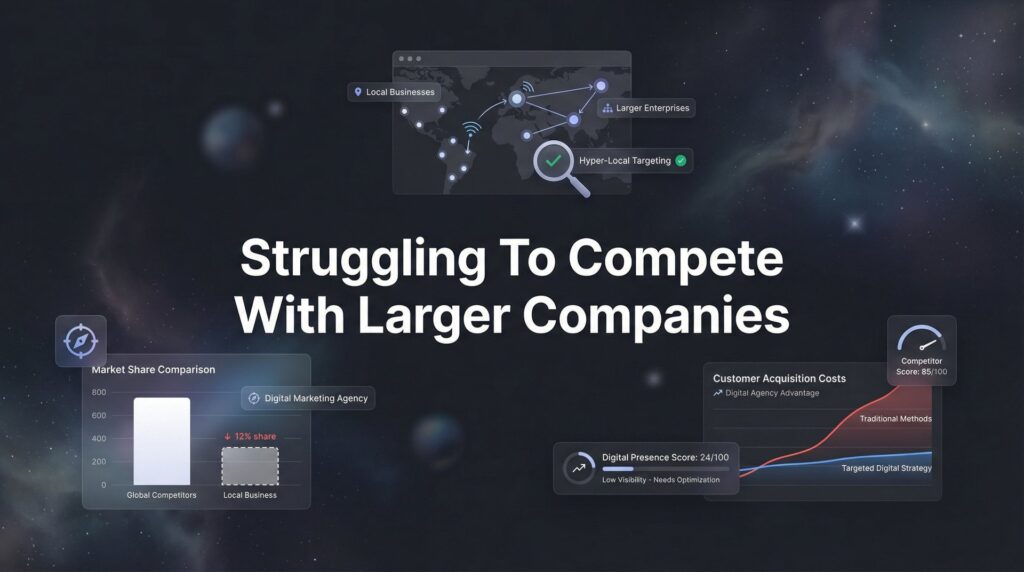
Let’s acknowledge the elephant in the room: you’re competing against businesses with bigger budgets, bigger teams, and bigger brand recognition. National chains have dedicated marketing departments. Franchises have corporate playbooks and consistent execution across every location. How are you supposed to compete with that?
The answer isn’t trying to outspend them. You’ll lose that fight every time. The answer is competing on different terms—leveraging advantages they can’t match no matter how much money they throw at the problem.
Your biggest advantage is community connection. You’re not a faceless corporation. You’re a local business owner who lives in the same community as your customers. You shop at the same grocery stores. Your kids go to the same schools. You understand local concerns and preferences in ways a national chain never will. This matters more than you think, especially when consumers increasingly value supporting local businesses.
You can also offer personalization that larger competitors simply can’t scale. You can remember customer preferences. You can adjust your service to individual needs. You can make decisions on the spot without checking with corporate. This flexibility and personal touch creates customer experiences that build loyalty and generate referrals—two things that don’t show up in ad metrics but dramatically impact your bottom line.
Strategic focus beats scattered spending every time. Big companies can afford to run campaigns on every platform. You can’t, and you shouldn’t try. Instead, identify the one or two channels where your ideal customers actually spend time and dominate those channels. Understanding whether PPC or SEO makes more sense for your specific situation can help you allocate your limited budget more effectively.
This focused approach also means choosing your battles carefully. You don’t need to rank for every keyword in your industry. You need to rank for the keywords that indicate buying intent in your specific market. You don’t need to be on every review platform. You need to excel on the platforms your customers actually check.
The local businesses successfully competing against bigger players understand they’re playing a different game. They’re not trying to match corporate marketing budgets. They’re building genuine relationships, delivering exceptional experiences, and making it easy for satisfied customers to spread the word. They’re leveraging their local knowledge to create campaigns that resonate specifically with their community. They’re being strategic rather than trying to be everywhere at once.
From Problems to Progress: Your Customer Acquisition Action Plan
Understanding these challenges is valuable, but only if it leads to action. So what do you actually do about all this? Where do you start when you’re facing visibility problems, budget constraints, trust gaps, lead quality issues, and fierce competition all at once?
Start with the highest-impact fixes first. For most local businesses, that means getting your foundational visibility right. Claim and optimize your Google Business Profile. Ensure your business information is consistent across every platform. Get your first 10-20 reviews from satisfied customers. These basics don’t require a huge budget, but they dramatically impact whether potential customers can find you and trust you enough to make contact.
Next, audit your conversion process. Before you spend another dollar on ads, make sure your website actually converts visitors into leads. Is your contact information prominent? Do your calls to action make sense? Does your site work properly on mobile? Can someone figure out what you do and how to hire you within 30 seconds? Fixing conversion issues often delivers better ROI than any new marketing campaign.
Then, get serious about tracking. You cannot improve what you don’t measure. Set up proper tracking for your marketing efforts. Know which campaigns produce actual customers, not just clicks or calls. Understand your cost per acquisition and your customer lifetime value. This data allows you to make intelligent decisions about where to invest your limited resources. If your costs are too high, learning how to reduce customer acquisition cost becomes a priority.
Here’s where many local business owners need to make an honest assessment: when does DIY marketing cost more than professional help? If you’ve been trying to handle your own marketing for six months and you’re not seeing results, the time you’ve invested has already cost you thousands in opportunity cost. If you’re spending 10 hours a week on marketing tasks that aren’t producing customers, you’re losing money even though you’re not writing checks to an agency.
Professional marketing help isn’t an expense—it’s an investment. The right partner doesn’t just run campaigns for you. They bring expertise in what actually works in your market, they have systems for tracking and optimization, and they free up your time to focus on running your business. The key is finding specialists who understand local business growth, not generalists who treat your plumbing company the same way they’d treat a software startup. A customer acquisition consultant who specializes in local businesses can often identify opportunities you’ve been missing.
The most successful local businesses build sustainable customer acquisition systems rather than chasing one-off tactics. They’re not constantly jumping to the newest marketing trend. They’ve identified what works for their specific business, they’ve built processes around those strategies, and they’re consistently executing and improving. They’ve moved from “trying stuff and hoping it works” to “systematically generating qualified leads.”
Moving Forward: Turning Challenges Into Competitive Advantages
The customer acquisition challenges facing local businesses in 2026 are real. Rising costs, increased competition, shifting consumer behavior, and limited resources create genuine obstacles to growth. But here’s what’s equally true: these challenges aren’t insurmountable, and understanding them puts you ahead of most of your competitors who are still throwing money at symptoms instead of solving root problems.
The local businesses thriving right now aren’t the ones with the biggest budgets. They’re the ones who’ve gotten strategic about their approach. They’ve fixed their visibility issues. They’ve built trust through proactive reputation management. They’ve optimized their conversion processes. They’ve focused their limited resources on high-impact strategies. And they’ve stopped trying to do everything themselves when partnership with specialists makes more sense.
Your next step is evaluating your current customer acquisition approach with brutal honesty. Which of these challenges is costing you the most customers? Where are you wasting money on marketing that doesn’t produce results? What would change in your business if you had a steady flow of qualified leads instead of feast-or-famine unpredictability?
Tired of spending money on marketing that doesn’t produce real revenue? We build lead systems that turn traffic into qualified leads and measurable sales growth. If you want to see what this would look like for your business, we’ll walk you through how it works and break down what’s realistic in your market.
The businesses that win at customer acquisition in the years ahead won’t be the ones who spend the most. They’ll be the ones who understand the real challenges, implement strategic solutions, and build systems that consistently deliver results. The question is whether you’ll be one of them.
Want More Leads for Your Business?
Most agencies chase clicks, impressions, and “traffic.” Clicks Geek builds lead systems. We uncover where prospects are dropping off, where your budget is being wasted, and which channels will actually produce ROI for your business, then we build and manage the strategy for you.