Learning how to increase average order value is about making customers feel like they're getting more value, not tricking them into spending more.
This usually involves smart tactics like product bundles, timely upsells, and a free shipping threshold. The goal is to boost revenue from existing customers, not just find new ones. By doing this, you make every marketing dollar work harder.
What Is Average Order Value (AOV)?
Average Order Value (AOV) is your total revenue divided by the total number of orders over a specific period. It’s a simple metric that shows how much customers typically spend in a single transaction.
A higher AOV means your marketing efforts are more efficient. You’re earning more from the customers you already have, which directly improves your profitability and return on investment (ROI).
Here’s the simple formula:
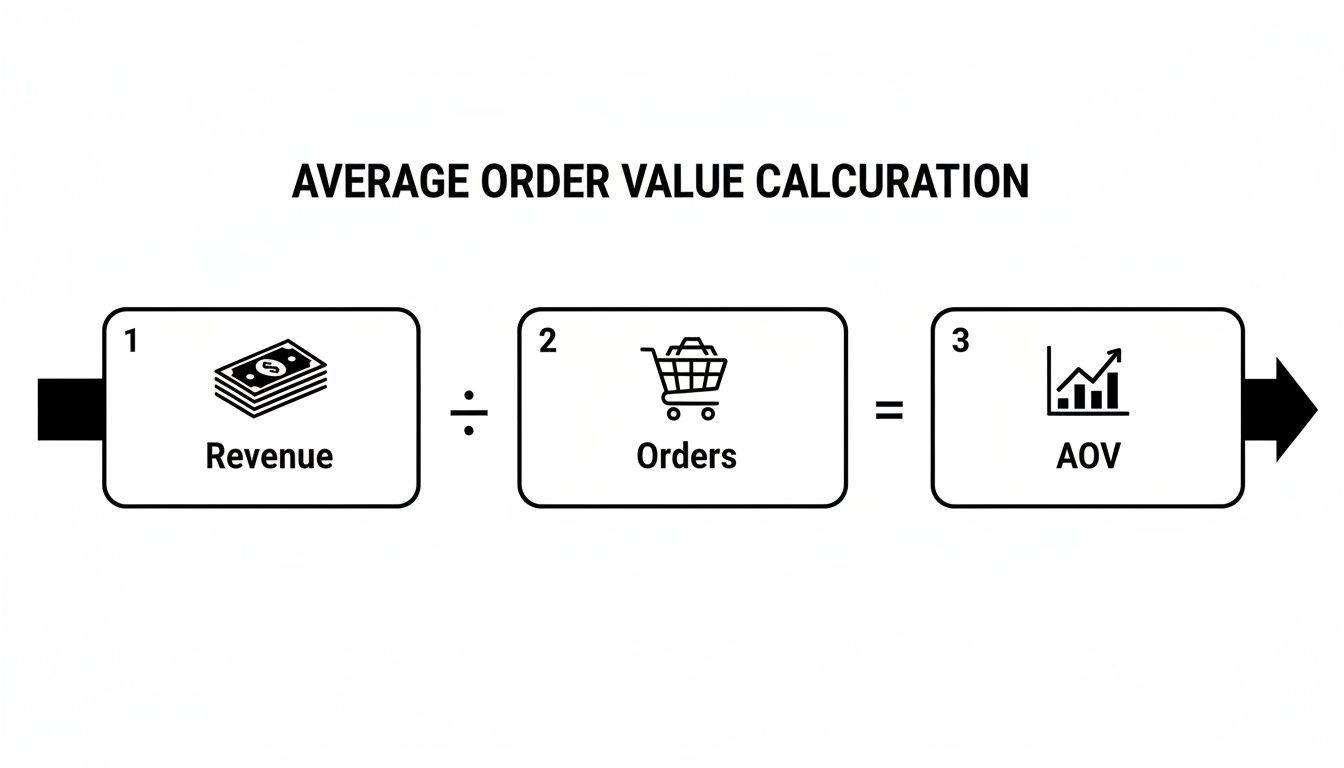
In Short: AOV is a key performance indicator (KPI) that helps you understand customer purchasing behavior and the effectiveness of your pricing strategies.
Why is AOV an important metric?
Tracking your AOV gives you insight into customer buying habits. When your AOV increases, it means your marketing is attracting the right customers—people who see real value in what you offer.
For example, a carpet cleaner’s AOV might be the cost of cleaning three rooms. If they offer an upsell like a stain treatment, they instantly increase that order's value without spending more on ads to find a new client. This efficiency is key to profitable growth.
How does AOV affect business growth?
A healthy AOV provides financial breathing room. That extra cash flow can be reinvested into better products, customer service, or business expansion. Mastering this metric is a crucial step toward building a resilient and profitable business.
Understanding AOV is a core part of any ecommerce growth strategy. Once you grasp the basics, you can apply proven tactics to increase average order value and see real results.
Core AOV Growth Strategies
Here’s a quick look at the main strategies you can use to encourage larger orders.
| Strategy | Primary Goal | Best For |
|---|---|---|
| Product Bundling | Increase perceived value and sell more items at once. | Businesses with complementary products (e.g., shampoo & conditioner). |
| Upselling | Encourage customers to buy a premium or upgraded version. | Companies with tiered products (e.g., standard vs. pro software). |
| Cross-selling | Suggest related or add-on items to the main purchase. | E-commerce stores with a wide product catalog (e.g., phone & case). |
| Free Shipping Threshold | Motivate customers to add more items to meet a minimum spend. | Nearly any business that ships physical goods. |
| Loyalty Programs | Reward repeat customers for spending more over time. | Brands focused on customer retention and lifetime value. |
Mixing these strategies helps create a system that consistently nudges your AOV upward.
Master Upselling and Cross-Selling
Upselling and cross-selling are classic methods for boosting average order value. Done right, they feel like helpful suggestions, not a pushy sales pitch.
So, what’s the difference?
- Upselling is about persuading a customer to buy a better, more expensive version of the product they're already considering.
- Cross-selling involves suggesting related products that complement what’s already in their cart. Think, "Do you want fries with that?"
The Art of the Upsell
A good upsell makes the customer feel like they’re making a smarter choice. The goal isn't to push the most expensive item, but to show the best value.
For example, a roofer could offer premium, weather-resistant shingles. They can frame the benefit: "This roof will last 10 years longer and handle hailstorms without a scratch." That’s a compelling reason to upgrade.
Here’s how to create effective upsells:
- Make It Relevant: The upgrade should be a logical next step.
- Explain the "Why": Use a simple comparison chart to show the added benefits.
- Keep It Reasonable: The upsell price should be within 25-40% of the original item's cost to avoid scaring customers away.
Cross-Selling for Bigger Carts
Cross-selling is most effective when you offer products that complete the main purchase. If someone buys a camera, suggesting a memory card and a camera bag is helpful service.
Another example is a web designer offering an ongoing SEO package after building a new site. It adds immediate value and helps the client achieve their real goal: getting more traffic.
Where to Place Your Offers
Timing is key. Present your offers when customers are most receptive.
- Product Page: Use sections like "Customers Also Bought" or "Complete the Look."
- Shopping Cart: Suggest small add-ons like a warranty or batteries right after an item is added.
- Post-Purchase: A one-click add-on with a discount on the thank-you page is highly effective.
Implementing these strategies can lift AOV by 10-30%. Post-purchase offers alone can add 10-15% in incremental revenue. For more ideas on building customer relationships, check out these 6 ways to boost your ecommerce customer engagement.
Use Product Bundles and Volume Discounts
Product bundles and volume discounts are powerful because they make it easy for customers to spend more. They shift the focus from "how much does this cost?" to "look at all the value I’m getting!"
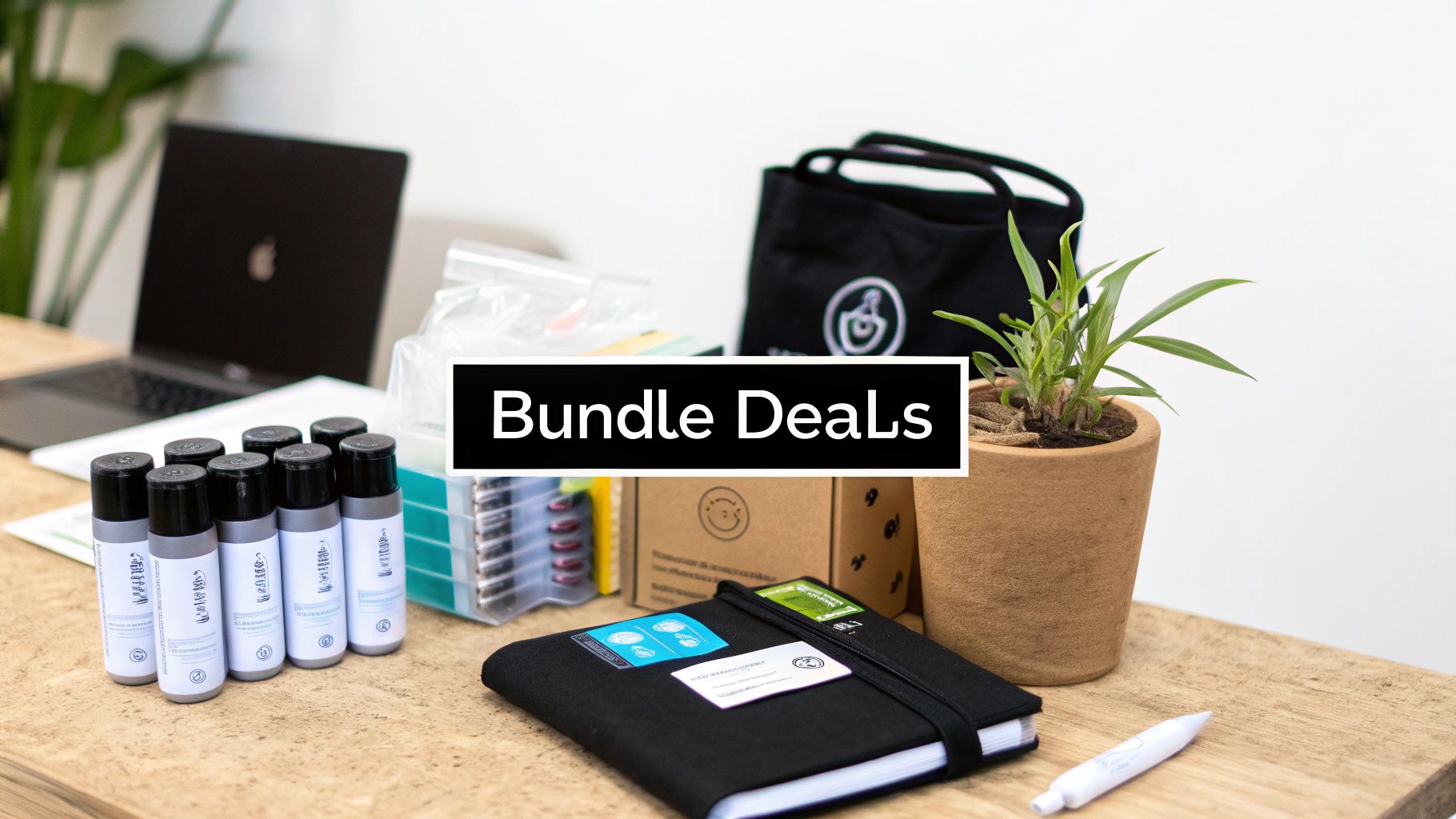
You’re not just suggesting another item; you’re offering a complete solution or a great deal for buying in bulk. This reduces decision fatigue and makes the shopper feel smart.
Create Product Bundles That Sell
A great bundle solves a specific problem in one click. Think "starter kits" or "complete collections."
For instance, a marketing agency can bundle Google Ads management with landing page design. This is a perfect strategy if you're trying to figure out how to increase average order value as a service business.
In e-commerce, a skincare brand might offer a "Daily Routine Kit" with a cleanser, toner, and moisturizer. The customer gets a full solution, and the store sells three products at once.
Tips for Effective Bundling:
- Solve a Problem: Combine items that logically work together.
- Show the Savings: Display the original combined price next to the discounted bundle price.
- Keep It Simple: Start with a few well-designed bundles that address common customer needs.
Motivate Larger Purchases with Volume Discounts
Volume discounts appeal to a basic human desire: getting a good deal. The more you buy, the more you save. It’s a simple way to encourage customers to stock up, which instantly increases their cart size.
This often takes the form of tiered pricing.
In Short: Bundles and tiered discounts reframe the purchase. Customers feel like they are investing in a solution or a smart deal, which drives a higher AOV.
You’ve seen this before:
- "Buy 2, Get 10% Off; Buy 3, Get 20% Off"
- "1 for $25, 3 for $65"
This gamifies the shopping experience. Customers see the next discount tier and often add one more item to get the better price. It's a win-win: they feel like they scored a deal, and you increase your average order value.
Offer Free Shipping and Tiered Rewards
The word "free" is one of the most powerful in marketing. When it comes to boosting AOV, a free shipping offer is a reliable tool.
Unexpected shipping costs are a top reason for cart abandonment. By setting a free shipping threshold, you tap into this customer mindset. Someone who is just a few dollars away will often add another item to their cart to qualify.
Find Your Free Shipping Sweet Spot
Setting the right threshold is key. Too high, and it feels unattainable. Too low, and you lose margin.
A good rule is to set your threshold about 15-20% higher than your current average order value.
If your AOV is $85, a $100 free shipping threshold is a great starting point. The customer sees adding a $15 item as a smarter move than paying $7.95 for shipping.
Use Tiered Loyalty Programs for Long-Term Growth
Free shipping is great for a single order, but tiered loyalty programs encourage customers to spend more over time. This model creates levels of achievement that get people excited.
Think of it like a game. Customers start at a basic level (e.g., Bronze) and unlock better perks as they spend more, moving up to Silver and Gold.
In Short: Tiered rewards gamify shopping. Customers are on a quest to unlock a higher status, which drives both AOV and customer lifetime value.
What Do Loyalty Tiers Look Like?
Make the rewards genuinely better as customers climb the ladder.
- Bronze Tier (Entry Level)
- Earn basic points on purchases
- A small birthday discount
- Silver Tier (Regulars)
- Earn points faster (e.g., 1.25x)
- Free shipping on all orders
- Access to exclusive deals
- Gold Tier (VIPs)
- Accelerated points (1.5x or 2x)
- Early access to new products
- A quarterly surprise gift
- Dedicated customer service
A program like this builds a loyal community around your brand, creating a stable base of repeat customers.
Automate AOV Growth with Personalization
So far, we’ve covered manual tactics like bundles and shipping thresholds. Now, let’s add automation. You don't need an Amazon-sized budget to offer personalized recommendations that naturally increase your average order value.
Modern e-commerce platforms use customer data—like browsing history and past purchases—to serve up relevant suggestions. This turns your AOV strategy into a one-on-one conversation with each customer.
This data-driven approach makes your upsells and cross-sells feel like helpful advice from a friend. It builds trust and encourages customers to add more to their cart.
Use Customer Data for Smarter Suggestions
The idea is to show customers things they are likely to want. Automation engines analyze behavior to predict what a shopper might buy next.
Common examples on your site include:
- "Frequently Bought Together": The system automatically groups items people often buy at the same time.
- "You Might Also Like": This carousel is driven by browsing history, showing similar products or complementary gear.
- "Recently Viewed": A simple reminder that keeps products top-of-mind as a shopper navigates your site.
Automating these placements ensures every visitor has a more relevant experience. Our guide on the top ecommerce apps can help you find tools to get started.
Automate Your Email Marketing
Automation is a game-changer for email marketing, especially with behavior-based triggers.
Imagine a customer buys a new laptop. An automated email can be sent three days later showcasing perfect accessories: a laptop sleeve, a wireless mouse, and a USB-C hub. The suggestions are timely and useful.
In Short: Behavior-based automated emails work because they are triggered by real customer intent, making them highly relevant and effective.
This approach is highly effective. Data shows that behavior-based automation can drive a significant portion of email revenue from a small fraction of sends. When customers click on these personalized promotions, they often spend more per order.
Automation vs. Personalization
It's important to understand the difference between these two terms.
- Automation is the engine. It's the technology that sends an email or shows a product recommendation automatically.
- Personalization is the fuel. It's the customer data—name, purchase history, browsing activity—that makes the automated message feel personal and relevant.
You need both. Automation without personalization is just spam. When you combine them, you create a system that helps customers discover more value, which is the secret to growing your average order value. For a broader view, learn how Marketing Automation Revolutionizing Ecommerce Growth.
People Also Ask: Common AOV Questions
When you're first learning how to increase AOV, a few common questions always come up.
What is a good average order value?
There's no single magic number. A "good" AOV is relative to your industry, products, and audience. A beauty store might aim for a $70 AOV, while a furniture store could target over $250.
The best benchmark is your own performance. A good AOV is one that is consistently increasing month over month. Focus on improving your own metrics rather than comparing them to broad industry averages.
How do I calculate my free shipping threshold?
This is one of the easiest and most effective tactics. You don't need a complex formula.
- Find your average order value from the last 30-60 days.
- Set your free shipping threshold about 15-20% higher than that number.
For example, if your AOV is $80, a $100 free shipping minimum is a great place to start. This small gap encourages customers to add another item to their cart instead of paying for shipping. You can check out more AOV boost statistics to see how different industries stack up.
Which AOV strategy should I start with?
For the quickest win, start with a simple cross-sell or upsell at checkout.
Most e-commerce platforms like Shopify have apps that make this easy to set up. Suggesting a complementary product just before a customer pays is a low-friction way to increase their cart total immediately.
My advice is to start with one simple offer, track its performance for a few weeks, and then build from there.
Ready to stop leaving money on the table and start seeing real growth? At Clicks Geek, we specialize in creating conversion-focused marketing and web design that drives higher AOV and boosts your bottom line. Let's build a more profitable business together.