Want to rank higher on Google Maps? It comes down to three key things.
You need a complete Google Business Profile (GBP). You need a steady stream of good reviews. And you need consistent business information everywhere online.
That’s the core idea. You're just sending clear signals to Google that your business is legitimate, active, and a great choice for local customers.
Step 1: Optimize Your Google Business Profile
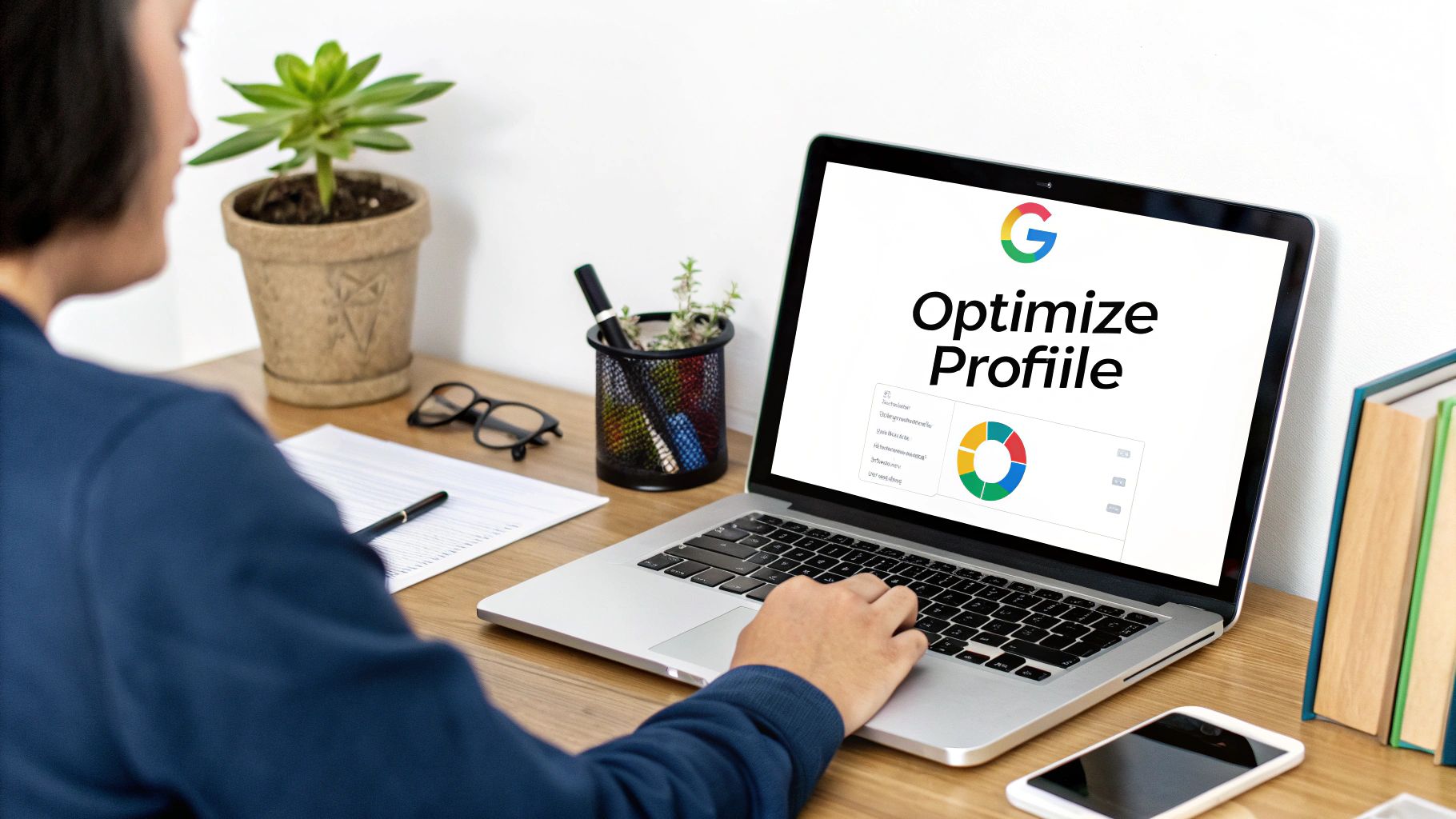
If you’re wondering how do I rank higher on Google Maps, your Google Business Profile is the first place to start. This isn't just a small task; it’s the foundation of your entire local SEO plan. If your profile is incomplete, nothing else will work well.
Think of your GBP as your digital storefront. An incomplete profile is like a shop with a broken sign and empty shelves. People will just walk by.
This flowchart shows the key pillars for getting noticed on Google Maps. It starts with your profile, focuses on your services, and relies on consistent NAP (Name, Address, Phone Number).
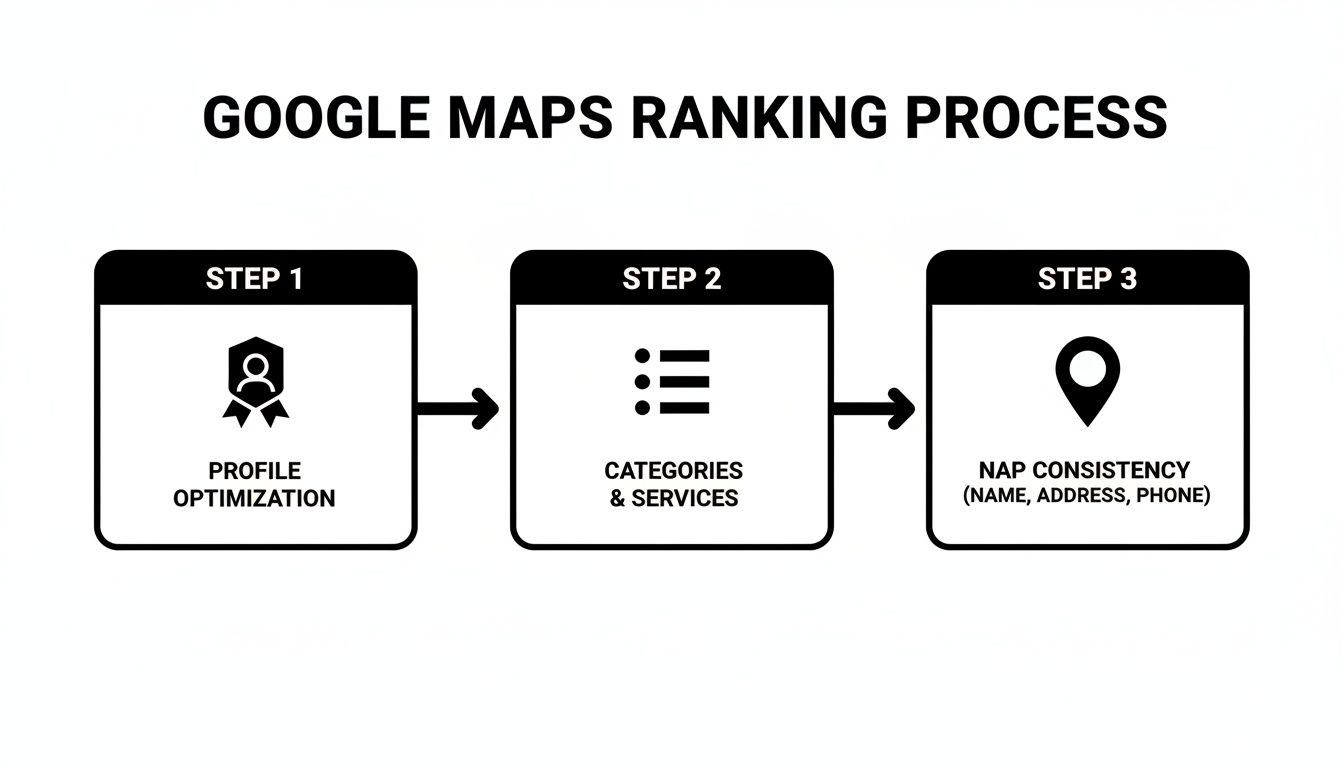
You have to get these three things right before trying more advanced tactics.
Here's a quick checklist to help you. Getting these right is essential for better visibility.
GBP Optimization Checklist
| GBP Element | Optimization Action | Why It Matters for Ranking |
|---|---|---|
| Business Name | Use your real-world business name. No keyword stuffing. | Google penalizes spammy names. Accuracy builds trust. |
| Primary Category | Choose the most specific category that describes your main service. | This is a huge ranking factor for relevance. |
| Secondary Categories | Add all other relevant categories for services you offer. | Helps you show up for more related local searches. |
| Address | Ensure it's 100% accurate and matches everywhere else online. | Critical for proximity searches and NAP consistency. |
| Service Area | If you travel to customers, define your service area precisely. | Tells Google which towns, cities, or regions you serve. |
| Phone Number | Use a primary local number that's consistent everywhere. | A key part of your NAP and a direct line for customers. |
| Website | Link to the most relevant page on your site (often the homepage). | Drives traffic and connects your GBP to your main web presence. |
| Business Description | Write a compelling, 750-character pitch with natural keywords. | Your chance to tell customers what makes you the best choice. |
If any of these are weak, you're leaving rankings on the table.
Choose Your Categories Wisely
Your business category is one of the most important fields in your profile. Your primary category needs to be a very specific description of what you do.
For example, if you're a lawyer, "Law Firm" is too broad. If you handle car accidents, your primary category should be "Personal Injury Attorney." This precision helps Google match you with the right searches.
Don't stop there. Select every secondary category that applies to your business. A roofing company might also add:
- Gutter Cleaning Service
- Siding Contractor
- Window Installation Service
These secondary categories act like keywords that help you get found for all your different services.
Write a Compelling Business Description
You get 750 characters for your business description. This is your elevator pitch to tell customers why you’re the best choice.
It's smart to include your main keywords, but write for humans, not just for search engines.
Pro Tip: Lead with your most important message. Users only see the first 250 characters before they have to click "more," so make that first sentence count.
The Critical Importance of NAP Consistency
NAP stands for Name, Address, and Phone number. This is non-negotiable. If you get this wrong, your local SEO efforts will fail.
Google checks your NAP information all over the internet—on your website, Facebook, and directories like Yelp or Angi.
Conflicting information confuses Google and makes it doubt your business. Even a small difference matters. If your GBP says "123 Main St." but your website says "123 Main Street," that's an inconsistency. Every detail must match perfectly everywhere.
In Short: Getting your profile right helps you land in the coveted Google Maps 3-Pack, the top three local results. Businesses in the 3-Pack get significantly more traffic and clicks. You can learn more about the power of the 3-pack.
Step 2: Build Social Proof with Customer Reviews
After optimizing your Google Business Profile, the next biggest factor for ranking is customer reviews. They are digital word-of-mouth. They show Google and customers that people trust your business.
A profile with no reviews looks abandoned. A steady flow of new, positive reviews sends a powerful signal to Google that you are a thriving, reputable business.
Why Reviews Are a Ranking Superpower
Reviews directly impact your position on the map. Google's algorithm uses them to understand the customer experience you provide.
Here’s what Google looks at:
- Review Quantity: The total number of reviews you have.
- Review Velocity: The speed at which you get new reviews. A consistent trickle is better than a big batch all at once.
- Review Sentiment: Your average star rating and the words people use.
- Review Diversity: Getting feedback on other relevant platforms also helps.
In Short: The frequency and quality of your reviews are powerful ranking factors. When a business consistently gets new reviews, its local search visibility often improves. For a closer look at the data, check out this deep dive into local SEO signals.
How to Get More Google Reviews (Without Being Pushy)
Asking for reviews can feel awkward. The key is to make it easy for happy customers.
Here are a few simple methods:
- The Direct Link: After a job, send a thank-you email or text with a direct link to your Google review page.
- QR Codes: Create a QR code that links to your review page. Put it on business cards or invoices.
- Your Website: Add a "Review Us on Google" button to your site.
Pro Tip: The best time to ask is right after you've delivered a great service. The positive experience is fresh in their mind.
The Hidden SEO Gold in Your Customers' Words
The text of a customer's review can help you rank.
When someone writes, "This was the best emergency plumber in Austin," they’ve given you a perfect local keyword. Google scans review text for relevance. If reviews mention specific services ("drain cleaning") or locations ("downtown Austin"), it reinforces that you're an authority for those things.
Always, Always, Always Respond to Every Review
Responding to reviews is a must. It's an easy win.
Here’s the game plan:
- Thank the Positive Ones: A simple, "Thanks, Sarah! Glad we could help," shows you appreciate them.
- Handle the Negative Ones Like a Pro: Acknowledge their issue, apologize, and offer to fix it offline. How you handle criticism shows potential customers you care.
Your responses are public and show that you are an engaged business owner. This active management is another positive signal to Google.
Step 3: Use Photos, Posts, and Messages to Boost Engagement
A complete Google Business Profile is just the start. To really climb the rankings, you need an active profile. Fresh photos, regular posts, and quick message replies show Google you’re an engaged, active business.
Google wants to show users the best, most reliable businesses. An updated profile looks more trustworthy than one that's been ignored for months.

Build a Powerful Visual Story with Photos
Photos create a great first impression. Google says businesses with photos get 42% more requests for directions and 35% more clicks to their websites.
Avoid generic stock images. People want to see the real deal.
- Showcase Your Work: If you’re a roofer, post before-and-after shots of your projects.
- Introduce Your Team: Photos of your staff help humanize your business and build trust.
- Highlight Your Location: Post clear pictures of your storefront and the inside of your shop.
Pro Tip: When you upload photos from your phone, the location data (geotag) is often included. This is a subtle way to reinforce your physical location to Google.
Treat Google Posts Like a Mini-Blog
Google Posts are a great, underused feature. They are like free ads that appear right on your profile.
Posting regularly tells Google you're actively managing your profile and keeps it fresh.
Here are a few ideas:
- Promote Offers: Announce a weekly special or discount.
- Highlight New Services: Share information about new things you offer.
- Share Project Photos: Post a photo from a recent job with a short description.
- Announce Events: Let people know about workshops or community events.
Always include a clear call to action, like "Call Now" or "Learn More."
Turn on Messaging and Respond Fast
Letting customers message you directly from your profile is a big deal. It’s an easy way for leads to ask a quick question.
But your response time is also a ranking signal. A business that replies in minutes looks more attentive.
Here’s how to manage it:
- Set up an automated welcome message to greet people instantly.
- Enable notifications on your phone through the Google Maps app so you never miss a message.
By using these tools, you build a dynamic presence that both customers and Google will reward.
Step 4: Send Strong Local Signals from Your Website
Your Google Business Profile and your website need to work together. When they are in sync, it sends a huge trust signal to Google.
Your website should confirm everything on your GBP listing. It proves you are who and where you say you are.
Create Hyper-Local Service Pages
Generic "Services" pages are a missed opportunity. You need to be specific.
Create separate pages for each core service you offer in each main city you serve. A page titled "Emergency Roof Repair in Austin, TX" will perform much better than a general "roofing services" page.
The Big Idea: One page for each service + location combo. This tells Google you're a specialist in that area.
Fill these pages with useful content. Talk about common local problems, mention neighborhoods you serve, and show photos of local jobs.
Embed a Google Map on Your Contact Page
This is an easy win for local SEO. Go to your "Contact Us" page and embed the Google Map of your business location. It visually confirms to Google that your business is located where your GBP says it is.
This is effective because:
- It verifies your location with Google's own tool.
- It helps customers get directions from your site.
- It reinforces your NAP.
It’s a small detail that makes a big difference.
Make Your NAP Information Unmissable
Your Name, Address, and Phone number (NAP) must be consistent, especially on your website. The best practice is to put this information in the footer of every page.
This way, your core business info is always visible to Google and to visitors. For any small business, professional local SEO services for small businesses often focus on this foundational consistency.
Broader marketing tactics, like some high-impact realtor marketing strategies, also include local promotion ideas that can work for any business.
Step 5: Build Local Authority with Citations and Backlinks
To rank higher on Google Maps, you must prove you're a trusted part of the local community. Google needs to see other reputable sources vouching for you. This is where citations and backlinks are important.
Every time a trusted website mentions your business, it’s a vote of confidence for Google.
So, What Exactly Are Local Citations?
A citation is an online mention of your business's Name, Address, and Phone number (NAP). It doesn't even need a link to your website.
Google looks for your NAP on sites like:
- Yelp
- Angi
- Yellow Pages
- Niche directories (like Avvo for lawyers or Houzz for home design)
- Your local Chamber of Commerce site
When the NAP on these sites perfectly matches your GBP, it signals legitimacy. If the info is messy, it creates confusion and can hurt your rankings.
Cleaning Up Your Digital Footprint: The Citation Audit
Inconsistency is a killer for local SEO. Using "St." on one site and "Street" on another can be a red flag for Google's algorithm.
A citation audit is essential. You can start by manually searching for your business on major directories and checking the details. The goal is simple: find and fix every inconsistency until your NAP is uniform everywhere.
My Two Cents: Don't treat citation consistency as optional. Every correct listing is a vote of confidence.
The Heavy Hitter: Local Backlinks
While citations are mentions, backlinks are clickable links from another website to yours. A quality backlink is pure gold in the SEO world. Getting a link from a respected local news site or community organization is a massive endorsement.
It's not about spammy tactics. It's about real relationship-building.
How to Actually Get Local Backlinks
Earning local backlinks takes some hustle. It’s about getting involved in your community.
Here are a few strategies:
- Sponsor a Local Event: Sponsor a local 5K or little league team. Organizers often thank sponsors on their website with a link.
- Join Your Chamber of Commerce: Most chambers have an online member directory, which provides a high-authority local link.
- Host a Local Workshop: Team up with another local business to host a free webinar. Promote it on each other's sites and link to one another.
- Get in the Local News: If you win an award or celebrate a milestone, let a local journalist know. A feature story often includes a backlink.
Building a strong profile of consistent citations and meaningful local backlinks proves you're a local authority. That’s how you earn a top spot on the map.
Frequently Asked Questions
Here are answers to some of the most common questions business owners ask about Google Maps rankings.
How long does it take to rank higher on Google Maps?
It depends. With consistent effort, most businesses see noticeable movement in their local rankings within 3 to 6 months. Factors like your industry's competition and how well you apply these strategies play a big role. It’s a marathon, not a sprint.
Can I rank in a city where I don't have an office?
It's very difficult. Google Maps is built around proximity and wants to show businesses that are physically located in the area. You can set service areas in your profile, but you will almost always be strongest in the city where your address is verified. To rank well in another city, you really need a physical location there.
Will running Google Ads boost my organic Maps ranking?
No. Running Google Ads does not directly impact your organic (non-paid) ranking on Google Maps. They are two separate systems. However, ads are a great way to get immediate visibility while your organic SEO efforts are still building up.
At Clicks Geek, we focus on turning local searches into paying customers. If you want a proven plan to get into the Google Maps 3-Pack and keep your phone ringing, we can help. Check out our results-driven local SEO services.