If you want to learn how to rank in Google Map Pack, you need to focus on three things: relevance, distance, and prominence. Forget secret hacks. The real path to a top-three spot is proving to Google that your business is the best answer for a local search.
In Short: Ranking in the Map Pack requires a fully optimized Google Business Profile, a strong local reputation, and a website that signals your expertise to search engines.
Why the Google Map Pack Is a Game Changer
Think about your last search for "pizza near me." The first thing you saw wasn't a list of websites, was it? It was a map with three local businesses highlighted.
That's the Google Map Pack. It's the most valuable real estate in local search.
The numbers are staggering. A huge 46% of all Google searches have local intent, and 86% of consumers use Google Maps to find local businesses. Businesses in the top three spots get most of the clicks. In fact, 42% of local searchers click on Map Pack results alone. You can read more about these local search trends to see the opportunity.
Understanding Google's Ranking Factors
How does Google decide who gets top billing? It wants to show the most helpful and reliable results. The algorithm focuses on three main criteria.
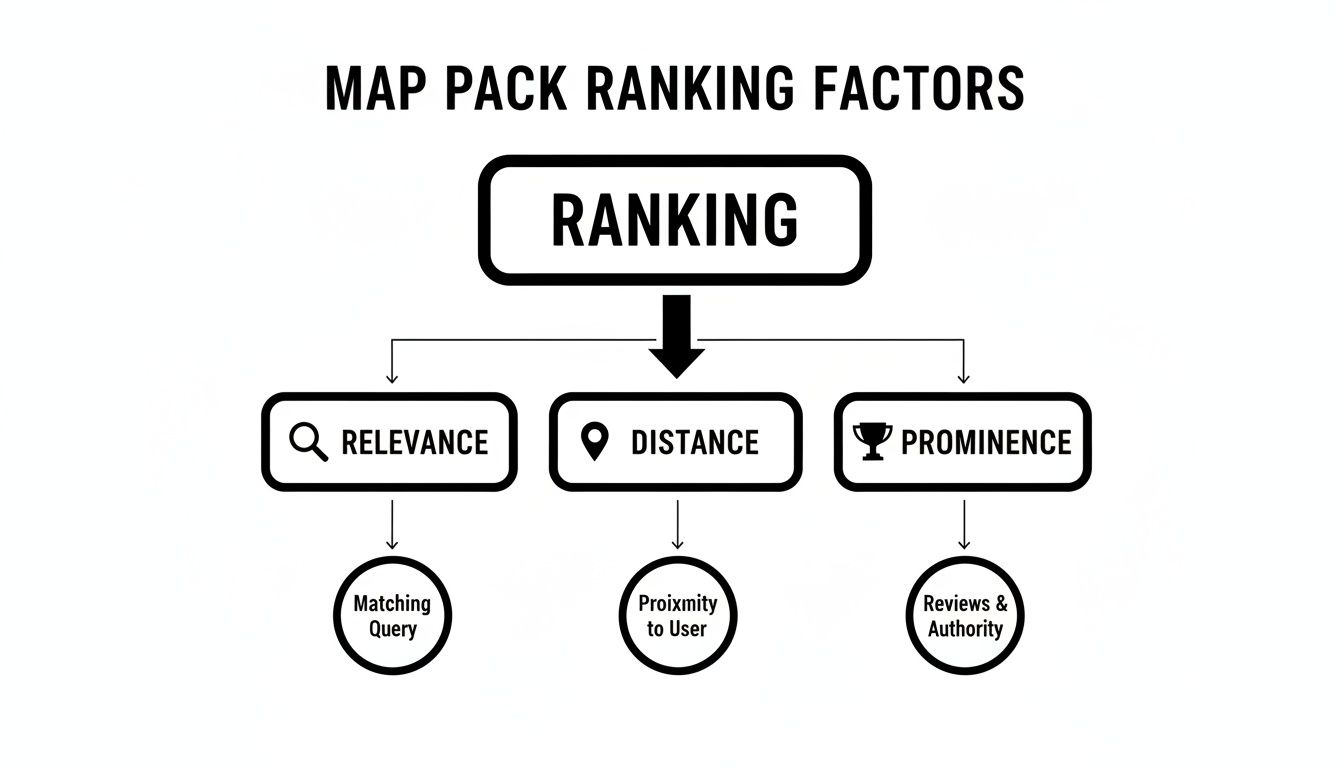
It's not about being the best at one thing. It's about balancing all three.
The Three Pillars of Local Ranking
So, what do these "pillars" mean for you?
| Ranking Pillar | What It Means for You | Your Main Goal |
|---|---|---|
| Relevance | How well your business profile matches a search query. | Fill out every section of your Google Business Profile with rich, specific details. |
| Distance | How close your business is to the person searching. | Ensure your address is perfectly accurate and consistent everywhere online. |
| Prominence | How well-known and respected your business is. | Build a strong digital reputation through reviews, backlinks, and mentions. |
If you show Google you're a relevant, nearby, and reputable business, you have a serious shot at the top.
-
Relevance: This is about matching a search. If someone types "emergency dentist," Google looks for businesses with that service listed. More detail helps Google connect you to the right people.
-
Distance: This is about proximity. How close are you to the searcher? You can't move your shop, but you can ensure your address is 100% accurate online.
-
Prominence: This is your business's reputation. Google looks at your number of reviews, what people say, and how many quality websites link to yours. It’s digital word-of-mouth.
Your Google Business Profile: Ground Zero for Local SEO
Your Google Business Profile (GBP) is your command center for local search. It is the single most important tool for ranking in the Google Map Pack. Leaving it half-finished is a huge mistake.
Mastering your GBP is non-negotiable. You can find proven Google Business Profile tips for local growth to get started.
GBP signals account for a massive 32% of local pack ranking factors. Nearly a third of your ranking potential comes from this one asset.
Nail Your Business Categories
Your first and most critical move is picking your primary business category. This tells Google what you do. Be specific. "Contractor" is too broad. Use "Plumbing Contractor" or "Roofing Contractor."
After setting your primary category, add secondary categories for everything else you offer. A plumber could add "Water Heater Repair Service" and "Drain Cleaning Service." This helps you show up for more related searches.
- Primary Category: Your main service (e.g., "Italian Restaurant").
- Secondary Categories: All other services (e.g., "Pizza Delivery," "Catering Service").
This simple step puts you in the running for more potential customers.
Write a Business Description That Works
Your 750-character business description is prime real estate. Use it to tell Google and customers who you are, what you do, and why you're the best choice.
Weave in keywords and phrases your customers actually use.
A landscaper in Phoenix could write:
"We are a full-service landscaping company in Phoenix offering expert lawn care, custom landscape design, and reliable irrigation system repair. For over 10 years, we've helped homeowners create beautiful, sustainable outdoor spaces."
This includes key terms like "landscaping company in Phoenix" and "lawn care" while sounding natural to a reader.
Turn Your Profile into a Visual Showcase
In local search, photos do a lot of heavy lifting. Profiles with high-quality, relevant images get more clicks, calls, and direction requests.
Regularly upload clear, well-lit photos and videos. Show off your work, introduce your team, and give people a feel for your location.
- Your Work: Before-and-after photos are gold.
- Your Location: Show your storefront, interior, and parking to make it easy to find you.
- Your Team: Friendly faces build trust.
- Videos: A quick 30-second tour or a clip of your team in action can be very effective.
Adding fresh photos regularly signals to Google that your business is active.
The interface makes it easy to upload your logo, cover photo, and images from recent jobs.
Use Every Feature Google Gives You
Google constantly adds new GBP features. Businesses that use them first often get a boost. These tools improve the customer experience. Most small businesses ignore them, which is why professional local SEO services for small businesses can provide a big advantage.
- Google Posts: Use Posts to announce sales, share updates, or highlight new products.
- Products & Services: List every product or service you offer, with descriptions, pricing, and photos if possible.
- Q&A Feature: This is a goldmine. Don't wait for customers to ask questions—add and answer common ones yourself.
Pro Tip: Seed your own Q&A section. Brainstorm the top 5-10 questions you get, post them, and answer them. This builds a helpful resource immediately.
Building Trust: Your Reputation as a Ranking Signal
When Google talks about "prominence," it means your real-world reputation. How well-known and trusted is your business? Two things signal trust to Google: a steady flow of great Google reviews and a clean, consistent web of citations.
Reviews are social proof. They tell customers and Google that you are a legitimate business people engage with. Citations are mentions of your business Name, Address, and Phone number (NAP) across different websites. They confirm your location and identity.
Cultivating a Five-Star Reputation with Google Reviews
Google reviews are a massive ranking factor. Your star rating and review count directly impact your Map Pack position. The freshness and consistency of reviews are just as important.
A recent study showed a business fell from the top spot in just 18 days after its reviews stopped. Competitors getting 13-45 new reviews monthly climbed past them. This shows that if you want to know how to rank in Google Map Pack, you need a constant stream of feedback. You can dive deeper into these local search findings to see how critical review velocity is.
How do you keep reviews coming?
- Ask at the right time. The best moment is right after providing great service.
- Make it simple. Use a direct review link from your GBP. Put it in your email signature or on invoices.
- Keep the request short. A quick text or email works well. "Hey [Customer Name], thanks for choosing us! If you have 30 seconds, we'd appreciate your feedback on Google. Here's the link: [Your Review Link]."
Important: Respond to every single review. Thank happy customers and professionally address unhappy ones. It shows you care.
The Unsung Hero: Consistent Citations
Citations are the foundation of local SEO. Every time your business's Name, Address, and Phone number (NAP) appear on a site like Yelp or Apple Maps, it's a citation.
Consistency is the magic word. Google cross-references this info. If your address is "Main St." on one site and "Main Street" on another, it creates doubt. Messy data hurts your reliability.
You need to build new citations and clean up old ones.
- Where to Build Citations: Start with major platforms like Yelp and Apple Maps. Then focus on industry-specific directories and local sites like your Chamber of Commerce.
- How to Fix Bad Citations: Do a citation audit by Googling your business name and old info. Contact website owners to request corrections. It's tedious but critical.
Frequently Asked Questions About Reviews and Citations
Q: How do I handle a negative Google review?
A: Respond quickly and publicly. Acknowledge their frustration, apologize for the bad experience, and offer to resolve it offline. A calm response can win over other potential customers.
Q: Which online directories are most important for citations?
A: Focus on quality over quantity. Major data aggregators like Yelp, plus directories specific to your city or industry, provide the most value.
Q: Should I pay for a citation-building service?
A: It can be a smart move if you're short on time. These services build consistent listings and help fix errors, saving you a lot of manual work.
How Your Website Supercharges Your Map Pack Rankings
Your Google Business Profile and your website work together. Your GBP is the summary; your website provides the depth and authority. Google cross-references your site to verify your profile and confirm you're a local expert.
Optimizing your website is a powerful way to climb the Map Pack rankings. It's your chance to provide the rich, local context that a profile can't.

A key tool is Local Business schema, a type of code that spoon-feeds Google your business information in a language it understands perfectly.
Create Hyper-Local Service Pages
Generic service pages get lost. To stand out, build dedicated pages for each service in each location you serve.
For example, a plumber in Austin needs granular pages:
- Drain Cleaning in South Austin
- Emergency Plumbing in Round Rock
- Water Heater Installation in Pflugerville
These pages tell Google, "I am the authority for this service in this neighborhood." Creating a local page optimized for 'near me' searches is a great example of targeting high-intent searchers directly.
Weave Local Keywords in Naturally
Make your hyper-local pages sound natural. Don't stuff keywords.
Here’s a quick on-page SEO checklist:
- Page Title: Include your main service and city (e.g., "Expert AC Repair in Phoenix, AZ").
- H1 Heading: Mirror your page title.
- URL: Keep it clean (
yourwebsite.com/ac-repair-phoenix). - Body Content: Mention the city and local landmarks.
- Image Alt Text: Describe images using local keywords (e.g., "technician finishing an AC repair in a Phoenix home").
Implement Local Business Schema Markup
Schema markup is a secret weapon. It's code you add to your site that acts as a translator for search engines, explicitly telling them your business name, address, phone number, and hours.
It leaves zero room for misinterpretation.
By adding Local Business schema, you hand Google the exact info it needs to validate your GBP listing. This builds trust and authority. You can use tools like Google’s Structured Data Markup Helper to generate the code.
Make Your Website Mobile-First (Non-Negotiable)
Most local searches happen on a phone—over 60% of all Google searches.
If a user clicks from the Map Pack to a clunky, slow website, they will leave. That bounce sends a negative signal to Google.
A responsive website that adapts to any screen is essential. Your phone number must be clickable, buttons easy to tap, and the site must load fast.
Advanced Strategies for Competitive Markets
You've done the basics, but you're still stuck. In competitive markets, you need to be more strategic.
Top-ranking businesses actively build local authority and analyze user signals. Here are three powerful strategies.
Build Powerful Local Links
A link from another website is a vote of confidence. A link from a respected local website is like a shout-out from the mayor. This is local link building.
The goal is quality, not quantity. You want a few highly relevant, local links that show Google you're a legitimate part of the community.
High-Impact Local Link Building Opportunities
| Link Source Type | Why It's Valuable | How to Secure It |
|---|---|---|
| Local Event Sponsorships | Shows real-world community involvement. | Sponsor a local 5k, youth sports team, or festival. Most feature sponsors on their website. |
| Chamber of Commerce | A high-authority, trusted local business directory. | Join your local Chamber of Commerce. Membership usually includes a directory listing. |
| Neighborhood Bloggers | Provides a relevant link surrounded by local content. | Find a popular local blogger. Offer a free service or interview in exchange for a feature. |
| Local News Outlets | The ultimate local authority link. A mention is pure gold. | Host a charity drive or win an award. Send a press release to local TV and newspapers. |
Building these relationships is a long game, but it creates strong "prominence" signals.
Influence User Behavior Signals
Google watches how people interact with your Map Pack listing. These user behavior signals are direct feedback. More positive engagement tells Google you're the right answer.
The big three signals are:
- Click-Through Rate (CTR): Are people clicking on your listing?
- Requests for Directions: A massive signal that someone plans to visit.
- Phone Calls: The clearest sign of a ready-to-buy lead.
You can't force clicks, but you can encourage them. Run a compelling offer in your Google Posts to increase your CTR. High-quality photos encourage people to request directions.
Pro Tip: Your Google Posts and description should address a local pain point. A Phoenix roofer could post, "Monsoon season is coming. Get a free roof inspection." This relevant messaging drives clicks and calls.
Track Your Rankings with Geo-Grid Tools
How do you know if your efforts are working? Searching from your office gives skewed results.
Geo-grid tracking tools are essential. They run searches from different points across your city, mapping your rankings block-by-block.
This data lets you:
- Pinpoint Weak Spots: Find where you're invisible.
- Spy on Competitors: See where rivals are beating you and why.
- Measure Your ROI: Watch how tweaks impact your visibility.
For a deeper dive, our guide to local maps SEO covers these topics in more detail.
Common Questions About Ranking in the Google Map Pack
Local SEO can be confusing. Here are straight answers to common questions about the Google Map Pack.
How Long Does It Take to See Results in the Google Map Pack?
It depends. There's no magic switch.
Generally, you can see movement within 60 to 120 days if you're doing everything right. This means an optimized GBP, new reviews, and fresh local content.
Several factors affect this timeline:
- Competition: Ranking a new pizza place in Chicago is harder than a niche shop in a small town.
- Starting Point: A brand-new business may need six months or more to build authority.
- Existing Issues: An established business cleaning up messy online info might see results faster.
Patience and persistence are key. The work you do today pays off in three months.
Do I Need a Physical Address to Rank in the Map Pack?
Not always. If you are a Service Area Business (SAB)—like a plumber or mobile detailer—you can rank without a public physical address.
You must provide a real address to Google for verification (no P.O. boxes). During setup, you can hide it and define your service areas instead.
Note: Google sometimes gives a slight edge to businesses with a physical storefront, especially for searches like "coffee shop near me."
Why Is My Competitor with Fewer Reviews Ranking Higher?
This is frustrating, but reviews are just one piece of the puzzle. Google is juggling relevance, distance, and prominence.
Reasons a competitor might outrank you:
- They are closer to the searcher. Distance is a huge factor.
- Their Google Business Profile is better. They may have more specific categories, more photos, or a better description.
- Their website is a local powerhouse. They could have great local service pages or dialed-in schema markup.
- They have better local backlinks. A single link from the Chamber of Commerce can be worth more than dozens of reviews.
Look at their entire local SEO strategy to find your edge. Learning how to rank in Google Map Pack means playing the whole field.
Can Google Ads Improve My Organic Map Pack Ranking?
No, paying for Google Ads has zero direct impact on your organic Map Pack ranking. You cannot pay Google for a better organic spot.
However, there is an indirect connection.
Ads get you more visibility, clicks, calls, and customers. More customers lead to more opportunities for genuine reviews. Over time, that stream of reviews can help your organic ranking. So, ads can speed up the customer feedback cycle that boosts your rank.
Ready to stop guessing and start dominating the Google Map Pack? The team at Clicks Geek specializes in data-driven local SEO strategies that get real results for businesses just like yours. Learn more about how we can help you get seen and get more customers.