Want to learn how to rank in the Google 3-Pack? It comes down to three key things: a complete Google Business Profile, a steady flow of positive customer reviews, and strong local signals across the web. Get this combination right, and you're telling Google you're the most relevant and trustworthy business for local searches.
This guide will walk you through the exact steps to make your business the clear choice.
In Short: Ranking in the 3-Pack requires optimizing your Google Business Profile, getting consistent reviews, and building local authority.
Why is ranking in the Google 3 pack so important?
Before we get into the details, let's be clear on why this matters. Ranking in the Google 3-Pack isn't just a vanity metric; it's about real growth for your business.
Landing one of those top three spots is like having your storefront on the busiest street in town. This visibility leads to more phone calls, more direction requests, and more website clicks from customers ready to buy.
The Real Impact on Your Business
The numbers show that appearing in the top three results is a huge advantage.
Businesses in the 3-Pack get 126% more traffic and 93% more actions (like calls and clicks) compared to those in positions 4-10. Since 68% of searchers click on a 3-Pack result first, its importance is clear.
Let's break down what this means for a local business.
3-Pack vs. Lower Rankings: The Impact on Your Business
This table shows the difference in customer engagement when you're in the 3-Pack versus just below it.
| Metric | Google 3-Pack Position | Organic Position 4-10 |
|---|---|---|
| Visibility | Prime spot above organic results | Buried below the 3-Pack |
| Customer Calls | Drastically higher call volume | Minimal direct calls |
| Website Clicks | Significant increase in clicks | Low click-through rates |
| Direction Requests | High number of foot traffic leads | Very few requests |
| Customer Trust | Seen as a top, vetted choice | Often overlooked |
The takeaway is simple: being in the 3-Pack is about getting chosen. It’s the difference between being a top option and being ignored by local customers.
What Is the Google 3-Pack?
You might hear it called the "local pack" or "map pack." The Google 3-Pack is the box at the top of search results for local queries. It shows a map and the top three business listings with key info: name, address, hours, and star ratings.
So, what kind of searches trigger the 3-Pack? Think about how you search.
- Service + "near me": like "emergency plumber near me"
- Best + Service + City: such as "best coffee shop in Austin"
- Service + Location: for example, "HVAC repair Brooklyn"
These searches show local intent, and Google aims to provide the most relevant local businesses. For more depth, our guide on the 8 essential steps for dominating local Maps SEO is a great resource. Understanding how local businesses can stand out online is key to getting found.
Your Google Business Profile is Ground Zero for Local SEO
Let's be clear: if you want to show up in the Google 3-Pack, your Google Business Profile (GBP) is everything. Think of it as your digital storefront. It's the first impression most local searchers will have.
This isn't a "set it and forget it" task. Your GBP is a living profile that needs regular attention. By keeping it updated, you send strong signals to Google that your business is active and deserves a top spot.
Everything starts here. It's the foundation.
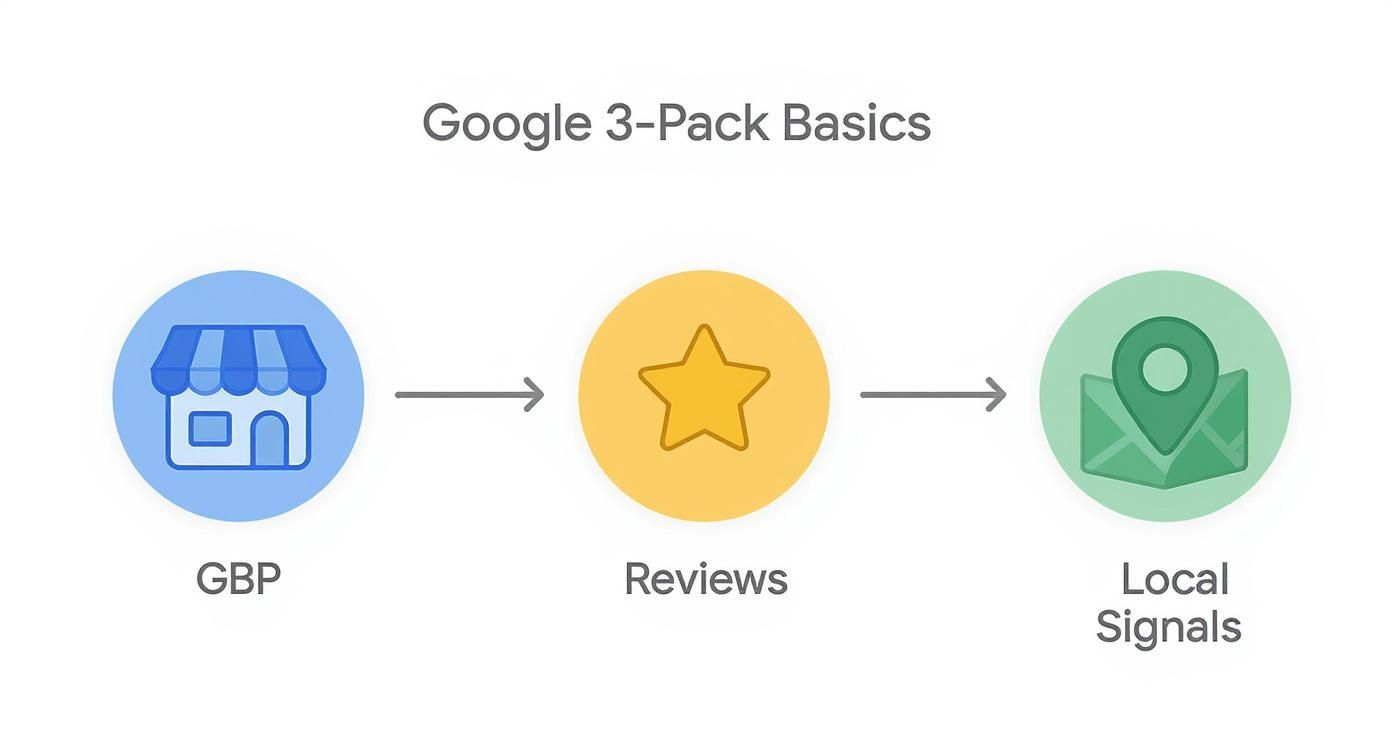
As you can see, a strong GBP, great reviews, and consistent local signals are the core of any successful 3-Pack strategy.
Nail Your Business Categories
Choosing the right categories is one of the most impactful things you can do. Your primary category tells Google exactly what you are.
Be specific. "Contractor" is too broad. "Plumbing Contractor" or "Roofing Contractor" is much better. This choice determines which searches you appear in.
Don't stop there. Google lets you add secondary categories, and you should use them. These help you appear in more specific searches. For a "Plumbing Contractor," good secondary categories would be:
- Water Heater Installation & Repair Service
- Drain Cleaning Service
- Emergency Plumber
This tells Google you can solve a wider range of customer problems, giving you more chances to be found.
Fill Out Every Single Field
An incomplete profile looks lazy to customers and Google's algorithm. Go into your GBP dashboard and fill out everything.
🔑 Key Takeaway: Your Google Business Profile is a direct conversation with Google. The more details you provide, the more confident it is in showing your business to customers.
You absolutely need to add:
- A solid business description: Include keywords about your services and service areas.
- Accurate hours: Always update your hours for holidays. An incorrect listing can lose a customer.
- Service areas: List the specific neighborhoods, towns, and zip codes you cover.
- A detailed services list: List every service you offer. Add short, keyword-friendly descriptions for each.
- Attributes: Check off everything that applies, like "Woman-owned," "Offers online estimates," or "Wheelchair accessible."
The more complete your profile is, the better Google understands your business. For a deep dive, check out this guide on optimizing your Google Business Profile.
Keep It Visually Fresh with Photos and Videos
Photos are more than just decoration; they are a ranking signal. Profiles with more high-quality, recent photos often outrank their competition.
Here’s a simple content plan:
- Team Photos: Show the real people behind your business to build trust.
- Your Work: Before-and-after shots are great for service businesses.
- Your Location: Take pictures of your storefront, office, or branded service vans.
- Happy Customers: With permission, photos of customer interactions are very powerful.
You're proving you're a real, active business. Visuals do this faster than words.
Use the Features Google Gives You
Google likes when you use its tools. Actively using features like Google Posts and the Q&A section is a strong signal that you're engaged.
- Google Posts are like free mini-ads on your profile. Create a new post weekly to highlight an offer, share a tip, or feature a service. It keeps your profile fresh.
- The Q&A section is an underrated tool. Customers can ask questions here, and you should be the first to answer. Even better, add your own common questions and answer them yourself. This lets you control the narrative.
Industry studies suggest that up to 32% of local ranking success comes from your GBP. This makes it more influential than your website or reviews. For more advanced strategies, look at our guide on how to rank higher on Google Maps.
Craft a Review Strategy That Google (and Customers) Will Love
Reviews are the lifeblood of your local SEO. They provide social proof to both Google and customers that your business is legitimate. A steady stream of positive reviews is like fuel for your 3-Pack ranking.
A strong review profile is a direct signal of prominence, one of Google's core ranking pillars. Consistently getting fresh, positive feedback tells the algorithm you’re actively making customers happy.
Make It Simple for People to Leave a Review
The main reason you don't have more reviews is that you're making it too hard. Happy customers are usually willing to share their experience, but you need to remove any friction.
Here's how to make it easy:
- Create Your Direct Review Link: In your GBP dashboard, get your unique review link. This link takes people directly to the review pop-up.
- Time Your Ask Perfectly: Ask right after a successful service or happy purchase when the positive feeling is fresh.
- Keep Your Follow-up Casual: A simple text or email works best. Something like, "Hey, would you mind sharing your experience on Google? It would mean a lot to us!" is all it takes.
Just remember, Google's guidelines prohibit offering incentives for reviews. Keep the ask natural and optional.
You Need to Respond to Every Single Review
If you want to rank in the Google 3-Pack, responding to reviews is essential. It shows you're engaged and that you care. Yes, this means responding to all of them—good and bad.
🔑 Key Takeaway: Responding to reviews shows potential customers that you listen. It builds public trust faster than almost any other action on your profile.
For a great review, a quick "Thanks, [Customer Name]! We're glad you had a great experience" is perfect.
For a negative review, a polite and professional reply can defuse the situation. It shows others you take feedback seriously. Acknowledge their concern and offer to resolve it offline.
The Pro Move: Getting Keywords into Your Reviews
This is a more advanced tactic. When a customer naturally uses your service keywords or mentions your location in their review, it's a direct signal to Google. A review like, "They were the best emergency plumber in downtown Denver" is SEO gold.
You can't tell people what to write. But you can gently guide them.
For example, in your follow-up email, you could ask, "We'd love to hear what you thought about your recent water heater installation." This subtly puts the keyword in their mind.
People Also Ask: Common Questions About Google Reviews
What's a good number of Google reviews to have?
Focus on a steady, consistent flow of new reviews, not a magic number. Having more recent reviews than your top competitor is often more impactful than a higher total number from years ago.
Do reviews actually help you rank higher on Google?
Yes, 100%. Reviews are a confirmed ranking factor for local search. They directly impact your prominence and relevance, which are key signals for the 3-Pack.
How can I get my first 5-star review?
Start with an amazing customer experience. Then, personally reach out to a recent happy customer. Tell them you appreciated their business and ask them to share their thoughts using your direct review link.
Connect Your Website to Local Search Signals
If your Google Business Profile is the star, your website is the supporting actor. Your site needs to send clear, consistent signals that back up everything on your GBP.
When Google sees that your GBP ("I'm a plumber in Austin") perfectly matches the evidence on your website, its confidence in your business grows. That trust is needed to get into the 3-Pack.
Get Your NAP Consistency Dialed In
The foundation of on-page local SEO is your NAP: Name, Address, and Phone number. This info must be identical everywhere.
Small differences matter. "St." on your website versus "Street" on your GBP can look like two different businesses to Google's algorithm.
- Comb through your site: Check the footer, contact page, and anywhere your address appears.
- Match it to your GBP: Make sure your website and GBP are a perfect mirror image.
- Wrap it in Schema: This code helps search engines understand your NAP information, removing any guesswork.
Nailing this consistency is a powerful trust signal.
Create Hyper-Local Content
To prove you’re a local authority, you need to create content that is genuinely local. This goes beyond just adding your city's name to your homepage.
This is where you have an advantage over national chains. You know the area best.
🔑 Key Takeaway: Creating content specific to your service area builds trust with local customers by showing you understand their unique needs.
Here are a few ideas:
- Neighborhood-Specific Service Pages: If you're a roofer in Dallas, create pages like "Storm Damage Repair in Plano" or "New Roof Installation in Frisco."
- Blog Posts About Local Happenings: Write about sponsoring a local team or participating in a community event. It shows you're invested in the community.
- Case Studies of Local Jobs: Showcase a project you completed for a local business or in a recognizable neighborhood.
This type of content shows you belong and can't be faked by big competitors.
Build Dedicated Location Pages
If you have more than one physical location, this is critical. You must have a unique page on your website for each one. Do not just copy and paste content and change the address.
Each location page needs to be a unique resource.
- Unique NAP and a Map: Each page must have the specific Name, Address, and Phone number for that location, plus an embedded Google Map.
- Localized Flavor: Add photos of the storefront and the local team. Mention nearby landmarks.
- Location-Specific Reviews: Include testimonials from customers of that specific location.
Doing this helps you rank in the Google 3-Pack for searches relevant to each of your locations. Also, make sure these pages are fast and mobile-friendly.
Boost Your Prominence with Citations and Local Links
Google's local algorithm cares about prominence, which is just a way of asking, "How well-known is this business locally?" To learn how to rank in the Google 3-Pack, building this local authority is essential.
It’s about creating a web of trust signals online that all point back to your business. The two best tools for this are citations and local links.
What Are Citations and Why Do They Matter?
A citation is any online mention of your business's Name, Address, and Phone number (NAP). Think of them as digital breadcrumbs across the internet that lead back to you. They appear on local business directories, industry sites, and social media.
When these citations are consistent, Google becomes more confident that your business details are correct. A small difference, like "St." versus "Street," can create confusion.
In Short: Citations are the foundation of your online reputation. Getting them right builds the trust Google needs to feature you in local search.
Your goal is a clean, consistent NAP footprint across all relevant platforms.
Building a Strong Citation Profile
First, be where your customers are already looking. Start with the big directories.
- Top-Tier Directories: Get a solid listing on Yelp, Bing Places, Apple Maps, and the Better Business Bureau.
- Industry-Specific Sites: If you're a contractor, be on Houzz or Angi. A lawyer? Get on Avvo.
- Local Directories: Don't forget your local Chamber of Commerce or city business association websites.
Next, search for your business to find and fix any old or incorrect listings. Inconsistent NAP can quietly hurt your rankings.
Transitioning from Citations to Powerful Local Links
While citations establish your NAP consistency, local links build true authority. A local link is a hyperlink from another local website to yours. These are more powerful than citations because they act as a direct vote of confidence.
If a local news blog links to your website in an article about the best plumbers in town, that's a huge signal to Google that you're a trusted local business.
How to Earn Local Links That Actually Move the Needle
Earning good local links is about building real relationships in your community.
Here are a few strategies that work:
- Sponsor a Local Event: Get involved with a local charity run, sports team, or festival. Organizers often have a sponsors page with links to supporters.
- Partner with Nearby Businesses: Team up with a non-competing business that serves similar customers. A wedding planner could get a link from a local florist's blog.
- Create Hyper-Local Content: Write a blog post that's useful for locals, like "A Homeowner's Guide to Preparing for [Your City's] Storm Season."
- Join Local Business Groups: Participate in your local Chamber of Commerce. These groups usually have member directories with links to your website.
Here's a quick look at where to focus your efforts.
Top Citation and Local Link Opportunities
| Opportunity Type | Examples | Impact Level |
|---|---|---|
| Foundational Citations | Yelp, Bing Places, Apple Maps, BBB | High |
| Industry-Specific Sites | Angi, Houzz (Contractors), Avvo (Lawyers) | High |
| Local Directories | Chamber of Commerce, City Business Associations | High |
| Local Sponsorships | Charity Events, School Teams, Community Festivals | Medium-High |
| Business Partnerships | Collaborations with non-competing local businesses | Medium |
| Hyper-Local Content | City-specific guides, event roundups | Medium |
The Local 3-Pack gets an estimated 40% to 50% of all clicks for local searches. A spot there drives leads and cements your brand's legitimacy.
If this feels overwhelming, professional local SEO services for small business can provide an expert-led path to building the prominence you need.
Got Questions About the Google 3-Pack? We've Got Answers
We’ve covered a lot about how to get your business into the top three local spots. Let's answer some of the most common questions about how to rank in the Google 3-Pack.
How long does it take to get in the Google 3-Pack?
The honest answer is, "it depends." There's no fixed timeline. For a new business in a competitive market like Chicago, it could take six months to a year of consistent work.
But in a less competitive niche or a smaller town, you could see results in as little as 60 to 90 days if you fully optimize your Google Business Profile, get reviews, and build citations from day one.
🔑 Key Takeaway: The secret isn't speed, it's momentum. Consistent, focused effort will always win over random bursts of activity.
Do I Need a Physical Storefront to Rank?
No, not at all. Google has a solution for businesses that go to their customers, called Service Area Businesses (SABs). This is perfect for electricians, mobile detailers, or landscapers.
When setting up your Google Business Profile, you'll select "service business." Instead of a map pin at your address, you'll define your service area by listing the zip codes, cities, or neighborhoods you cover.
If I Can Only Focus on One Thing, What Should It Be?
Hands down, your Google Business Profile (GBP). It's the biggest factor for local rankings.
But just having one isn't enough. The most important parts of your GBP are:
- Your primary category: This must be accurate. It tells Google exactly what you do.
- Profile completeness: Fill out every single field. A 100% complete profile signals trustworthiness.
- Constant activity: Regularly upload new photos, publish Google Posts, and answer questions to show you're an active, engaged business.
How Can I Possibly Beat a Competitor with Hundreds of Reviews?
Seeing a competitor with 500 reviews can feel daunting, but you can compete. The game isn't just about the total number; it's also about recency and quality.
A steady stream of new 4 and 5-star reviews every week often sends a stronger signal to Google than a large number of old reviews. Your goal is to build a system for consistently getting new feedback.
Also, respond to every single review. This engagement shows Google and future customers that you care, which can give you a huge edge.
Help! My Business Just Vanished from the 3-Pack!
Dropping out of the 3-Pack is frustrating, but don't panic. It's usually fixable. Local search results change based on search location, algorithm updates, and what your competitors are doing.
If you see a sudden drop, use this checklist:
- Audit your GBP: Log in and check for problems. Has any information changed? Is your profile suspended?
- Spy on your competition: Did a competitor get a lot of new reviews or build new directory listings?
- Check your NAP: Have you moved or changed your phone number? Any inconsistencies in your Name, Address, and Phone number (NAP) can hurt your rankings.
- See what Google's been up to: Check if a major algorithm update has rolled out.
Start by checking your own assets for errors. Often, a simple fix is all it takes to get back in the game.
At Clicks Geek, we turn local search complexity into measurable growth for your business. If you're ready to stop guessing and start dominating the Google 3-Pack, explore our proven digital marketing solutions at https://clicksgeek.com.