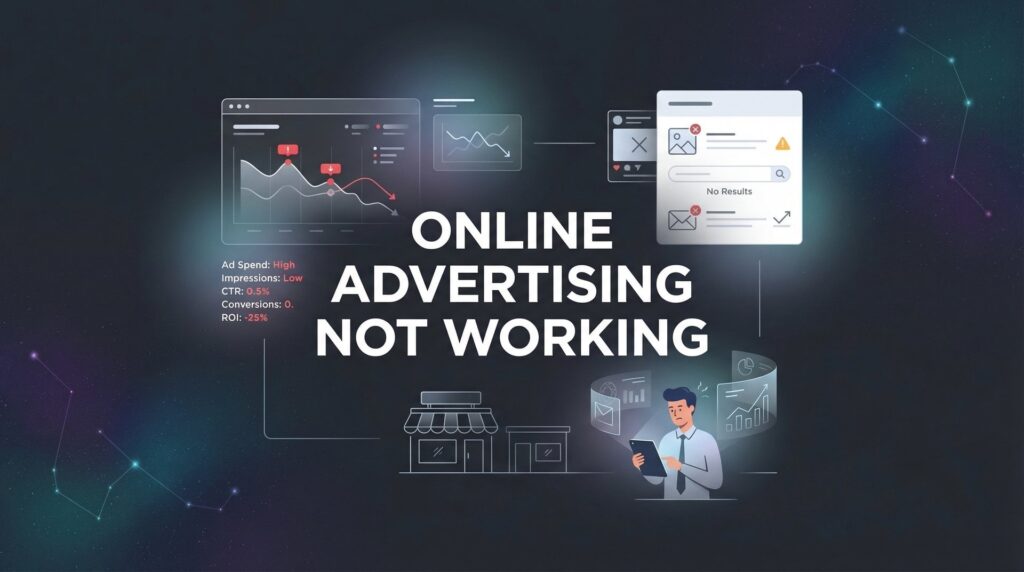
You’re spending money on online ads, but the phone isn’t ringing. Your dashboard shows clicks, maybe even impressions, but where are the actual customers? If your online advertising isn’t working, you’re not alone—and more importantly, you’re not stuck.
The problem usually isn’t that digital advertising doesn’t work. It’s that something specific in your setup is broken. Maybe you’re targeting the wrong people, or your landing page is sending visitors running. Maybe you’re measuring the wrong things entirely.
This guide cuts through the frustration and identifies the seven most common reasons local business owners watch their ad budgets disappear without results. Each section includes a diagnostic checklist and actionable fixes you can implement immediately.
Let’s stop the bleeding and turn your ad spend into actual revenue.
1. Targeting Too Broadly
The Challenge It Solves
Think of broad targeting like buying a billboard on a highway that goes everywhere. Sure, thousands of people see it, but how many of them actually need your service right now? When your ads reach everyone, they connect with no one.
You’re paying for clicks from people three states away who can’t use your service. You’re reaching demographics that would never buy from you. Your budget evaporates on traffic that was never going to convert, and you’re left wondering why online advertising doesn’t work.
The Strategy Explained
Effective targeting means showing your ads only to people who could realistically become customers. This isn’t about reaching more people. It’s about reaching the right people at the right time with the right message.
For local businesses, this starts with geographic boundaries. If you serve a 20-mile radius, why are you paying for clicks from people 50 miles away? Then layer in demographics: age ranges, household income levels, and life stages that match your ideal customer profile. Understanding online advertising for local businesses means mastering these geographic and demographic controls.
But here’s where it gets interesting. Intent-based targeting separates tire-kickers from serious buyers. Someone searching “emergency plumber near me” has completely different intent than someone browsing “how to fix a leaky faucet.” One is ready to hire. The other is researching DIY solutions.
Implementation Steps
1. Define your actual service area with specific zip codes or radius settings, then add location exclusions for areas you don’t serve to prevent wasted spend.
2. Analyze your best existing customers to identify common demographic patterns, then build targeting parameters around those characteristics rather than guessing.
3. Separate campaigns by search intent, creating dedicated ad groups for high-intent keywords like “near me” and “emergency” versus informational searches.
4. Use audience exclusions to prevent your ads from showing to people who already converted or clicked without converting multiple times.
Pro Tips
Start narrow and expand gradually based on actual conversion data. Most businesses make the mistake of starting broad and trying to narrow down. It’s easier to identify what works and scale it than to fix a scattered mess. Also, review your search term reports weekly during the first month. You’ll discover exactly who’s clicking your ads and can refine targeting based on real behavior, not assumptions.
2. Poor Landing Page Experience
The Challenge It Solves
You’re paying good money to get someone to click your ad. They arrive on your website, look around for three seconds, and leave. Your ad promised a solution to their specific problem, but your homepage talks about your company history and shows a generic stock photo.
The disconnect between what your ad promises and what your landing page delivers kills conversions faster than anything else. Every second of confusion is another potential customer hitting the back button.
The Strategy Explained
A proper landing page is a dedicated page built specifically for the people clicking your ad. It matches the ad’s message, addresses the specific problem they’re trying to solve, and makes taking action ridiculously easy.
This isn’t your homepage. Your homepage serves multiple audiences and purposes. A landing page has one job: convert this specific visitor into a lead or customer. Everything else is stripped away.
The page should load fast, work flawlessly on mobile devices, and guide visitors toward one clear action. No navigation menu to distract them. No links to your blog. Just the information they need to make a decision and a simple way to take the next step.
Implementation Steps
1. Create a dedicated landing page for each major ad campaign, ensuring the headline directly echoes the promise made in your ad copy.
2. Remove your main navigation menu and limit exit points, keeping visitors focused on the conversion goal rather than exploring your entire site.
3. Place your phone number prominently at the top of the page with click-to-call functionality for mobile users, making it effortless to contact you immediately.
4. Test your page on multiple mobile devices to verify forms work properly, buttons are easy to tap, and text is readable without zooming.
5. Add trust signals like customer reviews, industry certifications, and years in business near your call-to-action to address last-minute hesitation.
Pro Tips
Your landing page should answer three questions within five seconds: Where am I? What can I get here? What do I do next? If a visitor has to think about any of these, you’re losing conversions. Also, industry experience shows that dedicated landing pages consistently outperform sending traffic to homepages. The focused message and reduced distractions make a measurable difference in conversion rates. If your ads aren’t converting to sales, your landing page is often the first place to investigate.
3. Measuring Wrong Metrics
The Challenge It Solves
Your ad platform dashboard looks great. Thousands of impressions. Hundreds of clicks. A respectable click-through rate. But your bank account tells a different story. You’re celebrating vanity metrics while your actual business goals remain unmet.
Impressions don’t pay your rent. Clicks don’t cover payroll. If you’re not tracking what actually matters—phone calls, form submissions, appointments booked, revenue generated—you’re flying blind with an expensive plane.
The Strategy Explained
Real measurement tracks the complete journey from ad click to paying customer. This means setting up conversion tracking that captures every meaningful action: phone calls from your ads, form submissions, chat conversations, and ultimately, which leads turned into revenue.
Many local businesses stop at clicks because that’s what the dashboard shows by default. But someone clicking your ad costs you money. What you need to know is whether that click turned into a conversation, and whether that conversation turned into a customer. Learning how to fix your marketing conversion tracking is essential for understanding what’s actually working.
This requires connecting your ad platforms to call tracking systems and CRM tools. It means assigning values to different conversion actions based on their likelihood to generate revenue.
Implementation Steps
1. Implement call tracking with unique phone numbers for each ad campaign so you can attribute phone calls to specific ads and keywords.
2. Set up conversion tracking for all form submissions, ensuring your ad platform receives confirmation when someone completes a contact form.
3. Calculate your actual cost per lead by dividing total ad spend by the number of qualified leads generated, not just clicks received.
4. Track leads through to closed sales for at least 90 days to understand which campaigns generate customers versus which just generate tire-kickers.
5. Create a simple spreadsheet connecting ad source to customer revenue, giving you a clear picture of return on ad spend.
Pro Tips
Start tracking conversions before you increase your budget. Many businesses scale spending based on click volume, then discover their cost per actual customer is unsustainable. Know your numbers first. Also, don’t obsess over cost per click. A $20 click that generates a $2,000 customer is infinitely better than a $2 click that generates nothing.
4. Generic Ad Copy
The Challenge It Solves
Your ad says “Quality Service Since 2010” or “Experienced Professionals.” So does every competitor’s ad. When your messaging could apply to anyone in your industry, it connects with no one. Potential customers scroll past because nothing makes them stop and think “This is exactly what I need.”
Generic copy fails because it doesn’t address the specific problem your prospect is experiencing right now. It talks about you instead of speaking to them. It uses industry jargon instead of the language your customers actually use.
The Strategy Explained
Effective ad copy speaks directly to a specific pain point your ideal customer is experiencing. It uses their language, acknowledges their frustration, and promises a clear outcome they care about.
Instead of “Professional HVAC Services,” try “AC Died in This Heat? Same-Day Repair in Scottsdale.” Instead of “Experienced Personal Injury Attorneys,” try “Rear-Ended and Insurance Won’t Pay? We Handle Everything.”
The difference is specificity. The second version tells someone exactly who this ad is for and what problem it solves. It uses conversational language that matches how people actually describe their situation. This is a core principle of performance marketing—messaging that drives measurable action rather than vague brand awareness.
Implementation Steps
1. Interview recent customers to learn the exact words they use to describe their problem before finding you, then incorporate that language directly into your ad copy.
2. Lead with the problem or outcome in your headline rather than your company name or generic service description.
3. Include specific details that demonstrate understanding: timeframes, locations, situations, or pain points that make someone think “They get it.”
4. Test different angles by creating multiple ad variations addressing different aspects of the same problem, letting data reveal which resonates strongest.
Pro Tips
Read your ad copy out loud. If it sounds like something a robot would say, rewrite it. The best ad copy sounds like a helpful friend recommending a solution. Also, steal from your best customer reviews. The language people use to describe why they hired you is often perfect ad copy because it reflects how other potential customers think about their problems.
5. Insufficient Time and Budget
The Challenge It Solves
You launched a campaign last week with a $10 daily budget spread across five different services. After three days with no results, you paused everything and declared online advertising doesn’t work. Sound familiar?
Digital advertising platforms need data to optimize. Spreading a small budget too thin across too many campaigns prevents any single campaign from gathering enough information to improve. Pulling the plug too early means you abandon campaigns right before they would have started working.
The Strategy Explained
Successful campaigns require sufficient budget to generate meaningful data and enough time for platform algorithms to learn what works. This doesn’t mean throwing unlimited money at the problem. It means being strategic about where you focus your resources.
For most local businesses, this means starting with one or two core services rather than trying to advertise everything at once. It means committing to at least 30 days of consistent spending before making major changes. It means setting a daily budget that allows for at least 10-20 clicks per day so the platform has data to work with. If you’re experiencing low ROI from digital advertising, insufficient budget allocation is often a contributing factor.
Think of it like planting a garden. You can’t plant seeds on Monday and expect tomatoes by Wednesday. Campaigns need time to germinate, and they need consistent watering.
Implementation Steps
1. Identify your highest-margin service or most frequently requested offering, then allocate 80% of your initial budget to that single focus.
2. Calculate a daily budget that generates at least 10-15 clicks per day by dividing your total monthly budget by 30 and adjusting based on average cost per click.
3. Commit to running campaigns unchanged for the first 14 days to allow the learning phase to complete before making optimization decisions.
4. Track weekly performance trends rather than daily fluctuations, recognizing that some days will always perform better than others.
Pro Tips
Platform algorithms typically require time and conversion data to optimize effectively. Making constant changes resets the learning process and prevents campaigns from gaining traction. Set it up correctly, let it run, and resist the urge to tinker daily. Also, if your budget is truly limited, focus on high-intent keywords only. Someone searching “buy now” terms is worth more than someone browsing general information, so concentrate your spending where intent is clearest. Our guide on paid search advertising for beginners covers budget allocation strategies in detail.
6. Weak or Missing Offer
The Challenge It Solves
Your ad says “Call Today” or “Contact Us for More Information.” Okay, but why should someone do that right now instead of checking three more competitors first? Without a compelling reason to take action immediately, prospects bookmark your site and disappear forever.
A generic “contact us” call-to-action creates no urgency and provides no incentive. It asks people to reach out without giving them a reason why doing so benefits them. In a competitive market, that’s not enough.
The Strategy Explained
A strong offer gives prospects a specific, valuable reason to contact you now rather than later. This doesn’t necessarily mean discounting your services. It means lowering the barrier to that first conversation and providing clear value for taking action.
For service businesses, this might be a free assessment, diagnostic, consultation, or estimate. For e-commerce, it might be free shipping, a limited-time discount, or a bonus item. The key is that the offer must be specific, valuable, and time-sensitive.
“Free furnace safety inspection” is stronger than “call us.” “Free case evaluation—no obligation” is stronger than “contact our attorneys.” “Get your custom quote in 24 hours” is stronger than “request information.”
Implementation Steps
1. Create a low-risk first step that provides immediate value to prospects, making it easy to say yes before committing to a purchase.
2. Add specific timeframes to create urgency: “Schedule your free consultation this week” rather than vague “contact us anytime” language.
3. Emphasize what prospects get, not what you want them to do—frame the action around their benefit rather than your need for leads.
4. Test different offer types to discover what motivates your specific audience: some respond to free assessments, others to limited-time pricing, others to educational resources.
Pro Tips
Your offer should match your prospect’s stage in the buying journey. Someone searching “emergency plumber” doesn’t need a free estimate—they need someone there now. Someone researching “kitchen remodeling ideas” isn’t ready for a quote but might download a planning guide. Match the offer to the intent. Also, make sure you can actually deliver on your offer quickly. Promising a 24-hour response and taking three days destroys trust faster than having no offer at all.
7. No Follow-Up System
The Challenge It Solves
Your ads are working. Leads are coming in. But then what happens? Form submissions sit in your inbox for hours. Phone calls go to voicemail and don’t get returned until the next day. People who didn’t convert on the first visit never hear from you again.
You’re spending money to generate leads, then losing them through slow response times and lack of follow-up. It’s like filling a bucket with a hole in the bottom—no matter how much you pour in, you’re not getting anywhere.
The Strategy Explained
A proper follow-up system captures leads immediately and nurtures them through multiple touchpoints. This starts with speed: industry experience suggests that faster response times correlate with higher conversion rates. The business that responds first often wins, even if they’re not the cheapest.
But follow-up extends beyond that first response. Most people don’t buy on first contact. They need time to think, compare options, or wait for budget approval. Without a system to stay in front of these prospects, they forget about you and choose whoever they happen to see next. If you’re not getting enough qualified leads, a broken follow-up system might be letting good prospects slip away.
This means implementing email sequences, remarketing campaigns, and structured follow-up processes that keep you top-of-mind without being pushy.
Implementation Steps
1. Set up instant lead notifications that alert you immediately when someone submits a form or calls, enabling response within minutes rather than hours.
2. Create an email sequence for leads who aren’t ready to buy immediately, providing helpful information over 7-14 days to stay present without being aggressive.
3. Implement remarketing campaigns that show ads to people who visited your landing page but didn’t convert, reminding them of your offer as they browse other sites.
4. Establish a clear follow-up schedule for leads: contact within 5 minutes, follow up again at 24 hours, check in again at one week if no response.
5. Track which leads came from which campaigns in your CRM so follow-up can reference the specific service or problem they were researching.
Pro Tips
The fortune is in the follow-up, but most businesses give up after one attempt. Many sales require 5-8 touchpoints before someone converts. Create a system that persists without being annoying. Also, personalize your follow-up based on what someone was looking at. If they clicked an ad for emergency service, your follow-up should acknowledge urgency. If they downloaded a planning guide, your follow-up should offer next steps in the planning process.
Putting It All Together
When your online advertising isn’t working, the answer isn’t to throw more money at it or abandon digital marketing entirely. The fix lies in diagnosing which of these seven issues is sabotaging your results.
Start with your landing pages and conversion tracking. These two elements alone account for most failed campaigns. If people are clicking your ads but not converting, your landing page experience is likely the culprit. If you can’t tell whether ads are generating actual customers, your tracking setup is the problem.
Then work backward through targeting, messaging, and follow-up systems. Are you reaching the right people? Is your message compelling enough to stand out? Are you capturing and nurturing the leads you generate? Our comprehensive online marketing guide walks through each of these elements in detail.
Most businesses don’t have all seven issues. They have two or three specific problems that, once fixed, transform their results. The key is identifying which problems are costing you the most money and fixing those first.
Give each fix at least two weeks to show results. Digital advertising isn’t instant, but it also shouldn’t take months to see improvement. If you’ve addressed these issues and still aren’t seeing qualified leads and actual customers, something deeper is wrong with your strategy.
Tired of spending money on marketing that doesn’t produce real revenue? We build lead systems that turn traffic into qualified leads and measurable sales growth. If you want to see what this would look like for your business, we’ll walk you through how it works and break down what’s realistic in your market.
Want More Leads for Your Business?
Most agencies chase clicks, impressions, and “traffic.” Clicks Geek builds lead systems. We uncover where prospects are dropping off, where your budget is being wasted, and which channels will actually produce ROI for your business, then we build and manage the strategy for you.